


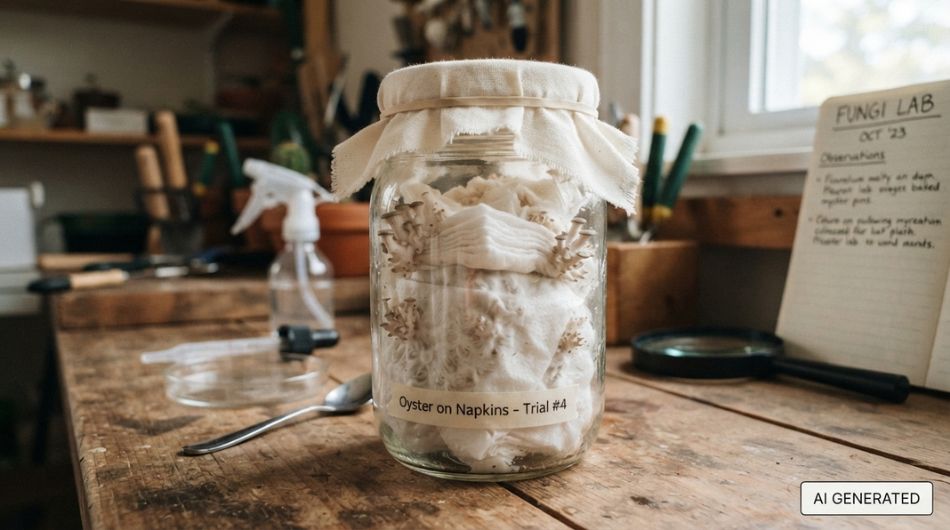
Home mushroom cultivation is undergoing a phase of profound transformation, driven by a growing curiosity towards sustainable, economical, and scientifically accessible methods. Among the most surprising and debated practices emerges an experiment as simple as it is revolutionary: using common paper napkins as a growth substrate for mycelium. This is not just a simple hobbyist trick, but a true experimental protocol rooted in the biology of saprophytic fungi, organisms capable of degrading cellulose and lignin to feed themselves.
This article explores in depth the best-known variants of this technique, the scientific foundations that make it possible, the implications for gut health related to the consumption of cultivated mushrooms, and finally, the specific variant with fresh button mushrooms, offering a comprehensive guide for enthusiasts, growers, and researchers. The goal is to transform an apparently banal gesture into a window onto the world of applied mycology, with a rigorous yet accessible approach, capable of capturing the attention of anyone who wants to understand how a waste material can become the engine of conscious food production.
In this article...
1. The science behind paper napkins: cellulose and mycelium
Understanding why a paper napkin can support fungal growth requires a brief journey into the biochemistry of cellulosic materials and the nutritional strategies of saprophytic fungi. Paper, in all its forms, is composed predominantly of cellulose fibers, a linear polymer of glucose that constitutes the main structural component of plant cell walls. Fungi of the genus Pleurotus, commonly known as oyster mushrooms, possess an extraordinarily efficient enzymatic repertoire that includes cellulases and hemicellulases, enzymes capable of cleaving the glycosidic bonds of cellulose and making the simple sugars necessary for mycelial growth available. This degradative capacity is the biological foundation that makes cultivation on paper theoretically possible, a substrate that, although lacking the complex nutrients of straw or sawdust, still offers an accessible source of carbon upon colonization.
Scientific literature confirms that oyster mushrooms are among the most aggressive colonizers of lignocellulosic materials and that paper, particularly that which is chemically untreated, represents a usable substrate. A study published in the World Journal of Microbiology and Biotechnology demonstrated that Pleurotus ostreatus achieves a biological efficiency of 112.4% on paper, a value comparable to that obtained on cardboard (117.5%) and superior to many traditional substrates. Biological efficiency, measured as the ratio between the fresh weight of the mushrooms and the dry weight of the substrate, indicates that paper is not at all an inert support, but a true nutrient that the mycelium is able to convert into fungal biomass with surprising yields. The North American Mycological Association explicitly includes toilet paper rolls and newspaper among the suitable substrates for Pleurotus, confirming that the practicality of these materials does not compromise the vitality of the fungus.
However, it is crucial to distinguish between paper and paper. White, unscented paper napkins, free of color prints or chemical treatments, represent the optimal choice because they minimize the risk of inhibitory substances for the mycelium. Recycled paper may contain inks and additives that, although harmless to humans, can slow down fungal colonization. Chlorine-unbleached toilet paper, cited in several popular protocols, is often indicated as preferable for the same reason. The simplicity of the material, paradoxically, is what makes it fascinating from an experimental point of view: an inexpensive substrate, available everywhere and devoid of intrinsic nutritional value for humans, becomes the theater of a complex enzymatic interaction that transforms a waste product into a food resource.
The role of moisture and sterilization
For the mycelium to effectively colonize a paper napkin, the material must be saturated with water but not excessively wet, as water stagnation favors the proliferation of competing bacteria and molds. Sterilization of the substrate is a non-negotiable step in any serious scientific protocol. The most accessible method consists of immersing the napkins in boiling water for a few minutes, then letting them cool and draining them thoroughly before inoculation. This heat treatment drastically reduces the competitive microbial load, creating a window of opportunity for the mycelium that is introduced subsequently. Alternatively, for those with kitchen equipment, pressure cooker sterilization represents the gold standard, although for paper napkins simple boiling is often sufficient given their thin structure and rapid heat penetration.
2. The best-known variants: from the roll to the napkin
The paper cultivation technique is not a monolith, but a set of protocols that differ in starting material, fungal species, and level of environmental control. The best-known and most documented variant is the one that uses toilet paper rolls, popularized by kits like the "TeePee Kit" by Field & Forest, which includes filtered bags, oyster mushroom spawn, and detailed instructions. In this configuration, the roll is saturated with boiling water, stripped of its cardboard core, inserted into a cultivation bag, and inoculated in the center with grain mycelium. The bag is then closed and placed in a dark environment at room temperature for three weeks, during which the mycelium progressively colonizes the paper. This variant is particularly suitable for beginners because the roll acts as a self-supporting structure and the amount of material is easily manageable.
A second variant, less structured but equally effective, employs single paper napkins or rolled-up paper towel sheets inserted into glass containers or bags. The fundamental difference compared to rolls is the greater exposed surface area and the consequent rapidity of colonization, which can reduce waiting times. However, moisture management becomes more critical, as thin layers tend to dry out faster. More experienced growers recommend keeping the napkins in an environment with high relative humidity, using a closed container or a tray with water at the bottom to create a saturated micro-atmosphere.
There is also a "mixed" variant that combines paper and other cellulosic materials, such as coffee grounds or shredded cardboard, to increase the nutritional density of the substrate. Although paper alone is sufficient to complete the fruiting cycle, the addition of lignin-rich materials can improve the yield and robustness of the mycelium. Scientific literature on the use of alternative substrates for Pleurotus highlights that mixtures of paper and other organic waste can modulate biological efficiency, although specific data on napkins are limited to grower accounts and popular protocols rather than controlled studies.
The shiitake mushroom variant: limits and potential
It is important to clarify that cultivation on paper is an almost exclusive prerogative of oyster mushrooms and a few other fast-growing species with a marked cellulose-degrading capacity. The shiitake (Lentinula edodes), despite being one of the most studied and appreciated mushrooms, prefers more complex woody substrates, such as hardwood sawdust enriched with wheat bran, and requires much longer incubation times (8-12 weeks). To claim that shiitake can be grown on paper napkins with the same ease as oyster mushrooms would be scientifically inaccurate. However, some experimenters have attempted to adapt the technique using paper enriched with organic supplements, obtaining erratic results generally inferior to those achievable with traditional substrates. The reason lies in the biology of the shiitake, which is a primary degrader of hardwood and requires a complex enzymatic succession to access nutrients. For those wishing to try growing shiitake at home, sawdust block kits represent the most reliable route, such as those available on the specialized market.
3. The fresh button mushroom variant: step-by-step procedure
The variant that employs fresh button mushrooms (Agaricus bisporus) as a source of mycelium represents the most ambitious and fascinating evolution of the paper napkin experiment. Unlike oyster mushrooms, which can be inoculated with grain spawn or fungal tissue, the button mushroom is a secondary fungus, whose life cycle generally requires a composted substrate and a "casing" phase (covering with a layer of peat and limestone) to induce fruiting. Attempting to grow button mushrooms on paper means pushing beyond the boundaries of established protocols, exploring the metabolic plasticity of a species traditionally associated with substrates rich in partially decomposed organic matter.
The following procedure is an experimental adaptation based on the principles of paper cultivation and the specific needs of Agaricus bisporus, and should be understood as an experiment to be conducted with a critical spirit and realistic expectations.
Materials needed: white, unscented paper napkins, a transparent glass or plastic container with a lid, fresh button mushrooms purchased at the supermarket (preferably organic and with an intact stem), distilled or boiled water, a sterilized knife, disposable gloves, 70% alcohol for disinfection.
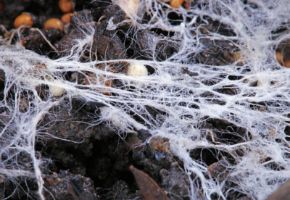
Procedure: First, sterilize the container and all tools with 70% alcohol. Cut the stem of a fresh button mushroom and take a small portion of internal tissue, avoiding the gills (which contain spores and are more exposed to contaminants). The taken tissue must be placed on a paper napkin previously sterilized by immersion in boiling water and then cooled. Close the container again and place it in a dark place at a temperature between 18 and 22°C. After 7-10 days, inspect visually: the appearance of a white, filamentous patina around the tissue indicates that the mycelium has begun to colonize the paper. At this point, it is possible to transfer portions of colonized paper to new sterilized napkins to expand the culture, a process known as "mycelium expansion". Fruiting, however, is the most uncertain step: Agaricus bisporus requires a casing layer and humidity and ventilation conditions that are difficult to replicate in a closed container. It is likely that the experiment will stop at the colonization phase, which still represents a scientifically valid result and an excellent opportunity to understand the limits and potential of the technique.
Why the button mushroom is different from oyster mushrooms
The fundamental difference lies in trophic ecology. Oyster mushrooms are extremely versatile primary degraders, capable of attacking fresh cellulosic materials with powerful enzymes and rapid colonization times. The button mushroom, on the contrary, is adapted to grow on compost in which organic matter has already been partially transformed by other microorganisms; its mycelium is slower and less aggressive towards simple substrates like paper. This distinction does not make the experiment useless, but rather redefines its objectives: not the production of an abundant harvest, but the practical understanding of the biological specificity of different fungal species.
4. Safety, contamination, and best practices
Home cultivation on paper, like any mycological practice, entails risks related to contamination by competing molds and bacteria. Green molds of the genus Trichoderma are among the most common contaminants and can quickly overwhelm the desired mycelium if sterility conditions are not respected. The first principle is manic cleanliness: washed hands, disinfected tools, a work environment free of air currents that could carry spores. The second principle is proper moisture management: a substrate that is too wet creates anaerobic conditions favorable to bacteria, while a substrate that is too dry prevents the mycelium from growing.
An often overlooked aspect concerns the quality of the water used. Tap water contains chlorine and other additives that, although in low concentrations, can inhibit fungal growth. The use of filtered, distilled, or decanted water for 24 hours is recommended to minimize the impact of chemical treatments. Furthermore, once the mycelium has colonized the paper, the container should not be opened frequently, as every opening introduces potential contaminants. Observation should be carried out through the transparent walls of the container, and any portion showing anomalous colorations (green, black, pink) must be immediately removed with sterilized tools and discarded.
5. Beyond cultivation: mushrooms and gut health
Home mushroom cultivation is not just an exercise in sustainability or a scientific hobby; it fits into a broader context of growing interest in the role of mushrooms in human health, particularly gut health. Research in recent years has shown that edible mushrooms, including Agaricus bisporus and Pleurotus ostreatus, contain polysaccharides and dietary fibers that act as prebiotics, selectively feeding the beneficial bacteria of the gut microbiota. Beta-glucans, in particular, have been identified as compounds capable of modulating the composition of the microbiota and promoting the production of short-chain fatty acids, essential metabolites for maintaining the integrity of the intestinal barrier and for regulating the immune system.
A recent study published in The Journal of Nutrition examined the effect of shiitake supplementation in a Western diet on murine models, finding a significant increase in beneficial bacteria such as Akkermansia and Lactococcus, known for their role in supporting metabolic health. Although these results are not directly transferable to paper cultivation, they reinforce the idea that the quality of the cultivated mushroom (and not just its quantity) has an impact on health. Mushrooms grown in controlled conditions, free of contaminants, and harvested at the right time, retain their nutritional and bioactive potential intact. To delve deeper into the link between mushrooms and the microbiota, you can consult the popular resources of PubMed Central and the Agricultural Research Service of the USDA.
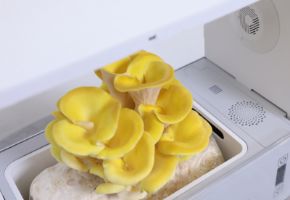
For those wishing to deepen their cultivation with professional tools, NaturNext.eu offers solutions designed to optimize every stage of the growth cycle. The NaturNext Grow Box integrates humidity sensors, full-spectrum LED lighting, a thermometer, and silent ventilation, allowing for the automatic control of environmental parameters that are crucial for the success of the cultivation. This technology represents the natural evolution of the paper napkin experiment: from the extreme simplicity of a recycled substrate to the precision of a controlled environment, the common thread remains the understanding of the mycelium's needs and the ability to meet them with the available means.
6. Frequently Asked Questions (FAQ)
Can I use any type of paper napkin?No. The napkins must be white, unscented, unprinted, and preferably unbleached with chlorine. Colored or scented napkins may contain chemicals that inhibit mycelial growth. |
How long does it take to see the first results?With oyster mushrooms, visible colonization of the napkin generally takes 7-14 days, while fruiting can begin 2-4 weeks after complete colonization. With button mushrooms, the times are longer and fruiting on paper is unlikely without an enriched substrate. |
Why isn't my mycelium growing?The most common causes are: substrate too wet (water stagnation), temperature too low or too high, bacterial contamination, or non-viable mycelium. Check that the napkins are moist but not dripping and that the temperature is between 20 and 24°C for thermophilic species. |
Are mushrooms grown on paper safe to eat?Yes, provided that the mycelium is identified with certainty, that there are no visible contaminations (colored molds, unpleasant odors), and that the mushrooms are cooked adequately. Untreated white paper does not release toxic substances into the mushroom. In case of doubt, it is always preferable to refrain from consumption. |
Can I reuse colonized napkins for a second crop?Napkins exhausted after fruiting can be composted, but rarely support a second significant production. It is possible to take a portion of colonized paper and transfer it to a new sterilized substrate to expand the culture before resources are depleted. |
Final considerations: from paper to the future of home mycology
The experiment of cultivation on paper napkins is not an endpoint, but a starting point. Through this journey, we have traversed the biochemistry of cellulose, the enzymatic strategies of saprophytic fungi, the practical variants of the technique, and the biological limits that distinguish oyster mushrooms from button mushrooms. What emerges clearly is that the simplicity of a recycled material does not equate to simplicity of understanding: behind a colonized napkin lies a complex network of interactions between moisture, temperature, sterility, and mycelial vitality. Those who approach this practice with curiosity and scientific rigor discover that every phase - from sterilization to inoculation, from colonization to fruiting - is an opportunity to learn to read the signals of the fungus.
The true lesson of the experiment lies in awareness. Growing mushrooms on paper means understanding that sustainability is not a label, but a daily practice made of precise choices: which paper to use, how to manage water, how to prevent contamination, when to harvest. This awareness transfers directly into the kitchen and onto the table, where a carefully cultivated mushroom retains its heritage of fibers, beta-glucans, and bioactive compounds intact, with documented benefits for the gut microbiota and overall well-being. Scientific research continues to explore these connections, and every new study reinforces the idea that mushrooms are much more than food: they are a bridge between nutrition and medicine.
For those wishing to take the leap in quality, the path is laid out. From the home experiment on paper napkins to controlled systems like the NaturNext.eu Grow Box, the principle remains the same: understand the needs of the mycelium and meet them with the right tools. Technology does not replace curiosity, but amplifies it, allowing growers, researchers, and enthusiasts to explore species, substrates, and conditions that were once the exclusive domain of professional laboratories.
The kingdom of fungi is a universe in continuous evolution, and every experiment (even the simplest, even the one that starts from a paper napkin) contributes to unveiling its secrets. Nature offers us extraordinary tools to take care of our health and our planet: it is up to us to have the curiosity to explore them and the discipline to do it in the right way.
This article was developed with the support of artificial intelligence and subsequently reviewed, corrected, and validated by the technical team of NaturNext.eu, which guarantees its reliability and compliance with official sources.
The kingdom of fungi is a universe in continuous evolution, with new scientific discoveries emerging every year about their extraordinary benefits for gut health and overall well-being. From now on, when you see a mushroom, you will no longer think only of its taste or appearance, but of all the therapeutic potential it holds in its fibers and bioactive compounds. ✉️ Stay connected - Subscribe to our newsletter to receive the latest studies on: Nature offers us extraordinary tools to take care of our health. Mushrooms, with their unique balance between nutrition and medicine, represent a fascinating frontier that we are only just beginning to explore. Keep following us to discover how these extraordinary organisms can transform your approach to well-being.Continue your journey into the world of mushrooms