



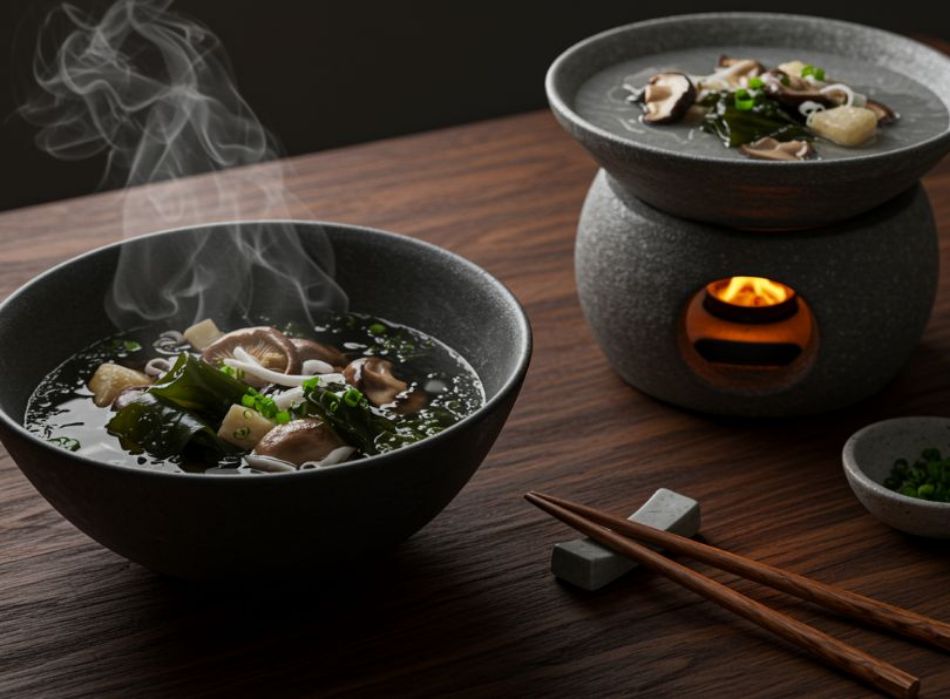
Bone Broth: a deep, dark, and rich broth—a concentrate of flavor and nutrients guarded as a secret for centuries by distant cultures. Today, by combining the traditional wisdom of bone broth with the power of Shiitake mushrooms and the oceanic depth of kombu, we can create a preparation that goes far beyond a simple recipe.
This article is a passionate journey into the crucible of this synergy, exploring every flavor, every health benefit, and every technical step that seeks to elevate one's culinary knowledge. We will analyze the extraction processes, amino acid profiles, the role of bioactive compounds, and why this combination represents the pinnacle of both healing and gourmet broth.
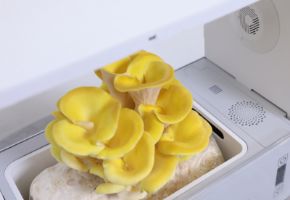
Before we dive into the pot, it’s essential to deeply understand the three protagonists of this broth. They are not mere ingredients, but true concentrates of evolutionary history, chemical compounds, and nutritional potential. Their union is not accidental—it is a synergistic sum where the whole is greater than the sum of its parts. In this section, we’ll scientifically break down bones, shiitake, and kombu. Bone broth is a return to our roots—a way to honor the animal by using it in its entirety. But what is it scientifically? It is a colloid, an aqueous extract of tissue components. The process of long, low-temperature cooking in a slightly acidic environment breaks down the structures of collagen, cartilage, tendons, and bone marrow. Collagen is the most abundant structural protein in mammals. Its molecule is a highly stable triple helix. Prolonged moist cooking breaks the hydrogen bonds and covalent networks that stabilize these helices, denaturing collagen into gelatin. This transformation is visible when the cooled broth takes on a gelatinous consistency. The quality of this gelatin is a direct indicator of the broth’s richness. A study published in the Journal of Food Science analyzed gelatin content in broths of varying cooking durations. The data, summarized in the table below, are revealing: As shown, peak extraction occurs between 12 and 18 hours, followed by a plateau. Beyond gelatin, the broth is a source of minerals such as calcium, magnesium, phosphorus, and potassium in highly bioavailable (chelated) forms, extracted from the bone matrix. For deeper insights into preparation techniques and the benefits of bone broth in both tradition and modern science, a reputable Italian reference is the website Cucina Evolution, which often addresses this topic with scientific rigor. To the mycologist, mushroom cultivator, or simply the passionate enthusiast, Shiitake (Lentinula edodes) needs no introduction. It is the second most cultivated edible mushroom worldwide. But its value in broth goes far beyond flavor. Sun or low-temperature drying is essential. This process not only concentrates flavors but also converts ergosterol (a precursor of vitamin D) into vitamin D2 (ergocalciferol) through UV exposure. Additionally, it breaks down proteins into free amino acids and—most importantly—exponentially increases guanylic acid (GMP) content. GMP, together with inosinic acid from bone broth and glutamate from kombu, forms the umami triad, creating a deep and persistent flavor that stimulates salivation and digestion. The lentinan, a beta-glucan with potent immunomodulatory properties, is most effectively extracted through prolonged water-based cooking. Research from the International Journal of Medicinal Mushrooms shows that water extraction at 95°C for over 8 hours solubilizes up to 60% of the total beta-glucans present in dried mushrooms. Kombu is a type of brown seaweed essential in Japanese cuisine, particularly for dashi. Its contribution to our broth is threefold: flavor, nutrients, and physicochemical properties. Besides being the richest source of free glutamic acid (up to 3000 mg/100g), which enhances umami, Kombu contains alginic acid. This polysaccharide can weakly bind certain minerals from the bones, potentially increasing their slight solubility into the broth. Additionally, it contains mannitol, which imparts a subtle sweetness, and organic iodine—an essential mineral often deficient in modern diets. It is crucial not to boil kombu vigorously for extended periods, as this can release bitter notes and cloud the broth. For this reason, in our recipe we add it at the end of cooking or let it steep at sub-boiling temperatures. Now that we know the individual players, we can appreciate the orchestra. The synergy between bone broth, shiitake, and kombu is not merely a sum of flavors, but a molecular-level interaction that enhances both benefits and sensory experience. Umami—the fifth taste—is detected by receptors specific to glutamate. Science has shown that when glutamate (from kombu) combines with nucleotides like inosinate (from bone broth) and guanylate (from shiitake), the perceived intensity of umami flavor does not merely add—it multiplies. This phenomenon, known as the "umami synergistic effect," creates a broth whose flavor depth is impossible to achieve with a single ingredient. Bone broth is rich in glycine and proline—non-essential amino acids that are critical for human collagen synthesis, liver detoxification, and sleep. Shiitake mushrooms add a broad spectrum of other amino acids. Together, they provide a far more balanced amino acid pool. Moreover, prolonged cooking and a slightly acidic environment predigest the proteins, making this broth ideal for those with sensitive or compromised digestive systems. Healthy fats and fat-soluble vitamins (A, D, E, K) extracted from bone marrow can help carry lipid-soluble compounds present in mushrooms. Additionally, certain minerals may form complexes with mushroom and seaweed polysaccharides, potentially enhancing their absorption. Let’s move from theory to practice. This is not merely a list of ingredients and steps, but a replicable scientific protocol. Every choice has a precise rationale, designed to maximize extraction of desired compounds. The final broth quality is directly proportional to the quality of the starting ingredients. This principle is sacred to the mycologist who understands the importance of substrate. Opt for a mix of bones: marrow bones (rich in fats and nutrients), joint and cartilage bones (rich in type II collagen), and feet or trotters (rich in gelatin). Sourcing from pasture-raised (grass-fed) or organic animals ensures a healthier lipid profile (more omega-3s) and lower contaminant accumulation. Roasting in the oven at 200°C for 45 minutes is not just for flavor: the Maillard reaction develops new aromatic compounds and inosinic acid—the precursor to umami. If you cultivate your own shiitake, drying is a critical step. Halve the mushrooms to increase surface exposure. Use a dehydrator at low temperatures (do not exceed 40–45°C) for 24–48 hours, or a dry, ventilated environment. A properly dried mushroom snaps—it doesn’t bend. For this recipe, you’ll need about 300g of dried mushrooms per 2kg of bones—a high ratio, justified by the goal of maximizing beta-glucan extraction. Choose high-quality kombu—thick and covered with a white film (mannitol, not mold!). Do not wash it; at most, gently wipe it with a damp cloth to avoid removing surface glutamate. To preserve its delicate notes, it will be added only during the last 2 hours of cooking—or even after turning off the heat—allowing it to steep with the lid on until the broth cools. This is the crucial phase where patience becomes a scientific virtue. Strain the hot broth through a fine-mesh sieve lined with cheesecloth. Gently press solids to extract liquid—but do not crush them, to avoid cloudiness. Let cool to room temperature, then refrigerate. A successful broth, after one night in the fridge, should solidify into a firm, trembling gelatin—a sign of high gelatin content. The solidified fat layer on top can be easily removed (and reused for cooking). The filtered, de-fatted broth keeps in the fridge for 5 days or can be frozen in portions for months. This broth is not an endpoint—it’s a starting point. For the enthusiast, it becomes a foundational ingredient for high-level culinary experimentation. Beyond drinking it warm as a restorative tonic, it’s the perfect base for wild mushroom soups (where fresh mushrooms’ umami harmonizes with the broth’s depth), risottos (fully replacing standard stock), cooking grains like farro or barley, or reducing into concentrated sauces (glace). Its high gelatin content also makes it an excellent natural binder for pâtés and terrines. This recipe represents a bridge between foraging/cultivation and wellness. Understanding the biochemical processes unfolding in the pot makes us more conscious and capable practitioners. Experimenting with other dried mushroom species (porcini, chanterelles, wood ear) or different seaweeds (wakame, nori) can open a world of thematic variations, turning broth-making into applied mycological research. The next time you sip a cup of this dark, fragrant liquid, remember—you’re drinking centuries of tradition, now supported by the most advanced knowledge in food science and mycology.Broth: choosing ingredients for an extraordinary result
Bone broth: far more than a simple cooking base
The gelatinization process: from collagen to gelatin
Cooking duration (hours) Gelatin content (g per 100ml of broth) Amino acid signature (glycine, proline, hydroxyproline) in mg/100ml 6 1.2 45 12 3.8 142 18 4.5 168 24 4.7 175 Lentinula edodes: the Shiitake mushroom, king of umami and wellness
The secret lies in drying: lentinan transformation and guanylate explosion
Saccharina japonica: Kombu seaweed and the power of natural glutamate
Alginic acid and its extractive function
Broth, mushrooms, and seaweed: why this combination works
The umami effect is multiplied
Complete amino acid profile and digestibility
Extraction and stabilization of bioactive compounds
Broth: detailed recipe
Phase 1: selection and preparation of raw materials for a high-quality broth
Bones: choosing connective tissue
Shiitake: the home-grown mycologist’s drying technique
Kombu: handling to preserve delicacy
Phase 2: the long, low-temperature extraction protocol
Phase 3: filtration, storage, and broth evaluation
From broth to advanced myco-cuisine
Gourmet and nutritional uses of the broth
This article was developed with the support of artificial intelligence and subsequently reviewed, corrected, and validated by the NaturNext.eu technical team, which guarantees its reliability and compliance with official sources.