




Welcome to one of the most surprising and rewarding gastronomic marriages that contemporary cuisine has to offer: the union between halloumi cheese, undisputed protagonist of Cypriot and Mediterranean tradition, and mushrooms, symbol of Italian and European woodland biodiversity. In this article, we will explore every aspect of this extraordinary duo, from the millennial history of halloumi to the most advanced cooking techniques for vegetarian BBQ, with careful attention to nutritional values, flavor pairings, and the secrets that only those who truly know both ingredients can reveal.
Whether you are professional chefs seeking inspiration for your summer menu, food bloggers passionate about scenic and healthy recipes, nutritionists looking for precise data, or simply lovers of good food who want to bring something memorable to the table: this is your definitive reference point on the world of halloumi and mushroom skewers for a vegetarian barbecue of true high class.
What is halloumi: origins, history, and cultural identity
When we talk about halloumi, we talk about much more than just a cheese. We talk about a cultural identity, a tradition rooted in centuries of Mediterranean history, a product that has conquered the world without losing its soul. Halloumi is the national cheese of Cyprus, an island at the crossroads between East and West, between the Middle East and Southern Europe, a place where civilizations have intersected, leaving indelible traces in local gastronomy. Understanding what halloumi is means immersing yourself in this extraordinary historical and cultural stratification, which today is also reflected in the growing passion of Italians for this unusual and versatile cheese.
Historical origins of halloumi
The historical origins of halloumi are wrapped in legendary charm dating back at least to the medieval period, with some scholars tracing its production even to the Byzantine era, between the 4th and 15th centuries AD. The oldest historical documents explicitly mentioning a cheese similar to Cypriot halloumi date back to the period of Venetian domination of the island (1489-1571), when the Venetians described with admiration a local cheese of extraordinary heat resistance. The word "halloumi" itself (also pronounced "haloumi" in Cypriot Greek) probably derives from the Arabic "ḥalūm" (حلوم), a term used to indicate various cheeses in the Near East, or, according to another theory, from the ancient Egyptian "h-r-m", referring to cheeses produced in that geographical area since antiquity.
The history of halloumi is intertwined with the history of Cyprus itself: the island was dominated by Phoenicians, Greeks, Romans, Arabs, Crusaders, Venetians, Ottomans, and finally the British, each leaving a mark on local food culture. Halloumi represents in a certain sense the synthesis of all these influences: it is a cheese that carries traces of Arab dairy tradition, Greek-Cypriot pastoral culture, and preservation techniques developed over centuries when refrigerators did not exist and salt and brine were the only preservatives available. It is a cheese born of necessity, the need to preserve sheep and goat milk in the hot Mediterranean summers, which over time has transformed into a symbol of cultural identity.
The meaning of PDO (Protected Designation of Origin)
In 2021, the European Union officially recognized halloumi with Protected Designation of Origin (PDO) status, a result that Cyprus had been pursuing for decades and which definitively sanctioned Cyprus as the only true homeland of this cheese. This protection guarantees that genuine PDO halloumi must be produced exclusively in Cyprus, following precise specifications that regulate the composition of the milk (at least 51% sheep or goat milk), production techniques, and characteristics of the final product. The PDO also represented a significant commercial victory: with the European mark, Cypriot halloumi can defend itself against imitations produced worldwide and enhance its authenticity on international markets.
For lovers of authentic gastronomy, this means something very important: when you look for truly quality halloumi, you should verify the presence of the PDO mark or at least choose producers who respect Cypriot tradition.
Halloumi in cypriot and mediterranean culture
In Cyprus, halloumi is not simply an ingredient: it is part of the national identity. It is consumed at breakfast with fresh watermelon (a typically Cypriot pairing that combines the saltiness of the cheese with the sweetness and juiciness of the fruit), at lunch in meze (the Cypriot multi-tasting meal similar to Spanish tapas), and at dinner grilled over charcoal. Every Cypriot family has its own traditional recipe for homemade halloumi, often passed down from generation to generation, with small personal variations regarding boiling time, salt quantity, and the addition of fresh mint—a traditional ingredient in older versions of the cheese. Mint, in particular, is a distinctive element of traditional Cypriot halloumi: fresh mint leaves are inserted between the folds of the cheese before preservation, conferring a fresh and characteristic aroma that distinguishes more artisanal versions from industrial ones.
In the broader Mediterranean culture, halloumi has found a natural home in Greece, Lebanon, Syria, Turkey, and throughout the Cypriot diaspora worldwide. The typical Greek cheese, as it is often improperly called by the general public, is actually specifically Cypriot, although its cultural roots sink into the Greek-Hellenistic substrate of the island. This clarification is important for understanding the difference between halloumi and feta, which is instead the true Greek PDO cheese, very different in production, characteristics, and culinary uses.
Halloumi vs feta: what's the difference?
| Characteristic | Halloumi | Feta |
|---|---|---|
| Country of Origin | Cyprus | Greece |
| Type of Milk | Sheep + Goat (+ Cow) | Sheep + Goat |
| Consistency | Semi-hard, elastic | Soft, crumbly |
| Melting Point | High (does not melt) | Low (melts) |
| Suitable for Grilling | Yes (excellent) | No (melts) |
| Flavor | Salty, milky, mineral | Salty, tangy, creamy |
| EU PDO | Yes (since 2021) | Yes (since 2002) |
| Main Use | Grilled, fried, skewers | Salads, fillings, raw |
How halloumi is made: traditional and modern production process
Understanding how halloumi is made is essential to appreciate its unique characteristics, particularly that property that makes it different from almost all other cheeses in the world: the ability to be grilled or fried without melting. This property is not accidental nor simple to achieve: it is the result of a precise production technique that includes a boiling phase of the cheese in its own whey (the milk serum), a process that denatures proteins in a particular way, creating a reticular structure that resists high temperatures.
Halloumi ingredients
The traditional ingredients of halloumi are simple and high quality: fresh sheep and goat milk (in variable proportions, with the PDO specification requiring at least 51% sheep-goat milk), rennet (traditionally of animal origin, extracted from the stomach of kid or lamb), sea salt, and, in traditional Cypriot versions, fresh mint leaves. Some industrial or semi-industrial productions also add cow's milk in variable proportions, which tends to slightly soften the flavor and reduce production costs. The best nutritional and organoleptic result is obtained, however, with versions with predominant sheep-goat milk, which guarantee the characteristic intense flavor, slightly spicy with herbal notes that distinguishes genuine traditional halloumi cheese.
Step-by-step production process
The production of halloumi follows a process that, in artisanal versions, has not substantially changed for centuries. Let's now see the main steps.
- Heating the milk: fresh milk is heated to about 35-38°C (the body temperature of the animals), the optimal temperature for rennet activity.
- Adding rennet: rennet is added to the heated milk and gently mixed. Within 30-45 minutes the milk coagulates, forming a solid mass (the curd) immersed in liquid whey (the serum).
- Cutting and pressing the curd: the curd is cut into pieces (of variable sizes depending on the desired final consistency) and then collected in cotton cloths or specific molds. It is then gently pressed to eliminate excess whey.
- First cooking in whey: this is the most important and distinctive phase of halloumi production. The pressed cheese loaves are immersed in boiling whey (at about 90-95°C) for 30-60 minutes. It is this boiling that denatures the whey proteins (particularly beta-lactoglobulin) and makes them deposit on the surface of the cheese, creating that characteristic structure that resists heat during subsequent cooking.
- Salting and flavoring: once removed from the boiling whey, the halloumi is sprinkled with salt (traditionally coarse sea salt) and, in traditional versions, with fresh mint leaves. The salt absorbs residual moisture and gives the cheese its characteristic salty flavor.
- Folding: while still warm and malleable, the halloumi is folded in half (a shape reminiscent of a closed book), enclosing the mint leaves inside. This characteristic shape is easily recognizable and distinguishes halloumi from all other cheeses.
- Aging and preservation: fresh halloumi can be consumed immediately or preserved in brine (water and salt) for weeks or months. Aging in brine makes the cheese progressively harder, saltier, and more intense in flavor. Aged versions (also called "mature halloumi" or "dry-aged halloumi") have a more complex flavor and are particularly appreciated for grating or for sophisticated gastronomic pairings.
Why doesn't halloumi melt?
The question everyone asks when they encounter halloumi for the first time is inevitably this: why doesn't it melt when put on the grill or in a pan? The answer lies in the chemistry of milk proteins. During the boiling phase in whey, the whey proteins (particularly beta-lactoglobulin and alpha-lactalbumin) undergo irreversible denaturation: they unfold and reassemble forming a rigid protein network that no longer responds to heat in the same way as native proteins.
In practice, the proteins of halloumi, already cooked once in boiling whey, do not melt again when reheated: they only brown externally, developing the characteristic caramelized crust and an interior that becomes soft and stringy to the bite without losing its shape. This phenomenon is unique among common cheeses and makes halloumi the grilling cheese par excellence.
Artisanal vs industrial halloumi
| Aspect | Artisanal halloumi | Industrial halloumi |
|---|---|---|
| Type of Milk | Sheep + Goat (100%) | Often with added cow's milk |
| Mint | Fresh, abundant | Absent or freeze-dried |
| Preservatives | Only sea salt | Sometimes citric acid, sorbates |
| Flavor | Intense, complex, herbal | More neutral, less characterized |
| Consistency | More elastic and compact | Softer, less resilient |
| Cooking behavior | Excellent, perfect crust | Good but less consistent |
| Price | Higher | More accessible |
Organoleptic characteristics: flavor, consistency, and color of halloumi
One of the most frequent questions from those who have never tasted halloumi is inevitably: what does halloumi taste like? It's a legitimate question, because halloumi has a truly unique organoleptic profile in the world cheese panorama, difficult to categorize in usual terms without having tasted it personally. In the following paragraphs, we will explore every sensory aspect of this extraordinary cheese, from aroma to flavor, from consistency to color, with particular attention to variations produced by aging and cooking.
The flavor of halloumi: detailed description
The flavor of raw halloumi is salty, milky, and mineral, with herbal notes in mint versions and a pleasant underlying acidity that vaguely recalls fermented sheep's milk. It is not a particularly spicy or pungent cheese (like certain aged ones), but it has a decisive gustatory personality that imposes itself in the mouth. The salinity level is quite high, an important element to consider in recipes, where it is rarely necessary to add additional salt if halloumi is used as the main ingredient. In younger, fresher versions, the flavor is more delicate and milky, while in more aged or dried versions, it becomes more intense, concentrated, with almost umami notes that bring it closer in complexity to more mature cheeses.
When cooked—grilled, pan-fried, or BBQ'd—the flavor of halloumi changes radically. Maillard reactions on the golden surface of the cheese create new aromatic compounds that add notes of toasted hazelnut, caramelized butter, and a slight sweetness that balances the salinity. The interior remains soft and milky, while the crispy exterior brings a gustatory complexity that makes cooked halloumi one of the most rewarding ingredients in Mediterranean and vegetarian cuisine. This contrast between golden, crispy exterior and soft, elastic interior is the organoleptic signature of cooked halloumi, and explains why this cheese is conquering chefs and food lovers worldwide.
The characteristic consistency
The consistency of halloumi is another absolutely distinctive characteristic. At room temperature or cold, halloumi has a semi-solid, elastic, and slightly rubbery texture, similar to certain pressed fresh cheeses but with greater resilience. If you squeeze a piece between your fingers, it doesn't crumble or squish: it remains intact, elastic, resistant. This property, technically called "springiness" or "rubberiness" in dairy terminology, is a direct consequence of the boiling phase in whey that we described in the production section. When you cut fresh halloumi with a knife, the characteristic sound it produces—an almost metallic squeak—is due precisely to this compact and resilient protein structure. Halloumi is also known as "the cheese that squeaks on the teeth", a phenomenon due to friction between the cheese proteins and tooth enamel, identical to what occurs with certain vegetables like green beans or fresh walnuts.
Color and visual appearance
The color of fresh halloumi is ivory white or cream white, sometimes with slight darker streaks where salt has concentrated. The external surface may show a slight sheen due to residual moisture from the brine. In mint versions, you can clearly see the green leaves trapped in the central fold of the cheese, a characteristic chromatic note that signals the traditional version.
When halloumi is cooked, the color changes radically: the surface in contact with the grill or pan becomes golden-amber, then brown-caramel in areas of greater heat contact. The grills leave characteristic cooking marks (grill marks) that make grilled halloumi visually spectacular, ideal for photographic presentations and scenic dishes. This chromatic transformation is not only aesthetic but also organoleptic: the darker areas concentrate the aromatic compounds of Maillard reactions, offering the most intense and complex flavor notes.
Nutritional values of halloumi and health benefits
One of the most important questions that nutritionists, athletes, and conscious eating enthusiasts ask about halloumi concerns its nutritional values and its impact on health. Halloumi is a nutrient-dense food from a caloric standpoint, offering an interesting macronutrient profile and a richness of micronutrients worthy of attention. However, like all foods high in saturated fats and salt, it should be consumed with awareness and included in a balanced diet. In this section, we will analyze in detail the nutritional composition of halloumi, comparing it with that of mushrooms with which it is paired in BBQ skewers, to offer a complete and scientifically grounded picture.
Nutritional table of halloumi (per 100g)
| Nutrient | Halloumi (100g) | % Daily values* |
|---|---|---|
| Energy | 316-330 kcal | 16% |
| Proteins | 21-23 g | 42-46% |
| Total Fats | 24-26 g | 34-37% |
| Saturated Fats | 14-17 g | 70-85% |
| Monounsaturated Fats | 6-7 g | — |
| Polyunsaturated Fats | 0.5-1 g | — |
| Carbohydrates | 1-2 g | 1% |
| Sugars | 0.5-1 g | 1% |
| Fiber | 0 g | 0% |
| Calcium | 700-900 mg | 88-113% |
| Sodium | 1100-1600 mg | 55-80% |
| Potassium | 60-80 mg | 3% |
| Phosphorus | 480-520 mg | 68-74% |
| Vitamin A | 150-200 mcg | 19-25% |
| Vitamin B12 | 0.7-1.2 mcg | 29-50% |
| Vitamin B2 (Riboflavin) | 0.3-0.5 mg | 21-36% |
| Zinc | 3-4 mg | 30-40% |
*% Daily values based on a 2000 kcal diet. Approximate values, variable by producer and type of milk used.
How many calories does halloumi have?
Halloumi has about 316-330 calories per 100 grams, which places it in the medium-high caloric density cheese category, comparable to cheeses like Gouda, Fontina, or Gruyère. The typical portion of halloumi in a recipe, about 80-100 grams per person as a main ingredient, therefore provides between 250 and 330 calories. It should be emphasized, however, that these calories are not "empty": halloumi is a nutritious food that provides high-quality proteins, calcium, phosphorus, and B vitamins, elements that justify its caloric content in a balanced diet. For those following a controlled diet, the key is moderation in portions, pairing halloumi with low-calorie vegetables and mushrooms, exactly as suggested by the BBQ skewer recipe that we will analyze in detail later.
Is halloumi high in fat?
Yes, halloumi is a relatively fatty cheese, with about 24-26 grams of fat per 100 grams, most of which are saturated fats (14-17g). This is an important datum to consider for those watching their saturated fat intake. However, it is essential to place this data in the context of overall nutrition: an intelligent pairing with low-fat ingredients (such as mushrooms, grilled vegetables, aromatic herbs) can create a nutritious and tasty dish without exceeding overall lipid intake.
An important nutritional advantage of halloumi is its very high calcium content: 100 grams of halloumi can provide up to 100% of the daily calcium requirement, making it one of the foods richest in this essential mineral for bone and muscle health.
Does halloumi contain lactose?
This question is particularly relevant for those suffering from lactose intolerance. Halloumi contains reduced amounts of lactose compared to fresh cheeses or milk, by virtue of the production process: boiling in whey and salting significantly reduce lactose content. However, unlike aged cheeses like Parmesan or very aged Pecorino (where lactose is almost completely absent), fresh halloumi maintains a residual lactose content that can be problematic for subjects with severe intolerance. Those with mild-moderate intolerance generally tolerate halloumi well in moderate portions. For certainty, it is advisable to consult your doctor or nutritionist and verify the specific values reported on the label.
Is halloumi suitable for vegetarian and vegan diets?
Traditional halloumi is a lacto-ovo vegetarian food (i.e., suitable for those following a vegetarian diet that includes dairy), but it is not vegan. Strict vegetarians who avoid animal rennet should look for versions produced with vegetable or microbial rennet, which are increasingly available even in Italy. For those following a vegan diet, there are now several vegan versions of halloumi produced with soy milk, cashews, almonds, or other plant-based components, designed to replicate the heat-resistant property of traditional cheese. These vegan versions, while not having exactly the same flavor and texture as the original, offer an interesting alternative for those who cannot or do not want to consume dairy. On NaturNext you will also find products suitable for different dietary needs, including plant-based versions.
Health benefits of halloumi
Despite its caloric and saturated fat content, halloumi offers numerous nutritional benefits when included in a balanced diet. Let's discover which ones.
- Excellent source of calcium: essential for bone health, blood clotting, and muscle function. Particularly important for menopausal women, growing adolescents, and the elderly.
- High protein content: halloumi proteins are of high biological quality, with all essential amino acids. Particularly useful for athletes, vegetarians, and those with increased protein needs.
- Vitamin B12: essential for the nervous system and red blood cell production. Often deficient in vegetarian diets; halloumi is an important source.
- Phosphorus: collaborates with calcium in maintaining bone and dental health.
- Zinc: important for the immune system, wound healing, and protein synthesis.
- Low carbohydrate content: halloumi is practically carbohydrate-free, making it suitable even for low glycemic index diets and ketogenic diets.
The world of mushrooms: species, properties, and pairing with halloumi
Mushrooms are the other undisputed protagonist of this guide, and it is certainly no coincidence that they have been chosen as ideal companions for halloumi in BBQ skewers. Mushrooms and halloumi share a fundamental gastronomic characteristic: both withstand high-temperature cooking magnificently, developing complex flavors through Maillard reactions and maintaining a pleasant texture that harmoniously marries in the bite.
But there's more: from a nutritional standpoint, mushrooms and halloumi complement each other almost perfectly because where halloumi is rich in proteins, fats, and calcium but poor in fiber and water-soluble vitamins, mushrooms offer fiber, B vitamins, vitamin D, minerals, and bioactive compounds practically absent in cheese. The mushroom-halloumi pairing is therefore not only gastronomic but also nutritionally intelligent.
Mushroom species most suitable for BBQ skewers
Porcini mushrooms (Boletus edulis and related species)
The Porcini mushroom is undoubtedly the noblest and most aromatic choice for halloumi skewers. Its meaty and compact consistency, almost reminiscent of red meat, makes it ideal for grilling, where it develops a golden and crispy surface while maintaining a moist and flavorful heart. The earthy, nutty, and deeply aromatic flavor of porcini is a perfect response to the saltiness and creaminess of halloumi.
Medium-sized Porcini caps (6-10 cm diameter) are ideal for skewers: they are cut into quarters or halves that maintain their shape during cooking without falling apart. Attention: fresh Porcini are available mainly between July and October, but they can also be found dried (to be rehydrated before use) and frozen year-round. For the skewer recipe, fresh porcini are recommended when available, or frozen as an excellent alternative.
Portobello mushrooms (Agaricus bisporus var. portobello)
The Portobello mushroom is the mature adult version of the common Champignon, with a cap that can reach 10-15 cm in diameter. Its flesh is dense, flavorful, and rich in moisture, with an earthy flavor and an almost buttery note that develops magnificently on the grill. Portobellos are available year-round, easy to find in supermarkets and organic stores, and offer excellent value for money. In BBQ skewers with halloumi, portobellos can be cut into large wedges or used whole as a "base" for more elaborate skewers.
Champignon mushrooms (Agaricus bisporus)
The Champignon is the most widely cultivated mushroom in the world, available year-round, economical, versatile, and with a delicate flavor that adapts well to many preparations. In BBQ skewers with halloumi, medium-sized champignons (4-6 cm diameter) are ideal because they can be skewered whole without cutting, maintaining excellent presentation. Grilling makes them soft internally with a slightly golden and flavorful surface. Champignon mushrooms are a practical and economical choice for those who want to prepare delicious skewers without spending too much.
Shiitake mushrooms (Lentinula edodes)
The Shiitake is a mushroom of Asian origin but now widespread throughout Europe, both fresh and dried. Its flavor is more intense and complex than champignon, with pronounced umami notes that make it particularly interesting in vegetarian-style dishes where you want to maximize gustatory depth. On the grill, Shiitake develops an almost meaty texture with a slightly crispy surface. In our halloumi skewers, shiitake adds an extraordinary umami dimension that perfectly balances the saltiness of the cheese. Remember to remove Shiitake stems (which remain tough even after cooking): use only the caps in skewers.
Pleurotus mushrooms (Pleurotus ostreatus - Oyster Mushrooms)
The Pleurotus, also called "oyster mushroom" or "ear mushroom", is a cultivated mushroom with a delicate flavor and a soft, almost velvety consistency. On the grill it tends to shrink significantly, but develops a concentrated flavor and a slightly crispy texture that pairs well with halloumi. It is particularly suitable in skewers mixed with vegetables and halloumi, where its irregular shape creates a visually dynamic and interesting presentation.
Comparative nutritional table: mushrooms vs halloumi
| Nutrient (per 100g) | Halloumi | Fresh Porcini | Champignon | Portobello | Shiitake |
|---|---|---|---|---|---|
| Calories (kcal) | 320 | 28 | 22 | 26 | 34 |
| Proteins (g) | 22 | 3.7 | 3.1 | 2.1 | 2.2 |
| Fats (g) | 25 | 0.5 | 0.3 | 0.4 | 0.5 |
| Carbohydrates (g) | 1.5 | 4.4 | 3.3 | 4.6 | 6.8 |
| Fiber (g) | 0 | 2.8 | 1.0 | 1.3 | 2.5 |
| Calcium (mg) | 800 | 4 | 3 | 2 | 2 |
| Vitamin D (mcg) | 0.1 | 0.7 | 0.2 | 26.5* | 0.4 |
| Vitamin B12 (mcg) | 1.0 | 0 | 0 | 0 | 0 |
| Sodium (mg) | 1300 | 6 | 5 | 5 | 9 |
| Potassium (mg) | 70 | 450 | 318 | 364 | 304 |
| Selenium (mcg) | trace | 9 | 9.3 | 12.3 | 5.7 |
*Portobello mushrooms exposed to sun can contain high amounts of vitamin D. Approximate average values.
From this table, the nutritional complementarity between halloumi and mushrooms clearly emerges: the cheese brings calcium, vitamin B12, and complete proteins; mushrooms add fiber, potassium, vitamin D (especially in portobellos), and selenium, a fundamental antioxidant mineral. Together, halloumi and mushrooms form a nutritionally balanced and gastronomically extraordinary pair.
The aromatic synergy between mushrooms and halloumi
From an aroma standpoint, the synergy between mushrooms and halloumi is what taste chemists would call "multiplicative synergy": the final result is not simply the sum of the flavors of the individual ingredients, but something more complex and rewarding. Mushrooms bring umami compounds such as glutamate and guanylic acid, which amplify the perception of savoriness and depth of all other flavors present in the dish.
Halloumi, with its richness of glutamate (coming from the protein maturation process in boiling whey), is a natural partner in this umami dance: the two ingredients enhance each other, creating a gustatory experience much more intense than one would expect from the individual components. Add Mediterranean aromatic herbs like thyme, rosemary, and oregano, a drizzle of high-quality extra virgin olive oil, and a balancing acidity from lemon, and you have the ingredients for a dish of extraordinary complexity and harmony.
How to clean and prepare mushrooms for skewers
Proper preparation of mushrooms is fundamental to get the best from their grilling. The fundamental principle is that mushrooms should never be washed under running water, because their spongy tissue absorbs water like a sponge, making grilling almost impossible (water-soaked mushrooms remain soft and rubbery instead of browning). The correct technique is as follows:
- Dry cleaning: use a kitchen brush or a slightly damp paper cloth to gently remove dirt and debris from the cap and stem surface. For mushrooms with gills, gently clean between the gills with a soft brush;
- Removing tough stems: the stems of shiitake, pleurotus, and often even large champignons tend to remain tough after cooking. Remove them (they can be used for broths) and use only the caps in skewers;
- Cutting: medium-sized mushrooms (4-6 cm champignons) can be skewered whole. Large porcini and portobellos should be cut into quarters or halves. Try to obtain pieces of similar size to the halloumi to ensure even cooking;
- Final drying: if mushrooms have been accidentally wetted, pat them dry with kitchen paper and let them rest on a rack for at least 15-20 minutes before using.
BBQ and vegetarian barbecue: the art of grilling without meat
Vegetarian BBQ or vegetarian barbecue, as many call it using the Italian denomination of the English term, is one of the fastest-growing gastronomic trends in recent years, not only among convinced vegetarians but also among so-called "flexitarians", i.e., people who, while not being vegetarians, consciously choose to reduce meat consumption and explore satisfying plant-based alternatives.
Vegetarian BBQ is not the impoverished or B-grade version of traditional barbecue: it is an autonomous gastronomic discipline, with its own techniques, key ingredients, pairings, and specific challenges. And in this scenario, halloumi occupies a place of absolute honor.
Why halloumi is perfect for BBQ
Halloumi is the most loved vegetarian ingredient by those who grill, and the reasons are multiple and convergent. First of all, as we have already explained, halloumi doesn't melt: it can be placed directly on a hot grill without the risk of seeing it drip through the grates and be lost in the fire. This makes it practical and reliable like few other cheeses in the world.
Secondly, halloumi responds magnificently to BBQ heat: its surface browns and caramelizes spectacularly, developing the characteristic grill marks that are not only visually rewarding but also gastronomically fundamental (the grill mark striations concentrate the most intense aromatic compounds of cooked cheese).
Thirdly, the consistency of grilled halloumi (crispy outside, soft and almost melting inside) offers a bite satisfaction that approaches that of grilled meat, making it particularly rewarding for those exploring plant-based alternatives to the classic meat BBQ.
Essential equipment for vegetarian BBQ with halloumi
To prepare halloumi and mushroom skewers in the best way, it is useful to have available:
- charcoal or gas BBQ grill: both work well. Charcoal offers smoky notes that enrich the flavor of mushrooms and halloumi; gas provides more precise temperature control.
- skewers: preferably metal (reusable and better heat conductors) or bamboo pre-soaked in water for at least 30 minutes (to prevent burning). The ideal length is 30-35 cm for generous portions.
- grill thermometer: not essential but useful for controlling cooking temperature. The optimal temperature for halloumi is 180-220°C on the grill surface.
- kitchen brush: for brushing skewers with marinade during cooking.
- perforated accessory grill: a perforated grill plate allows cooking smaller pieces without the risk of them falling through the grates.
- BBQ lid: useful for creating an oven effect that cooks the upper part of skewers evenly without burning them.
Temperature and cooking times for grilled halloumi
Cooking halloumi on the grill requires moderate-high heat (180-220°C) and relatively short times (3-5 minutes per side). The secret to perfectly grilled halloumi is not to touch it too early: when placed on the hot grill, halloumi tends to stick slightly in the first 1-2 minutes, then releases naturally when the Maillard crust has formed.
If you try to turn it before the crust is ready, you risk tearing the cheese. The signal that it's ready to be turned is a visible golden crust on the edges of the piece. When turned, it should release easily and cleanly from the grill.
Cook the other side for another 3-4 minutes and serve immediately: grilled halloumi is at its peak quality in the first 5 minutes after cooking, when the interior is still soft and the outer crust crispy. If left to cool, it tends to become harder and rubbery.
Statistics and trends in the vegetarian BBQ market
| Indicator | Data | Source/Year |
|---|---|---|
| Vegetarian BBQ Market Growth Europe | +23% annually (2021-2024) | Euromonitor, 2024 |
| % Italian consumers doing vegetarian BBQ at least 1x/month | 31% | Nielsen Italy, 2023 |
| Most searched vegetarian BBQ ingredient online (Italy) | Halloumi (38%) | Google Trends Italy, 2024 |
| Growth of "vegetarian barbecue" searches on Google IT | +156% (2020-2024) | Google Trends, 2024 |
| Global halloumi market value 2023 | €680 million | Mordor Intelligence, 2023 |
| Projected global halloumi market 2028 | €1.2 billion | Mordor Intelligence, 2023 |
| Main halloumi consumption markets outside Cyprus | UK, USA, Germany, Sweden, Australia | CBI Market Intelligence, 2024 |
| % flexitarians in Italy (2024) | 42% | EURISPES, 2024 |
Complete recipe: halloumi, mushroom, and vegetable grilled skewers
Here we are at the pulsating heart of this article: the complete and highly detailed recipe for halloumi, mushroom, and vegetable skewers for vegetarian BBQ. This recipe has been designed to be accessible to students and home cooks, sufficiently detailed to satisfy the curiosity of food bloggers, technically precise for professional chefs, and nutritionally balanced to meet the needs of an attentive nutritionist. It is not simply a recipe: it is a complete manual for getting the most out of two extraordinary ingredients.
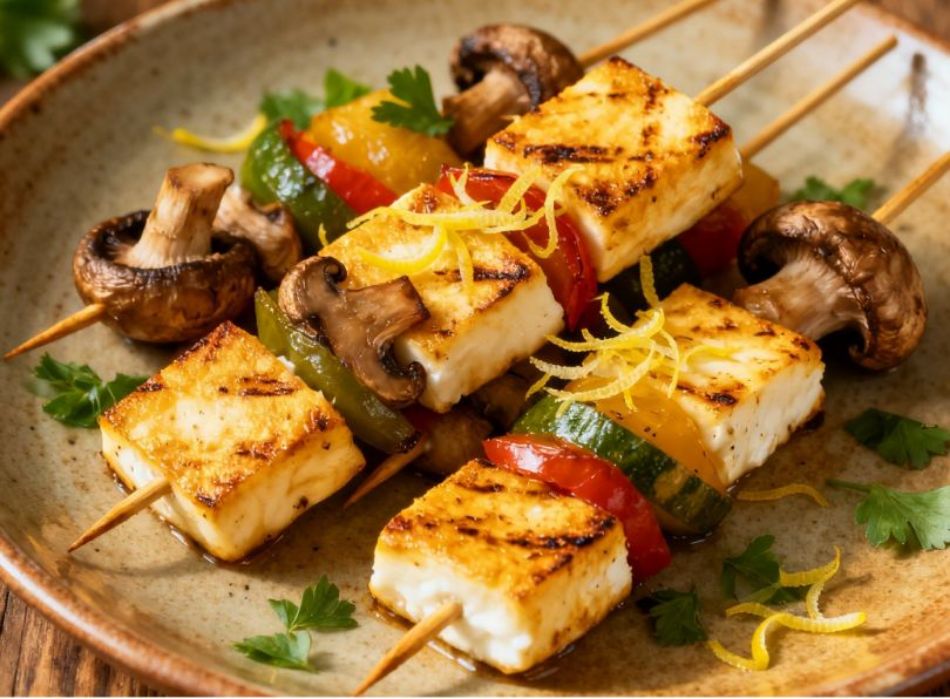
Halloumi, mixed mushroom, and mediterranean vegetable skewers on BBQ grill
Serves: 4 people | Preparation: 20 minutes + 15 min marinating | Cooking: 15-18 minutes | Difficulty: Easy | Cost: Medium
Ingredients
For the skewers (main ingredients)
- 400 g of quality halloumi (preferably Cypriot PDO)
- 200 g of fresh or frozen porcini mushrooms (or, alternatively, portobello)
- 200 g of medium-sized champignon mushrooms
- 2 bell peppers of different colors (red, yellow, or orange)
- 2 medium zucchini
- 1 large red onion
- 200 g of cherry tomatoes (optional)
For the mediterranean marinade
- 5 tablespoons of high-quality extra virgin olive oil
- Juice of 1 organic lemon
- 2 cloves of finely minced garlic
- 1 teaspoon of fresh thyme (or ½ teaspoon if dried)
- 1 teaspoon of dried oregano
- ½ teaspoon of smoked paprika
- ½ teaspoon of ground cumin
- Freshly ground black pepper
- Note: do not add salt to the marinade, halloumi is already very salty
For serving
- Fresh mint leaves (echoing Cypriot tradition)
- Fresh parsley leaves
- Tzatziki sauce or Greek yogurt
- Lemon wedges
- Toasted pita bread or focaccia (optional)
Step-by-step preparation
Phase 1: preparing the ingredients (15 minutes)
Start with the halloumi: cut it into cubes about 3 cm on each side, trying to keep dimensions as uniform as possible. This uniformity is fundamental to ensure even cooking on all pieces. If your halloumi has been preserved in brine, pat it dry with kitchen paper before cutting. If it is very salty, you can briefly soak it in cold water (10-15 minutes) to reduce salinity, then pat dry well.
Prepare the mushrooms: clean them dry with a brush or damp cloth. Large porcini should be cut into quarters, medium champignons can be used whole (inserting the skewer through the stem and cap), large portobellos into 3 cm pieces. Remove shiitake stems if using them.
Prepare the vegetables: wash and dry peppers, zucchini, and onions. Cut peppers into 3 cm squares, zucchini into 1.5-2 cm thick rounds, onion into quarters (then separated into petals). Cherry tomatoes are used whole.
Phase 2: the marinade (5 minutes + 15 minutes resting)
In a large bowl, mix all the marinade ingredients: EVO oil, lemon juice, minced garlic, thyme, oregano, smoked paprika, cumin, and black pepper. Mix vigorously with a fork until you obtain a homogeneous emulsion. Add the halloumi cubes and mushroom pieces to the bowl, mixing gently to coat every piece. Let marinate for at least 15 minutes (up to 2 hours in the refrigerator for a more intense flavor). Vegetables can be added to the marinade in the last 10-15 minutes, as they absorb flavors more quickly than halloumi.
Phase 3: assembling the skewers
This phase requires a bit of aesthetic and practical attention: the goal is to create visually beautiful skewers, with alternating colors and similarly sized pieces that cook evenly. On each skewer, alternate ingredients following a chromatic sequence: for example, onion - halloumi - mushroom - red pepper - zucchini - halloumi - mushroom - yellow pepper - cherry tomato. This color alternation creates a spectacular visual effect and ensures that every bite contains both halloumi and mushrooms and vegetables. Do not press the pieces too tightly on the skewer: leaving a small space between each element allows heat to circulate evenly around each ingredient.
Phase 4: cooking on the BBQ (15-18 minutes)
Prepare the grill: heat the BBQ to medium-high heat (180-220°C). If using charcoal, wait until they are covered with white ash before starting cooking. Oil the grates with an oil-soaked cloth to prevent ingredients from sticking.
Cooking: place the skewers on the hot grill perpendicular to the grates. Do not move them for the first 2-3 minutes: let the crust form. When the halloumi has developed a nice golden coloration on the first side (you will see it from the edges), turn them 90° to obtain the classic crossed grill marks. Continue cooking, turning every 3-4 minutes, for a total of 12-15 minutes, until the halloumi is golden-amber on all sides and the mushrooms are soft and slightly caramelized. During cooking, brush the skewers with the remaining marinade to intensify flavors.
Phase 5: presentation and serving
Serve the skewers immediately (they are at their peak in the first 5 minutes after cooking), arranged on a serving platter with fresh mint and parsley leaves, lemon wedges, and a bowl of tzatziki or Greek yogurt as accompaniment. A drizzle of raw EVO oil completes the dish. The beauty of this dish also lies in its presentation: the vivid colors of the peppers, the white-gold of the halloumi, the brown of the mushrooms, and the green of the aromatic herbs create a chromatic work that is already, in itself, a declaration of gastronomic intent.
Nutritional values per serving
| Nutrient | Per serving (approx. 350g) | % Daily values* |
|---|---|---|
| Energy | ~380-420 kcal | ~19-21% |
| Proteins | ~26-30 g | ~52-60% |
| Total Fats | ~28-32 g | ~40-46% |
| Saturated Fats | ~13-16 g | ~65-80% |
| Carbohydrates | ~12-16 g | ~5-6% |
| Fiber | ~3-5 g | ~12-20% |
| Calcium | ~600-750 mg | ~75-94% |
| Sodium | ~800-1100 mg | ~40-55% |
| Vitamin C | ~80-100 mg | ~100-125% |
*Values based on a 2000 kcal diet. Sodium values are high due to halloumi: those who need to limit sodium can soak halloumi in water before use.
Skewer variations: halloumi burger, pan-fried, and other recipes
Once you have mastered the basic recipe for halloumi and mushroom skewers, the world of variations opens up like an infinite horizon of creative possibilities. Halloumi is one of the most versatile ingredients in Mediterranean cuisine, capable of adapting to very different preparations while always maintaining its gustatory identity. In this section, we will explore the most interesting and appetizing variations, from halloumi burgers to Asian-style skewers, from pan-fried halloumi to warm salads with mushrooms.
Halloumi burger with Portobello mushrooms
The halloumi burger is probably the most trending halloumi recipe on social media in recent years, a vegetarian response to the classic hamburger that has conquered even the most ardent carnivores. The version with portobello mushrooms is particularly satisfying and nutritionally complete. Here's how to prepare it:
Cut the halloumi into slices about 1.5 cm thick. Grill on BBQ or cast-iron pan until well browned on both sides (about 3-4 minutes per side). Meanwhile, grill a portobello cap (the "disc" that replaces meat in the vegetarian burger version) seasoned with oil, garlic, and thyme. Assemble the burger in a toasted brioche bun: lettuce leaf, tomato slice, grilled portobello mushroom, halloumi slice, caramelized onion, avocado sauce or tzatziki. The result is a vegetarian burger that doesn't make you miss meat: the elastic and flavorful consistency of halloumi, combined with the meaty satisfaction of portobello, creates a fully satisfying bite experience.
Pan-fried halloumi with mushrooms and spinach
For those who don't have a BBQ or prefer to cook at home, pan-fried halloumi is a quick and delicious preparation that can be brought to the table in less than 15 minutes. Heat a non-stick pan (or better, a cast-iron pan) over high heat without adding oil. Add the halloumi slices and cook 2-3 minutes per side, until the surface is golden and slightly crispy. Remove the halloumi from the pan, lower the heat to medium, add a drizzle of EVO oil and sauté sliced mushrooms with garlic and thyme for 5-7 minutes. Add fresh spinach (or other leafy greens) and wilt for 1-2 minutes. Return the halloumi to the pan, drizzle with lemon juice, sprinkle with black pepper, and serve immediately.
Asian-style halloumi skewers
For a more exotic version of skewers, replace the Mediterranean marinade with an Asian marinade: soy sauce (further reduces the need for added salt), sesame oil, freshly grated ginger, lime, garlic, and a pinch of chili. Pair halloumi with shiitake mushrooms, pak choi, spring onions, and fresh pineapple. The contrast between the saltiness of halloumi and the sweetness of pineapple, mediated by the earthy notes of shiitake, is one of those pairings that seem unlikely on paper but turn out extraordinarily balanced on the palate.
Halloumi and mushrooms in warm salad
A perfect summer dish: grill halloumi slices and mixed mushrooms (champignon, porcini, pleurotus) separately, seasoned with oil and garlic. Arrange on a bed of arugula or mixed greens, add semi-dried cherry tomatoes, black olives, capers, and toasted walnuts. Dress with an emulsion of EVO oil, aged balsamic vinegar, honey, and mustard. The contrast of temperatures between freshly grilled halloumi and fresh vegetables is one of the most refined pleasures of this warm salad.
Baked halloumi with mixed mushrooms
For a more comforting, comfort-food version, arrange halloumi slices in a baking dish, surrounded by mixed mushrooms, date tomatoes, onions, garlic, and aromatic herbs. Drizzle generously with EVO oil and bake in a preheated oven at 200°C for 20-25 minutes, until the halloumi is golden and the mushrooms are soft and fragrant. Serve with toasted rustic bread to collect the cooking juices. This version is ideal for colder months, when BBQ is not practical but you still want to enjoy the sublime pairing of halloumi and mushrooms.
Where to find and purchase quality halloumi in Italy
One of the most practical and frequent questions from those approaching halloumi is: "Where can I buy halloumi in Italy?" and more specifically "Where can I find high-quality halloumi, preferably PDO?". The good news is that the spread of halloumi in Italy has grown enormously in recent years, and today this cheese is much more accessible than it was even just 5-10 years ago. Below is a practical guide to the most reliable purchasing channels.
Large distribution supermarkets
In major Italian supermarket chains (Esselunga, Coop, Conad, Carrefour, Ipercoop), halloumi is now regularly found in the packaged cheese section, often near feta or exotic cheeses. The most common brands are Cypriot producers like Pittas or Alambra, or private label supermarket brands. Quality varies: versions in standard supermarkets are generally produced with significant percentages of cow's milk, which makes them more economical but less characterized than the original sheep-goat. For everyday uses and family preparations, these products are perfectly adequate.
Organic and specialty stores
Organic and natural food stores (such as NaturaSì, local Bio Boutiques, and natural product shops) are often the best places to find superior quality halloumi, with higher percentages of sheep-goat milk and without added preservatives. Organic halloumi is characterized by milk from certified farms, without antibiotics or growth hormones, and often with vegetable or microbial rennet that makes it suitable even for the strictest vegetarians.
Ethnic shops and mediterranean product stores
Italian cities with Cypriot, Greek, and Middle Eastern communities (Milan, Rome, Turin, Bologna) often host specialized ethnic shops where you can find more artisanal and traditional versions of halloumi, sometimes imported directly from Cyprus or produced locally following traditional recipes. These shops are a goldmine for those seeking the authentic flavor of Cypriot halloumi with mint.
Online shopping: the most convenient and complete channel
Online shopping has become the preferred channel for those who want access to the best selection of halloumi available in Italy. The advantage of online shopping is the ability to compare different products, read reviews from other buyers, and receive directly at home products of quality difficult to find in local shops.
Natura Sì halloumi and organic alternatives
Natura Sì halloumi is one of the most widespread organic versions in Italian natural food stores. It is characterized by a clean nutritional profile, without preservatives and with a good percentage of sheep-goat milk. For those seeking quality organic alternatives, it is a reliable choice and easily available throughout the national territory.
Approximate halloumi prices in Italy (2024)
| Type of halloumi | Channel | Approximate price /100g | Notes |
|---|---|---|---|
| Standard (mixed milk) | Supermarket | €1.50-2.50 | Commercial brands, basic quality |
| Medium-high quality | Specialty store | €2.50-4.00 | Better sheep-goat milk percentage |
| Organic / PDO | Bio shop / online | €4.00-6.50 | Cypriot PDO, sheep-goat milk |
| Artisanal with mint | Ethnic shop / online | €5.00-8.00 | Traditional Cypriot recipe |
Alternatives and substitutes for halloumi
Despite the growing availability of halloumi in Italy, there are situations where this cheese is not available or not suitable for dietary reasons or personal preference. In these cases, it is useful to know the most valid alternatives that can replace halloumi in BBQ skewers with mushrooms and vegetables, even if not exactly replicating its unique characteristics.
Alternative cheeses to halloumi for grilling
Queso panela (Mexico)
Queso panela from Mexico has characteristics similar to halloumi in terms of heat resistance, although the consistency and flavor are different (more delicate and milky). It behaves well on the grill and can be used as a substitute for halloumi in many recipes.
Smoked provolone (Italy)
Smoked provolone, especially that produced in Southern Italy, has a relatively high melting point that allows it to be grilled without completely melting, at least for short periods at moderate heat. The flavor is very different from halloumi (more intense and smoky), but the grilling experience is partially comparable.
Fresh or semi-aged pecorino
Fresh pecorino (not aged) has characteristics quite similar to halloumi in terms of composition (sheep milk) and consistency. It doesn't withstand grilling with the same elegance as halloumi, but can be used in a pan with good results. The flavor is more delicate in fresh versions and more intense in semi-aged versions.
Extra-firm tofu (for vegan version)
Extra-firm tofu, marinated and then grilled or fried, is the most widespread vegan alternative to halloumi. It doesn't have the same heat resistance or elastic texture, but with a good marinade and high-heat cooking it can offer a satisfying experience. The secret to best-grilled tofu is to eliminate as much water as possible before cooking: press the tofu block between two cutting boards with a weight on top for at least 30 minutes, or use the freeze-thaw method (which changes the tofu structure making it more spongy and capable of absorbing marinades).
Vegan versions of halloumi
The market for vegan halloumi alternatives is growing rapidly, with specialized producers offering versions based on cashews, soy, almonds, or blends of plant-based ingredients specifically designed to replicate the heat-resistant property of traditional cheese. Some of these versions (such as those produced by VioLife, Violife, or brands specializing in vegan food) come quite close to the experience of original halloumi in terms of grilling behavior, although the flavor is inevitably different. For vegans and those following plant-based diets, these versions represent an excellent solution for participating in vegetarian BBQ without giving up the satisfaction of grilled skewers.
Global market and international spread of halloumi
The story of halloumi's commercial success is one of the most fascinating and instructive in the panorama of international agri-food products over the last twenty years. From an almost unknown cheese outside the island of Cyprus and the Cypriot diaspora until the 1990s, halloumi has transformed into one of the most sought-after and fastest-growing cheeses on the world market, with an annual growth rate that between 2010 and 2024 has steadily exceeded 15-20% in major Western markets. Understanding the reasons for this success is important not only to understand the product but also to orient oneself in the choice of brands and origins when purchasing.
The UK market: the largest global consumer
The United Kingdom is by far the largest consumer market for halloumi outside Cyprus, with demand that in the 2010s grew almost exponentially, driven by the growth of vegetarianism, the popularity of Mediterranean cuisine, and a unique cultural phenomenon: the so-called halloumi burger, which has conquered the menus of pubs, food festivals, and fast-casual restaurants throughout Great Britain. According to CBI Market Intelligence data, the British halloumi market has quintupled in size between 2010 and 2022, leading Cyprus to export over 60% of its total halloumi production to the UK.
The Italian market: significant growth and new opportunities
In Italy, the halloumi market started later than in Northern Europe but is catching up with sustained growth rates. According to Nielsen Italy data, halloumi sales in Italian supermarkets grew by 67% between 2019 and 2023, with further acceleration during the post-pandemic period. Growth is driven mainly by the Millennial and Gen Z segments, more open to gastronomic experimentation and more sensitive to themes of vegetarianism and food sustainability. The region with the highest consumption is Lombardy, followed by Lazio and Emilia-Romagna.
Data and statistics on the global halloumi market
| Year | Global market value (€ million) | Annual growth (%) | Cypriot exports (tons) | Main destination markets |
|---|---|---|---|---|
| 2018 | 380 | +14% | 12,800 | UK, USA, Germany, Australia |
| 2019 | 440 | +16% | 15,200 | UK, USA, Germany, Sweden |
| 2020 | 490 | +11% | 16,100 | UK, USA, Germany, Sweden, France |
| 2021 | 560 | +14% | 18,500 | UK, USA, Germany, Sweden, Italy |
| 2022 | 620 | +11% | 20,100 | UK, USA, Germany, Italy, Australia |
| 2023 | 680 | +10% | 21,800 | UK, USA, Germany, Italy, France |
| 2024 (estimate) | 740 | +9% | 23,500 | UK, USA, Germany, Italy, Sweden |
| 2028 (projection) | 1,200 | +10-12% CAGR | 35,000+ | Expansion in Asia, Middle East |
Source: compiled from Mordor Intelligence, CBI Market Intelligence, FAO Trade Data, 2024
PDO protection and commercial implications
The recognition of PDO (Protected Designation of Origin) status for Cypriot halloumi in 2021 has had profound commercial implications. Before the PDO, dozens of producers worldwide (Denmark, Ireland, Australia, USA) produced cheeses called "halloumi" or sold as such, exploiting the fame of the name without respecting Cypriot production criteria. With the PDO, the name "Halloumi" (or the Greek variant "Χαλούμι") is protected within the European Union: only cheese produced in Cyprus according to specifications can use this name.
This has created a "premiumization" effect in the European market, with Cypriot producers now able to position their product as authentic and of certified origin at higher prices, while non-Cypriot producers must use alternative denominations (such as "halloumi-style cheese" or "grilling cheese").
Tips for chefs, nutritionists, and enthusiasts
This section is dedicated to the different reader profiles who might find themselves here: the professional chef seeking technical inspiration, the nutritionist who wants precise data, the food blogger looking for original content, the organic shop owner who wants to educate their customers, and the university student passionate about cooking who wants to learn without spending too much.
For the professional chef
If you manage a restaurant and want to include halloumi in your summer menu, these are the advanced techniques that will make the difference:
- cold smoking: before grilling, expose halloumi slices to a brief cold smoking treatment with cherry or beech wood. The smoke penetrates slightly into the cheese and creates extraordinary aromatic complexity that reveals itself during grilling;
- prolonged marination with calibrated acidity: for high-level service, marinate halloumi for 12-24 hours in a mixture of high-quality EVO oil, Meyer lemon, fresh herbs, and a small amount of white wine vinegar. The acidity slightly softens the external texture and creates a more complex flavor layer;
- truffle pairing: truffle, both summer black or Alba white, pairs magnificently with grilled halloumi. Shave fresh truffle over freshly grilled skewers, or dress with quality truffle oil: the multiplicative umami effect between halloumi, mushrooms, and truffle is memorable;
- precise temperature control: for professional cooking, use an infrared thermometer to verify that the grill temperature is between 190 and 210°C. At this temperature, halloumi develops the Maillard crust in about 2.5-3 minutes per side, maintaining a creamy interior;
- whey reduction sauce: if you produce halloumi in-house or have access to production whey, create an aromatic reduction (with herbs, lemon, and a little honey) to use as a glaze in the last minute of skewer cooking: it intensifies flavor extraordinarily.
For the food blogger
Halloumi with mushrooms is one of the most photogenic subjects in vegetarian cuisine. For successful social content:
- golden hour photography: photograph skewers just removed from the grill, with smoke still visible and grill marks clearly evident. The warm evening light is perfect for enhancing the golden tones of halloumi;
- top-down angle (flat lay): arrange skewers on a rustic wooden cutting board, surrounded by raw ingredients (mushrooms, colorful peppers, aromatic herbs). The top-down angle shows all colors optimally;
- the "cheese pull" shot: photograph the moment when a piece of grilled halloumi breaks, showing the soft and slightly stringy interior. This type of video/photo is among the most shared on Instagram and TikTok;
- hybrid recipes for vegan followers: create skewer versions with vegan halloumi and document the difference compared to the original—this type of inclusive content attracts both vegans and the curious.
For the nutritionist
Including halloumi in balanced meal plans requires some specific considerations:
- sodium control: with about 1100-1600 mg of sodium per 100g, halloumi is a high-salt food. For those suffering from hypertension or needing to control sodium intake, recommend preliminary soaking in cold water (30-60 minutes) which significantly reduces salinity;
- complete protein for vegetarians: halloumi provides all essential amino acids in adequate quantities, making it a valuable protein supplement for vegetarian diets. Paired with mushrooms (source of vitamin D, selenium, and bioactive compounds), it creates an interesting nutritional synergy;
- glycemic index: with almost zero carbohydrates, halloumi has virtually no glycemic impact. Ideal for patients with type 2 diabetes or insulin resistance, always in the context of an overall meal plan.
- bioavailable calcium: halloumi calcium has medium-high bioavailability (about 30-35%), comparable to that of milk calcium. In moderate portions (80-100g/day), it can contribute significantly to meeting daily calcium requirements.
For the organic shop owner
To enhance halloumi sales in your shop:
- customer education: prepare an information sheet near the halloumi display that explains the difference between Cypriot PDO halloumi and imitations, the characteristics of the organic product, and usage suggestions.
- cross-selling with mushrooms: position halloumi near the selection of dried or frozen mushrooms, with a recipe suggestion for BBQ skewers. This type of visual pairing significantly increases average purchase value.
- tasting: organizing a grilled halloumi tasting—even just with a simple non-stick pan positioned at the counter—is one of the most effective ways to convert curious customers into convinced buyers. The aroma of browning cheese is irresistible.
- social communication: share skewer recipes on your social channels, tagging the organic halloumi producers you sell and using hashtags like #vegetarianbarbecue, #halloumirecipes, #mushroomskewers.
For the university student passionate about cooking
If you're looking for an easy, quick, economically sustainable, and nutritionally valid dish, halloumi and mushroom skewers are for you:
- economical version: use champignons instead of porcini (much cheaper), standard supermarket halloumi, seasonal low-cost vegetables (zucchini, peppers, onions). The result will still be delicious at a fraction of the cost;
- pan version without BBQ: if you don't have access to a barbecue, a simple non-stick pan over high heat gives very satisfying results. Don't be afraid to heat it well before adding halloumi: high heat is fundamental for browning;
- weekly meal prep: prepare the marinade and cut all ingredients on the weekend, storing them separately in the refrigerator. During the week, preparing the skewers takes less than 20 minutes;
- economical protein source: a complete meal of halloumi-mushroom-vegetable skewers for one person costs about €4-6, providing about 26-30g of protein. It's hard to find such a satisfying protein source at this price.
Most frequently asked questions about halloumi
In this section, we collect answers to the most frequently asked questions about halloumi, we hope you find it useful...
Basic questions about halloumi
What is halloumi?
Halloumi is a traditional Cypriot cheese produced with sheep and goat milk (and sometimes cow), characterized by a high melting point that makes it ideal for grilling. The term probably derives from the Arabic "ḥalūm" (a type of Middle Eastern cheese) or ancient Egyptian. It is the national cheese of Cyprus and has been protected by European PDO since 2021.
What type of cheese is halloumi?
Halloumi is classified as a semi-hard cheese, unaged or lightly aged, with unique heat-resistant properties. It does not belong to any of the classic European categories (it is not a fresh cheese like mozzarella, not aged like pecorino, not blue-veined like gorgonzola) but represents a category of its own in the "grilling cheeses" typology.
What is the typical Greek cheese called?
Technically, halloumi is a Cypriot cheese, not Greek. The most famous Greek cheese is feta. However, in the common Italian imagination, halloumi is often associated with Greece due to the common Hellenistic cultural roots of Cyprus. The typical Greek cheese is feta (Greek PDO), while the typical Cypriot cheese is halloumi (Cypriot PDO).
What is the difference between halloumi and feta?
The differences are deep and substantial: feta is soft and crumbly, does not withstand heat, has a tangy flavor, and is used mainly cold in salads; halloumi is semi-solid and elastic, withstands high-temperature cooking magnificently, has a salty-milky flavor, and is used mainly grilled or fried. The only common characteristic is origin from Mediterranean sheep-goat milk.
What is a cheese similar to halloumi?
The cheeses most similar to halloumi in cooking behavior are Mexican queso panela, Greek kefalotyri (more aged and salty), Greek manouri (more delicate), and some versions of fresh pecorino. None exactly replicate the elastic texture and high melting point of halloumi, but these cheeses come closer than most common cheeses.
Cooking questions
How do you cook halloumi?
Halloumi is cooked on the grill, in a pan, in the oven, or on BBQ. In a pan: heat a non-stick or cast-iron pan over high heat without oil. Add halloumi slices (cut 1-1.5 cm thick). Cook 2-3 minutes per side without touching until the golden crust forms. Serve immediately.
How to make pan-fried halloumi?
Pan-fried halloumi is prepared without oil (the cheese is already fatty enough) over high heat, turning only once. It is eaten immediately after cooking, on its own, in salad, in skewers, in burgers, or as an appetizer with honey and walnuts. Cold and uncooked, it can also be added to salads or used grated in more aged versions.
How to store halloumi?
Unopened halloumi is stored in the refrigerator respecting the expiration date on the package (usually 3-6 months). Once opened, it should be stored in a closed container with the original brine (or lightly salted water) and consumed within 5-7 days. Halloumi can also be frozen: cut it into slices before freezing, wrap them in plastic wrap, and store for up to 3 months. Thaw in the refrigerator the night before use.
Nutritional questions
Does halloumi contain lactose?
Halloumi contains a residual amount of lactose, lower than fresh cheeses but not zero like very aged cheeses. Those with mild intolerance generally tolerate it well; those with severe intolerance should consult their doctor or look for versions specifically indicated as "lactose-free".
Is halloumi high in fat?
Halloumi contains about 24-26g of fat per 100g, a good portion of which is saturated. It is not harmful if consumed in moderation within a balanced and varied diet. The nutritional benefits (calcium, complete proteins, B vitamins) justify its regular consumption in moderate portions (80-100g per meal).
How many calories does halloumi have?
About 316-330 calories per 100 grams. A typical 100g portion in skewers provides about 320 kcal, combined with the calories from vegetables and mushrooms (very low) and the oil in the marinade, for a total meal of about 380-420 kcal.
Purchasing questions
Where to buy halloumi in Italy? Where to find halloumi in Italy?
Halloumi is found in Italy in well-stocked supermarkets (Esselunga, Coop, Carrefour), in organic stores (NaturaSì and similar), in ethnic shops specializing in Mediterranean products, and online on specialized shops.
Where to buy high-quality PDO halloumi?
For high-quality Cypriot PDO halloumi, the best channels are specialty artisanal cheese shops, high-end bio shops, and online shopping, where the selection is wider and you can find artisanal Cypriot producers who export directly to Italy. Always verify that the product bears the European PDO mark (the wording "Protected Designation of Origin" or the European graphic symbol).
Halloumi with mushrooms is the future of BBQ
We have reached the end of this in-depth journey into the world of halloumi and mushrooms, two extraordinary ingredients that together give life to one of the best vegetarian BBQ dishes that contemporary cuisine has to offer. Halloumi, mushroom, and vegetable skewers are not simply a recipe: they are a gastronomic philosophy that unites Cypriot tradition and Italian biodiversity, intelligent nutrition and sensory pleasure, preparative simplicity and gustatory complexity.
They are a dish that responds to the challenges of our time: reducing meat consumption, enhancing authentic quality ingredients, seeking satisfying and healthy gastronomic experiences without giving up a gram of pleasure.
Happy vegetarian BBQ to all!
This article was developed with the support of artificial intelligence and subsequently reviewed, corrected, and validated by the NaturNext.eu technical team, which guarantees its reliability and compliance with official sources.
The kingdom of mushrooms is a universe in continuous evolution, with new scientific discoveries emerging every year on their extraordinary benefits for intestinal health and general well-being. From today on, when you see a mushroom, you will no longer think only of its flavor or appearance, but of all the therapeutic potential it contains in its fibers and bioactive compounds. ✉️ Stay connected - Subscribe to our newsletter to receive the latest studies on: Nature offers us extraordinary tools to take care of our health. Mushrooms, with their unique balance between nutrition and medicine, represent a fascinating frontier that we are only beginning to explore. Continue to follow us to discover how these extraordinary organisms can transform your approach to well-being.Continue your journey into the world of mushrooms