


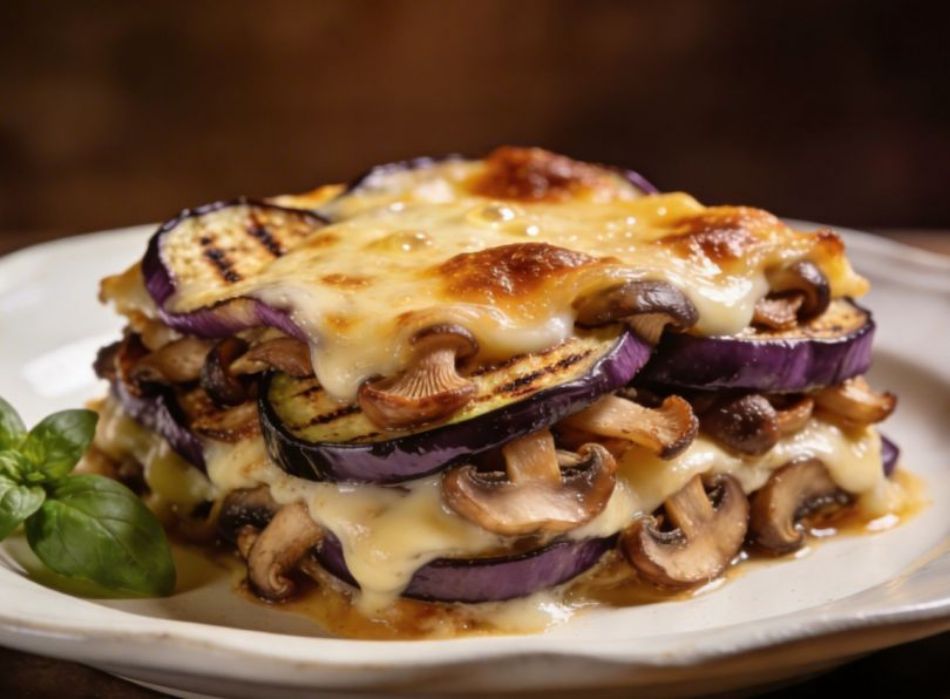
Moussaka is not merely a dish, but a tableau upon which millennia of cultural exchanges, trade routes, and culinary innovations have settled. In this article, we will delve into all the secrets of this Mediterranean dish. In particular, after introducing the history and origins of this first course, we will focus on a specific variant: vegetarian mushroom moussaka. We will explore every component, from the dish's identity to its historical roots, from preparation techniques to the secrets of béchamel sauce, culminating in a complete dissection of its nutritional values.
The goal is to provide not just a recipe, but a veritable piece of research on moussaka, capable of satisfying the most technical curiosities and answering every possible question comprehensively: from the origins of the name to wine pairings, from regional variations to dietary modifications.
Moussaka? The origins of a disputed dish
If we were to ask ourselves which people moussaka belongs to, we could start with the term that denotes this dish. The Italian and English word "moussaka" (or "musakka" in Turkish) derives from the Arabic musaqqa‘a (مصقعة), which literally means "that which has been moistened" or "drenched," referring to the technique of cooking vegetables with liquids like tomato sauce. This linguistic root projects us directly into the heart of the medieval Arab world, where the first cookbooks, such as the famous Kitab al-Tabikh (The Book of Dishes) by Ibn Sayyar al-Warraq in the 10th century, describe layered preparations of eggplant and meat. Therefore, the origin of moussaka is not Greek, but Arab. The primordial dish was a simple baked tray of fried eggplants, lamb or mutton, onions, and tomatoes. Béchamel sauce, now considered a distinctive element, was entirely absent.
Ottoman expansion and spread throughout the Balkans
With the expansion of the Ottoman Empire, this preparation spread throughout the Balkans, meeting and integrating with local traditions. It is in this cultural melting pot that moussaka began to diverge into different branches. In Turkey, Turkish moussaka (musakka) is still a dish of eggplants, ground meat, tomatoes, and green peppers, usually served with rice pilaf and yogurt, and does not involve multiple layers or béchamel sauce. It is a preparation more similar to a thick stew than a savory pie.
In Bulgaria, Serbia, and Romania, Bulgarian or Serbian moussaka took a different path, often replacing eggplants with potatoes and using a top layer of yogurt and eggs, an ancestor of béchamel. This variant, more economical and linked to the dairy products of the area, is simply called "musaka" and is a staple of home cooking.
The Tselementes revolution: the birth of modern Greek moussaka
This brings us to Greece and the name that revolutionized the dish: Nikolaos Tselementes. This Greek chef, trained in Austria and deeply influenced by French cuisine, published a cookbook in the early 20th century (1910-1920) titled "Odigos Mageirikis" (Cooking Guide), which became the bible of Greek bourgeois cuisine. Tselementes had a mission: to "Europeanize" Greek cuisine, distancing it from its Ottoman and Eastern roots. With this in mind, he applied a principle of French cuisine classique to the traditional musakka: béchamel sauce.
By adding a layer of gratinated béchamel on the surface and sometimes between the layers, he created what we know today as original Greek moussaka recipe. Not only that, Tselementes also codified the use of ground beef or lamb, red wine, and a sprinkle of cinnamon, creating an aromatic profile that balanced the richness of the béchamel. His invention was so overwhelmingly successful that it overshadowed all previous versions, becoming the very symbol of culinary Greece.
It is therefore correct to say that modern Greek moussaka is a 20th-century invention, a product of the ingenuity of a man who wanted to make his national cuisine more "French."
Differences between moussaka and eggplant parmigiana
A parallel is often drawn between moussaka and eggplant parmigiana. Both are layered preparations based on fried eggplants, but their histories and ingredients are different. What is the origin of parmigiana? The name "parmigiana" does not indicate origin from Parma, but likely derives from the Sicilian dialect word "palmigiana", which refers to the slats of shutters, similar to overlapping slices of eggplant. Parmigiana is a dish from Southern Italy, with Campanian and Sicilian variants, based on fried eggplants, tomato, basil, and cheeses like Parmesan or caciocavallo. It does not include ground meat or béchamel sauce (although modern versions with the latter exist). While Greek moussaka is a complete, protein-rich dish, parmigiana is a side dish or a vegetarian main. Their similarity is an example of culinary convergence: two different cultures that, starting from a common ingredient (eggplant, brought to Europe by the Arabs), developed similar but distinct solutions.
Ingredients and regional variations of moussaka
Now let's summarize the various existing variations of moussaka, before moving on to our vegetarian recipe.
Classic Greek moussaka
Greek moussaka is composed of three main elements, prepared separately and then assembled:
- eggplants: the vegetable heart of the dish. Long, dark purple eggplants are used, sliced lengthwise, salted to remove bitter water, and then fried or, in modern versions, grilled;
- meat ragù (kreas): a thick sauce based on ground meat (lamb, beef, or a mix), onion, garlic, tomato, red wine, and a spice mix including cinnamon, cloves, bay leaf, and nutmeg. The presence of cinnamon is the distinctive trait linking moussaka to its Eastern past.
- béchamel sauce (besamel): the creamy top layer, and sometimes intermediate, of clear French derivation. It's a classic béchamel enriched with egg yolk and grated cheese (kefalotyri or Parmesan), ensuring a golden, gratinated crust.
To these are added breadcrumbs for the base and cheese for the topping. If you are wondering what meat is in moussaka, originally it was lamb, while today it is often mixed with beef for a milder flavor. Among the spices, besides cinnamon, we find nutmeg (in the béchamel and sometimes the ragù), oregano, thyme, and a pinch of black pepper.
Turkish moussaka (Musakka)
Turkish moussaka is radically different; it is not a layered dish. Eggplants are cut into large dice or thick slices, fried, and then layered in a pan with a sauté of ground meat, onions, green peppers, and chopped tomatoes. Everything is baked in the oven, but without béchamel and without the precise parallel-layer architecture of the Greek version. It is served warm or at room temperature, often accompanied by rice pilaf and plain yogurt, which acts as a fresh, acidic counterpoint to the dish's richness. The main spices are allspice, cumin, and parsley. This version is much closer to the original Arab-Ottoman dish.
Bulgarian and Serbian moussaka
Moving north, we encounter Bulgarian and Serbian moussaka. Here, the eggplant loses its primacy to the potato, a more resilient and widespread ingredient in continental areas. The base is a layer of sliced potatoes, followed by ground pork or beef, onions, and peppers. The top layer is often a simple mixture of beaten yogurt and eggs, which during cooking forms a soft, slightly tangy crust, very different from Greek béchamel. Some variants also use kaymak (sour cream). This version is more rustic and substantial, suited to colder climates. There is also a completely vegetarian potato moussaka, very popular during religious fasting periods.
Vegetarian mushroom moussaka:
In our recipe, we move away from carnivorous tradition to explore the world of mushrooms. The choice of mushrooms is not accidental but responds to botanical and structural criteria. We will use a mix of:
- Porcini (Boletus edulis): for their intense and unmistakable aroma, which provides woodland depth and umami;
- Champignons (Agaricus bisporus): for their meaty texture and ability to absorb flavors, creating the base of the ragù;
- Cardoncello (Pleurotus eryngii): for their firm flesh and slightly spicy, aromatic flavor that holds up well to long cooking.
This trio of mushrooms, with their different aromatic notes and consistencies, recreates the complexity of a meat ragù, but with a much more favorable lipid profile and a unique richness of fiber and micronutrients. From a mycological perspective, using different species of fungi allows us to exploit a broader range of volatile compounds and polysaccharides, making the dish not only tastier but also more interesting from a nutraceutical standpoint.
| Regional Variant | Base Ingredients | Layering Technique | Characteristic Spices | Typical Accompaniment |
|---|---|---|---|---|
| Greek (classic) | Eggplants, lamb/beef, tomato, béchamel, cheese | Parallel, orderly layers, with béchamel on top and sometimes between layers | Cinnamon, cloves, nutmeg | Greek salad, feta, bread |
| Turkish | Eggplants, beef, tomato, green peppers | Not layered, ingredients mixed in pan or cooked in skillet | Allspice, cumin, parsley | Rice pilaf, plain yogurt |
| Bulgarian/Serbian | Potatoes, pork/beef, yogurt, eggs | Layers of potatoes and meat, yogurt-egg topping | Sweet paprika, dried mint, garlic | Shopska salad, ayran |
| Egyptian | Eggplants, beef, onions, garlic, tomato sauce | Single layer of stuffed eggplants or layers in a shallow pan | Garlic, cumin, coriander | White rice, pita bread |
| Vegetarian Mushroom | Eggplants, mushroom mix (porcini, champignon, cardoncello), béchamel | Parallel layers, like Greek, with mushroom ragù instead of meat | Thyme, marjoram, cinnamon (hint), nutmeg | Green salad, light red wine |
Vegetarian mushroom moussaka
How do you make moussaka? Let's first discover the ingredients.
Ingredients for 6 people
For the eggplants:
- Long purple eggplants - 900 g
- Coarse salt - to taste
- Extra virgin olive oil - 30 ml
For the mushroom ragù:
- Yellow onions - 200 g (1 large)
- Garlic - 4 cloves
- Fresh porcini mushrooms - 250 g
- Champignon mushrooms - 250 g
- Cardoncello (or pleurotus) mushrooms - 200 g
- Tomato passata - 450 ml
- Dry red wine - 120 ml
- Extra virgin olive oil - 40 ml
- Ground cinnamon - 1 teaspoon
- Dried oregano - 1 tablespoon
- Fresh thyme - 2 sprigs
- Salt and black pepper - to taste
For the béchamel sauce:
- Whole milk - 600 ml
- Butter - 60 g
- All-purpose flour - 60 g
- Nutmeg - 1/2 teaspoon
- Salt - 1 pinch
- Bay leaf - 1 (optional)
For assembly:
- Grated Parmigiano Reggiano cheese - 100 g
- Breadcrumbs - 40 g
- Butter for the pan - to taste
Procedure
The first crucial step is handling the eggplants. Eggplants contain a lot of water and bitter compounds like solanine. The salting process is very important: sprinkling the slices with coarse salt triggers an osmotic process: the salt on the outside creates a hypertonic environment that draws water from inside the eggplant cells. This water carries away some of the bitter compounds. After 30-40 minutes, the eggplants are rinsed and dried.
The next step is cooking: the traditional recipe calls for frying, but for a lighter version that enhances the flavor, we grill them. Grilling on a hot plate (or in a very high-temperature oven) triggers the Maillard reaction between amino acids and sugars on the eggplant's surface, creating hundreds of aromatic compounds and the typical flavorful crust. This step is essential for giving depth to the final dish and preventing the eggplants from releasing water during baking, which would make the moussaka watery.
The mushroom ragù
Mushrooms, like eggplants, are sponges for water, so the correct procedure involves:
- sautéing the onion and garlic well: in extra virgin olive oil, over low heat, for at least 8-10 minutes, until they become translucent and sweet. This creates the aromatic base;
- adding the diced mushrooms: it's important not to overcrowd the pan. The mushrooms should be sautéed over high heat. Initially, they will release their water, and during this phase, it is essential to continue sautéing until the water has completely evaporated. Only at this point will the mushrooms begin to brown, developing further notes of umami (due to the conversion of glutamates);
- deglazing with red wine: the wine should be added when the mushrooms are well-browned. The alcohol evaporates quickly, carrying away the more volatile notes and leaving room for the wine's extracts and tannins, which bind to the fats and proteins of the mushrooms, creating complexity;
- adding the passata and spices: the tomato passata should be reduced over low heat for at least 20-30 minutes. The goal is to obtain a thick, almost dry sauce, where flavors are concentrated and there is no free water that could later soak the eggplant layers. The cinnamon and oregano should be added in this phase to allow their essential oils to integrate into the sauce.
Béchamel sauce
One often hears "what's the big deal about making béchamel?" but béchamel is one of the mother sauces of French cuisine and among the most difficult; its preparation must yield a smooth and velvety result. It starts with a roux, a mixture of butter and flour cooked together. For our roux, we cook butter and flour for 2-3 minutes until golden (blond roux). This step serves to:
- coat the starch granules of the flour with fat: this prevents the granules from clumping together when they come into contact with the milk;
- mask the taste of raw flour: cooking eliminates the floury taste and develops slightly toasted notes.
At this point, hot milk is added (using hot milk facilitates incorporation and reduces time). Stirring vigorously with a whisk, the starch granules, hydrating and heating up, begin to gelatinize; they absorb the liquid and swell, releasing molecules of amylose and amylopectin that thicken the surrounding liquid, creating the typical velvety consistency. Adding nutmeg and a bay leaf during cooking flavors the sauce. The béchamel for moussaka must be quite thick, because it should not run between the layers, but rather support the structure of the dish. Once ready, remove it from the heat and you can optionally incorporate an egg yolk for a richer version and part of the grated cheese.
Assembly and baking: the physics of layering and the final rest
Now it's time to assemble the moussaka. Start by sprinkling the bottom of the pan with breadcrumbs: this thin layer will absorb excess moisture and create a crispy base. Then proceed with layers: eggplants, mushroom ragù, a thin layer of béchamel, cheese. And repeat. The final layer must be béchamel, generously sprinkled with cheese and breadcrumbs to form a golden and crispy crust. During baking in the oven (180°C for 40-45 minutes), the layers compact, flavors meld, residual water evaporates, and the surface gratins. The final step under the grill for 5 minutes caramelizes the sugars in the milk and béchamel, creating a golden crust.
But the most important secret is the final rest: once out of the oven, the moussaka must rest for at least 15-20 minutes. This time allows the béchamel and starches to "re-stabilize" and cohesive forces to act. If cut while hot, the moussaka will fall apart; if left to rest, it will hold its loaf shape and can be served in perfect slices.
How is moussaka eaten? Usually warm, cut into squares, as a main course.
Tips for perfect moussaka
There are several precautions to consider if you want to achieve a perfect result, worthy of a chef. Let's see what they are.
How to avoid watery moussaka
Public enemy number one for moussaka is water. In addition to salting the eggplants and reducing the ragù, here are other tips: do not wash the eggplants after salting them, just pat them dry with paper towels. Use a thick, quality tomato passata and do not overdo the amount of béchamel. Let the ragù cool completely before assembling, so it doesn't release hot steam inside the pan.
The secret to lump-free béchamel
The whisk is béchamel's best friend. Pour the hot milk in a steady stream over the roux off the heat, stirring vigorously to incorporate it all. Then return to the heat and continue stirring, always in the same direction. If lumps do form, a quick pass with an immersion blender or through a sieve can save the situation.
How to make moussaka lighter
For a light moussaka, several strategies can be adopted: grill the eggplants instead of frying them, use semi-skimmed milk and half the butter for the béchamel, replace some of the fatty cheese with flavored breadcrumbs, increase the proportion of mushrooms at the expense of other higher-calorie ingredients, use lean ground meat (if choosing the non-vegetarian version).
Storage and reheating
How to store moussaka? In the refrigerator, well covered with plastic wrap or in an airtight container, for 3-4 days. It freezes very well, preferably already portioned, for up to 2-3 months.
How to reheat it? The oven is the only method that respects the dish's structure. Reheat at 160°C for 20-25 minutes if starting from cold, or at 180°C for 10-15 minutes if the moussaka is at room temperature. The microwave makes it soft and rubbery, destroying the layering.
Pairings and presentation: aesthetics and synesthesia of the dish
What to serve with moussaka? In Greek tradition, moussaka is served as a main course, often accompanied by a simple Greek salad (horiatiki) with tomatoes, cucumbers, olives, red onion, and feta, dressed with oregano and oil. The acidity and freshness of the salad cut through the richness of the béchamel.
Other ideas could be: grilled vegetables, tzatziki (yogurt, cucumber, and garlic), or simply some good rustic bread for dipping. With our mushroom version, a field green salad with arugula and Parmesan shavings can enhance the woodland notes.
Which wine to pair with moussaka?
The choice of wine depends on the version made. With classic Greek moussaka, rich in meat and spices, the ideal pairing is a Greek red wine like Nemea (from Agiorgitiko grape) or a Naoussa (from Xinomavro grape). These are wines with good acidity and soft tannins that marry well with the richness and spices. Another classic option is Retsina, a resinated white or rosé wine whose characteristic aroma (due to pine resin) creates a fascinating contrast with the cinnamon and nutmeg.
For our vegan mushroom moussaka, a lighter, fruitier red, such as a Pinot Noir or a not-too-structured Primitivo from Puglia , will enhance the flavor of the mushrooms without overpowering them. Alternatively, a full-bodied white, lightly aged in wood, like a Chardonnay from northern Greece, can be surprising in its ability to envelop the creaminess of the béchamel.
| Type of Moussaka | Recommended Wine | Region/Grape | Pairing Notes |
|---|---|---|---|
| Classic Greek (lamb) | Full-bodied Red | Nemea (Agiorgitiko), Naoussa (Xinomavro) | Soft tannins and ripe fruit balance the richness of the meat and béchamel. |
| Classic Greek (beef) | Structured Red | Greek Cabernet Sauvignon, Primitivo | Structure and spicy notes align with the tomato sauce and cinnamon. |
| Turkish (no béchamel) | Light Red or Rosé | Greek Rosé, Côtes du Rhône | Freshness and fruitiness cleanse the palate after the meat and eggplant texture. |
| Vegetarian Mushroom | Light Red or Structured White | Pinot Noir, Chardonnay (oaked) | Pinot Noir enhances earthy mushroom notes; Chardonnay envelops the béchamel. |
| Bulgarian (with potatoes) | Simple Red or Beer | Merlot, lager beer | A simple wine or a fresh beer pairs with the dish's rusticity. |
Presentation and serving
How to present moussaka? Serve it warm, cut into squares or diamonds, showing its perfect layers. A tip for a clean cut: use a smooth-bladed knife and run it under hot water before each cut. It can be served on a flat plate, accompanied by a small side salad and, if desired, a spoonful of tzatziki or Greek yogurt.
Nutritional values
The following data has been calculated for an average serving (about 400g) of our vegetarian mushroom moussaka, considering the use of whole milk, butter, Parmesan, and grilling the eggplants. These are indicative values that may vary based on specific brands and cooking techniques.
| Nutrient | Quantity | % RDA* (average adult) | Notes and benefits |
|---|---|---|---|
| Energy (calories) | 395 kcal | ~20% | A complete meal, balanced in macronutrients. |
| Protein | 17 g | ~30% | Mushrooms provide protein with all essential amino acids, albeit in lower quantity than meat. Cheese and milk complete the amino acid pool. |
| Total Fat | 18.5 g | ~26% | Part of which are saturated fats (butter, cheese) and part unsaturated (olive oil). |
| Saturated Fat | 6.5 g | ~30% | To be monitored, but in a balanced meal it falls within limits. |
| Carbohydrates | 39 g | ~15% | Provide slow-release energy thanks to fiber. |
| Fiber | 9.5 g | ~32% | Excellent intake. Fiber from eggplants and mushrooms promotes satiety and intestinal health. Eggplants also contain nasunin, a powerful antioxidant. |
| Sugars | 13 g | – | Mainly lactose from milk and natural sugars from tomato and vegetables. |
| Sodium | 620 mg | ~27% | To monitor if you have hypertension. Can be reduced by using less salt and Parmesan. |
| Potassium | 1050 mg | ~30% | Excellent intake, essential for muscle function and blood pressure. |
| Calcium | 280 mg | ~28% | Thanks to dairy and cheese. |
| Iron | 2.8 mg | ~20% (men), ~16% (women) | Iron from mushrooms is well absorbed when paired with vitamin C from tomatoes. |
| Vitamin D | 3-5 µg | 20-50% | If mushrooms were exposed to UV light or if using enriched cultivated mushrooms, vitamin D can be significant. Otherwise, the amount is modest but present. |
| Selenium | 15 µg | ~27% | Mushrooms are an excellent source of this powerful antioxidant. |
*RDA = Recommended Daily Allowance. Percentages are approximate and based on a 2000 kcal diet.
Specific benefits of mushrooms in moussaka
Mushrooms are not just a meat substitute; they bring unique benefits. They are rich in beta-glucans, soluble fibers that help control cholesterol. They are one of the few plant sources of vitamin D (if exposed to sunlight during growth). They contain ergothioneine and glutathione, two powerful antioxidants that protect cells from oxidative stress and aging. Their richness in umami (natural glutamate) makes the dish deeply satisfying without needing excessive fats or salt.
Adaptations for specific dietary needs
- Vegan moussaka: Replace butter with vegetable margarine or oil, milk with soy or oat milk (soy milk, due to its protein content, yields a more stable béchamel), and Parmesan with nutritional yeast flakes or a vegan grating cheese. Ensure the breadcrumbs are dairy-free.
- Gluten-free moussaka: Use rice flour or a gluten-free blend for the béchamel, and gluten-free breadcrumbs. All other ingredients are naturally gluten-free.
- Low-fat moussaka: Besides grilling, use skimmed milk, reduce butter in the béchamel to 30g, and use less cheese, perhaps a more aged and flavorful pecorino to need less. Increase the proportion of mushrooms and tomato.
- Low-FODMAP moussaka (for those following this diet): Be cautious with garlic and onion, which are high FODMAP. They can be substituted with the green part of leek and garlic-infused oil (aroma only). Eggplants should be consumed in moderation, and champignon mushrooms are better tolerated than others.
Some curiosities...
Let's answer comprehensively all the most common questions surrounding this dish.
What is moussaka in Greece?
In Greece, moussaka is considered a national dish, a symbol of family cooking and tavern tradition. It's the Sunday dish, the festive dish, but also a comfort food classic. Tselementes' version is so ingrained that many Greeks believe it is as ancient as their civilization. It is served in all taverns, hot or warm, and is often the first dish that comes to mind when thinking of Greek cuisine abroad.
What pasta is eaten in Greece?
Yes, pasta is eaten in Greece! The most famous pasta dishes are pastitsio, often considered the "cousin" of moussaka. Pastitsio is a baked pasta dish: usually ziti (long, hollow pasta) layered with a meat ragù similar to that of moussaka, topped with a thick béchamel sauce, and gratinated. If moussaka is the "vegetable-based" version, pastitsio is the "pasta-based" version. Both share the same culinary philosophy: layers, spiced ragù, and béchamel.
What are the origins of Moussaka?
As extensively discussed, the origins are Arab (musaqqa‘a). The dish spread throughout the Ottoman Empire, took root in the Balkans with local variants (Turkish, Bulgarian, Serbian), and was ultimately radically transformed in Greece at the beginning of the 20th century by Nikolaos Tselementes, who added béchamel, codifying the version most famous today.
What foods are there in Greece?
Besides moussaka and pastitsio, Greek cuisine is a triumph of Mediterranean flavors: horiatiki (Greek salad), tzatziki, dolmades (stuffed vine leaves), souvlaki (skewers), gyros, spanakopita (savory pie with spinach and feta), tyropita (cheese pie), grilled fish, melitzanosalata (eggplant dip), and a myriad of honey and nut-based desserts like baklava and galaktoboureko.
What is mousakas?
Mousakas (μουσακάς) is the transliteration from modern Greek. In Italian, the most common and accepted form is "moussaka" (with two 's's and one 'k'), which follows international spelling. The Greek pronunciation is [musaˈkas] (moosa-KAS), with the accent on the last syllable.
What meat do Greeks eat?
Traditionally, Greeks eat a lot of lamb and goat, especially during Easter festivities. Pork is very common (souvlaki, gyros), as are beef and chicken. In coastal and island areas, fish and seafood are protagonists.
Who invented lasagna?
Who invented lasagna? The origins of lasagna are ancient and uncertain, but they are traced back to ancient Rome, where laganae, sheets of cooked pasta, were prepared. The modern version, layered with ragù and béchamel, is typical of Emilia-Romagna (especially Bologna) and was codified in the Middle Ages. While lasagna was born in Italy, moussaka (in its current form) was born in Greece, but both share the concept of a "layered dish" and the influence of béchamel (in modern times).
Moussaka: much more than a simple recipe
Vegetarian mushroom moussaka is not just a dish, but a sensory and cultural journey that traverses millennia of history, unites peoples and traditions, and celebrates the biodiversity of the fungal kingdom. From ancient Arab kitchens to Greek taverns, from the woods where Porcini and Cardoncello grow to your table, each layer of this preparation holds a story.
For the mycologist, it's an opportunity to enhance the organoleptic and nutraceutical properties of mushrooms in a noble gastronomic context and for the cooking enthusiast, there is the chance to experiment with a plant-based variant of a timeless classic, without sacrificing the depth of flavor and creaminess that have made moussaka famous worldwide.
Whether you serve it warm on a summer evening accompanied by a glass of Nemea, or as winter comfort food after a day of foraging in the woods, remember: you are bringing to the table not just a meal, but a fragment of Mediterranean culture, a tribute to the earth and its most precious fruits.
Bon appétit and happy continued exploration of the wonderful universe of mushrooms and mindful cooking.
This article was developed with the support of artificial intelligence and subsequently reviewed, corrected, and validated by the NaturNext.eu technical team, which guarantees its reliability and compliance with official sources.