





Slowly, like a mycelium: lessons in resilience from the earth's most patient fungus
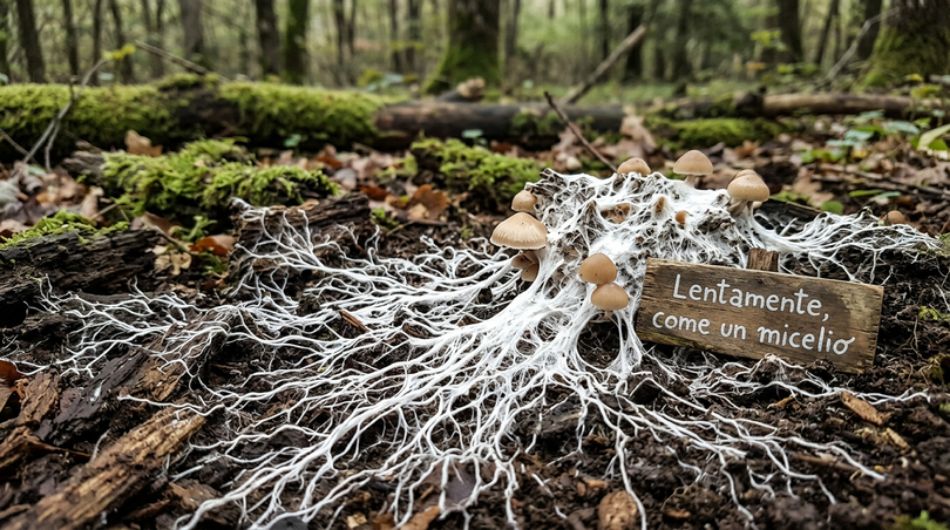
🌱 Imagine walking through a forest after a day of rain. The ground is damp, the smell of wet earth envelops you. Suddenly, at the foot of an old beech tree, you see a small light cap sprouting: it's mycelium in action. That silent creature, which many ignore or trample on, has a lot to teach you about how to face life's difficulties.
We humans are obsessed with speed. We want immediate results, instant healings, rapid successes. Yet, beneath our feet, there is an organism that has chosen the opposite path: the mushroom. Or rather, its underground network, the mycelium. This network can stretch for kilometers, live for centuries, and survive fires, floods, and famines. How does it do it? With a strategy called slow resilience.
In this article, we will explore what it means to be resilient like a mycelium. Not a muscular or explosive resilience, but a crawling, patient, interconnected resilience. You will discover why nature has hidden its greatest life lesson in the least expected place: in the darkness of the underground.
📖 In this article...
| What is mycelium? The network of life |
| Slow resilience: the invisible superpower |
| The 7 lessons of resilience from mycelium |
| Practical applications in daily life |
| Scientific studies and the neurobiology of patience |
| Common mistakes: what NOT to do (learning from mushrooms) |
| FAQ: Questions and answers on fungal resilience |
What is mycelium? The network of life that will change your perception of the world
To understand resilience, we must first get to know the main actor: the mycelium. When you think of a mushroom, you probably picture the cap and the stem. That is just the tip of the iceberg, the "fruit" of the organism. The real body, the one that lives, breathes, eats, and communicates, is underground.
Anatomy of the invisible
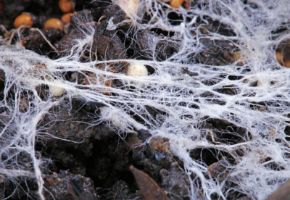
Mycelium is an intricate network of white, very thin filaments called hyphae. A single hypha is thinner than a human hair. But put together, they form a structure that can cover hectares of forest. In the Malheur National Forest in Oregon, a mycelium of Armillaria ostoyae was discovered that spans 965 hectares, with an estimated age between 2,000 and 8,000 years. A single organism.
What does mycelium do? It decomposes dead matter, creates symbioses (mycorrhizae) with tree roots, and communicates via chemical signals. A tree attacked by pests warns its neighbors through the hyphae of the mycelium.
Slow resilience: the invisible superpower
We live in the era of fast resilience. 5-minute tutorials, motivational pills. But mushrooms teach us that true resilience is the depth of preparation.
Exponential growth: the power of doing a little every day
Mycelium grows slowly, sometimes just a few centimeters a day. But it grows exponentially. Improving by 1% every day leads to a 37% improvement in a year. Resilience is not brute force, it is persistence.
The sleep of mycelium: the importance of latency
Fungi enter dormancy when conditions are unfavorable. They don't die, they wait. Conserving energy is a strategy. In our hyperactive culture, sometimes the most resilient thing to do is not to react.
The 7 lessons of resilience from mycelium
🔗 Lesson 1: the strength of the network (no one is an island)
Mycelium shares resources. The quality of relationships is the greatest predictor of happiness. Build your mycelial network: be generous, ask for help, repair bonds.
♻️ Lesson 2: turn waste into treasures (emotional saprophyte)
Saprophytic fungi live on dead matter. Create an "emotional compost": write down what that failure taught you. Use criticism as a substrate.
🐢 Lesson 3: exponential patience (small efforts, big results)
Mycelium explores before it consumes. Use the "probe and colonize" method to change careers, relationships, or skills.
🧪 Lesson 4: biochemical adaptability (change strategy, not goal)
Fungi produce different enzymes. If one diet doesn't work, change your approach. If therapy doesn't help, change the method.
🌑 Lesson 5: the power of invisibility
You don't have to show every battle. Work in depth, show only the results.
🌿 Lesson 6: total regeneration (if you cut a hypha, two grow back)
Every crisis can become a branching point. Post-traumatic growth (PTG): greater wisdom, empathy, strength.
⏳ Lesson 7: the art of not rushing (fungal times)
Replace arbitrary deadlines with real conditions. Not "in a year I will be happy" but "when I have these needs met".
Practical applications in daily life
| Exercise | Time required | Benefit |
|---|---|---|
| Emotional compost journal | 10 min/day | Transforms resentments into lessons |
| Mycelial map (draw your network) | 30 min | Increases sense of security |
| Scheduled dormancy day | 1 day | Reduces burnout |
| Probe and colonize: try 3 small hobbies | 6 hours total | Find a new passion |
| Rewrite a failure as "substrate" | 20 min | Cognitive restructuring |
| Walk in the woods looking for hyphae | 1 hour | Mindfulness |
| Strategic silence (don't talk about a project for 30 days) | 30 days | Reduces performance anxiety |
| Grow a small mushroom at home (Oyster mushroom kit) | 2 weeks | Experiential patience |
Scientific studies and the neurobiology of patience
Walter Mischel's marshmallow experiment showed that children who could wait had better school results and less stress. Patience trains the dorsolateral prefrontal cortex, while impatience hypertrophies the amygdala. The University of Leiden study confirmed that moderate stress (hormesis) enhances resilience in both fungi and humans.
Common mistakes: what NOT to do (learning from mushrooms)
- Mistake 1: wanting everything right now. Resilience is not bought, it is cultivated.
- Mistake 2: isolating yourself. Burning bridges weakens the mycelial network.
- Mistake 3: not accepting failure as a substrate. Shame blocks growth.
- Mistake 4: being rigid with enzymes: one method is not enough.
- Mistake 5: showing everything right away (fruiting too early). Build invisible foundations.
FAQ: questions and answers on fungal resilience
| Question | Answer (click to open) |
|---|---|
| 1. Can I really learn resilience from a mushroom? | ▶ Show answerYes, it is both a powerful metaphor and a real biological model (biomimicry). Fungi have adaptation and DNA repair mechanisms that can be translated into human behaviors. |
| 2. How long does it take to become resilient like a mycelium? | ▶ Show answerSome aspects take months, others years. But start today with a small hypha: 5 minutes of emotional compost. In a year, you will see the network. |
| 3. What if I don't have a "network" of people? | ▶ Show answerMycelium explores until it finds trees. Sign up for courses, volunteering, walking groups. Even just one person is a start, as are books and podcasts. |
| 4. Isn't dormancy just procrastinating? | ▶ Show answerNo. Dormancy is active: you monitor the conditions and act when they are favorable. Procrastination avoids out of fear. |
| 5. Can I apply these lessons at work? | ▶ Show answerYes. "Probe and colonize" for innovation, "fragmentation" to manage failures. Companies like Google and Patagonia study mycology to manage stress and creativity. |
| 6. What is the first practical step for today? | ▶ Show answerGo out and observe a mushroom, even in the city. Ask yourself: "What is it transforming? How can I apply this today?" Choose a lesson and apply it to a concrete problem. |
🌲 Conclusion: mycelium has no brain, yet it solves routing problems better than supercomputers. It has no eyes, but it finds food in the dark. If an organism without neurons is so resilient, imagine what you can do with your conscious mind. The next time you walk in a forest, gently dig under a mushroom: you will see the white filaments. There is your very own strength: hidden, patient, unstoppable.
⭐ Slowly, like a mycelium. Because slowness always beats haste.
This article was developed with the support of artificial intelligence and subsequently reviewed, corrected, and validated by the NaturNext.eu technical team, which guarantees its reliability and compliance with official sources.
The kingdom of fungi is a constantly evolving universe, with new scientific discoveries emerging every year about their extraordinary benefits for gut health and overall well-being. From now on, when you see a mushroom, you will no longer think only of its taste or appearance, but of all the therapeutic potential it holds within its fibers and bioactive compounds. ✉️ Stay connected - Subscribe to our newsletter to receive the latest studies on: Nature offers us extraordinary tools to take care of our health. Mushrooms, with their unique balance between nutrition and medicine, represent a fascinating frontier that we are only just beginning to explore. Keep following us to discover how these extraordinary organisms can transform your approach to wellness.Continue your journey into the world of mushrooms