



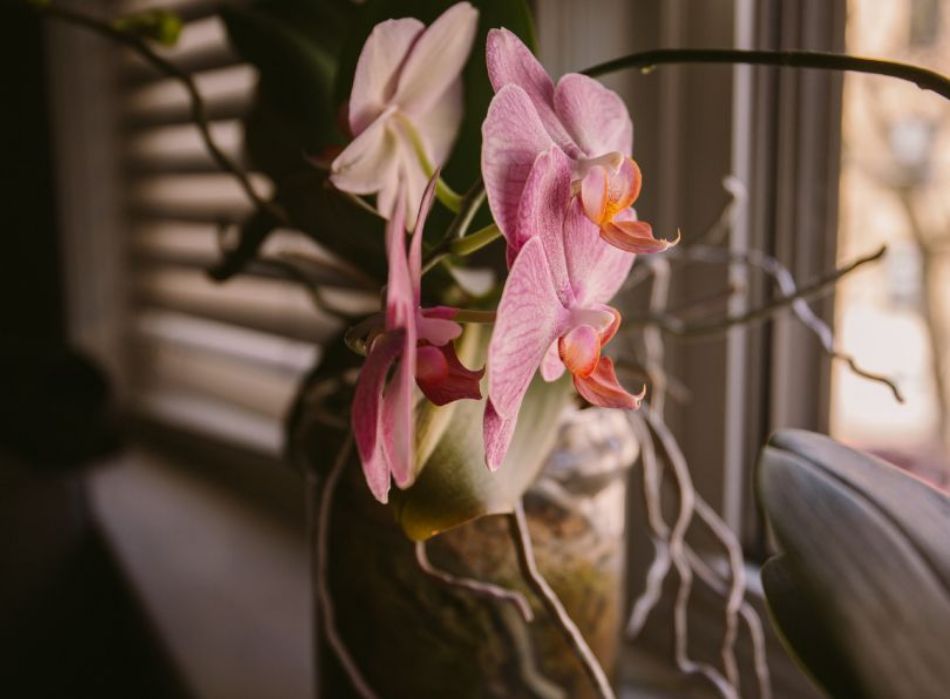
When discussing the relationship between orchids and fungi, we are not referring to a simple association, but to an absolute dependence. This symbiosis arises because orchid seeds are among the smallest in the plant kingdom: lacking endosperm, they contain no nutrient reserves and, to germinate, must be infected by a mycorrhizal fungus. This symbiosis, known as orchid mycorrhiza, represents a model of interspecific cooperation.
Today, we invite you to explore this extraordinary partnership between the plant and fungal worlds!
Orchids: why can’t they live without fungi?
The orchid seed is minuscule: it weighs on average 0.3 micrograms. Compared to a bean seed (500 mg), it is 1.6 million times lighter. This extreme reduction is an adaptation for wind dispersal (anemochory) and ensures the survival of numerous orchid species. The fungus colonizes the cells of the protocorm, supplying carbon, vitamins, and amino acids. Without this contribution, the seedling dies within days.
Seed size and nutrient reserve comparison
| Family/Species | Average weight (mg) | Endosperm | Fungal symbiosis | Seeds per capsule |
|---|---|---|---|---|
| Orchidaceae (Phalaenopsis) | 0.0003 | Absent | Obligate | 1,000,000 – 4,000,000 |
| Fabaceae (Phaseolus vulgaris) | 500.000 | Abundant | None | 4–10 |
| Poaceae (Triticum) | 35.000 | Present | Facultative | 20–50 |
| Pinaceae (Pinus) | 6.000 | Present (Megagametophyte) | Ectomycorrhizal | 50–100 |
The symbiotic fungi: who they are, how many, what they provide
Not all fungi can form symbiosis with orchids. Most belong to the phylum Basidiomycota, particularly the families Tulasnellaceae, Ceratobasidiaceae, and Sebacinaceae. Some Ascomycota also associate with specific orchid species. Over 400 fungal species are documented as partners, though actual diversity is likely far greater.
Specificity of the relationship: generalists vs. specialists
One of the most surprising botanical curiosities is that some orchids are generalists, associating with dozens of fungal species, while others are so specialized they depend on a single fungal species. For example, the subterranean Australian orchid Rhizanthella gardneri lives exclusively with Thanatephorus gardneri. Conversely, Ophrys and Orchis interact with multiple Tulasnella strains.
Orchid-fungus associations and specificity levels
| Orchid | Symbiotic fungus | Mycorrhiza type | Specificity |
|---|---|---|---|
| Rhizanthella gardneri | Thanatephorus gardneri | Orchidoid | Very high (monophagous) |
| Goodyera repens | Ceratobasidium cornigerum | Orchidoid | Medium |
| Ophrys insectifera | Tulasnella calospora | Orchidoid | Low (generalist) |
| Cattleya spp. | Ceratobasidium, Tulasnella | Orchidoid | Generalist |
| Neottia nidus-avis | Sebacina, Tulasnella | Mixotrophic/myco-heterotrophic | High |
Exchange mechanism: carbon, nitrogen, phosphorus
The fungus supplies organic carbon derived from decomposing organic matter or, in some cases, from nearby trees (via ectomycorrhizae). Fully myco-heterotrophic orchids like Neottia and Corallorhiza are entirely parasitic on the fungus, which in turn connects to tree roots—forming a complex common mycorrhizal network. Naturnext AI estimates that up to 85% of the carbon in some saprophytic orchids originates from fungal sources.
From birth to life: the fungus’s role in the protocorm
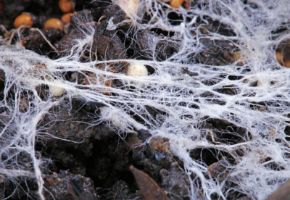
The critical moment occurs after pollination forms the seed. Wind-dispersed, it must land on a substrate hosting a compatible fungus. Here, controlled infection takes place: hyphae penetrate the seed cells, forming coiled structures (pelotons) inside cortical cells. The seedling, still lacking chlorophyll, becomes a protocorm and begins receiving nourishment from the fungus.
Dialogue before contact
Recent studies (source: New Phytologist, 2025) show that orchid seeds release signaling molecules—including flavonoids and strigolactones—that stimulate fungal growth and activate symbiosis-related genes. The fungus reciprocates with recognition factors. This dialogue is so precise that some fungal strains grow toward the seed from several centimeters away.
Orchid germination comparison: with vs. without symbiotic fungus
| Orchid species | Germination % with fungus | Germination % without fungus | Days to form protocorm |
|---|---|---|---|
| Dactylorhiza majalis | 78% | 0% | 18–25 |
| Platanthera bifolia | 65% | 0% | 20–30 |
| Serapias lingua | 82% | 0% | 15–20 |
| Vanilla planifolia | 45% (in vitro) | 0% | 30–45 |
Myco-heterotrophic orchids: when the plant becomes fungus-dependent
A group of orchids has completely lost chlorophyll and photosynthetic ability: the myco-heterotrophic orchids (formerly mislabeled "saprophytes"). A well-known example is the Neottia nidus-avis, the Bird’s Nest Orchid. These plants obtain all carbon from the fungus, which in turn acquires it from leaf litter or neighboring trees—effectively enabling carbon "theft."
The Evolutionary Paradox
Why would plants abandon photosynthesis? The answer lies in competition for light in dark forest understories: relying on fungi allows colonization of shaded habitats. However, this evolutionary path is nearly irreversible. Today, at least 235 fully myco-heterotrophic orchid species exist, many threatened due to dependence on a single fungal network.
Myco-heterotrophic orchids and fungal carbon sources
| Orchid | Habitat | Symbiotic fungus | Fungal carbon source |
|---|---|---|---|
| Neottia nidus-avis | Beech forests, moist woodlands | Sebacina incrustans | Ectomycorrhizae of beech |
| Corallorhiza trifida | Coniferous forests | Tomentella, Thelephora | Ectomycorrhizae of pine |
| Hexalectris spicata | North American forests | Sebacina | Broadleaf trees |
Harnessing symbiosis in the laboratory
For orchid growers, replicating this symbiosis in vitro is key to propagating these remarkable plants. Symbiotic germination techniques, developed in the 1920s, are now highly refined. Fungi are isolated from wild orchid roots, seeds are sown on agar-based media with the fungus, yielding thousands of plantlets. Without this method, many rare species could not be saved from extinction.
Co-cultivation protocols
Common culture media include oatmeal agar (OMA) and diluted Murashige-Skoog (MS). Sterile seeds contact the fungal inoculum; success rates range from 30% to 90%, depending on strain-species compatibility. Below is a summary of best practices:
Symbiotic germination efficacy across culture media
| Culture medium | Tested fungus | Orchid | Germination % | Time (weeks) |
|---|---|---|---|---|
| Oatmeal agar (OMA) | Tulasnella calospora | Dendrobium kingianum | 88% | 6 |
| MS/2 (sugar-free) | Ceratobasidium | Cymbidium spp. | 65% | 8 |
| Potato dextrose agar (PDA) | Epulorhiza repens | Spiranthes | 72% | 5 |
Fascinating orchid facts
The world of orchids is rich with scientific anecdotes. Some fungi alter flower morphology; certain orchids emit scents mimicking fungal pheromones. Here are more intriguing details:
- Longevity record: Protocorms of some temperate orchids can remain viable underground for years, nourished by the fungus while awaiting favorable conditions—up to 8 years documented;
- Seed size: The tiniest orchid seed belongs to Anaspectrum at 0.05 mm; to find a compatible fungus, it may travel kilometers;
- "Cheating" fungi: Some mycorrhizal fungi exploit the plant, extracting sugars without reciprocating. Orchids counter this by digesting pelotons when overexploited.
So many orchids… So many fungi!
Documented orchid species are numerous. Below is their estimated proportion relative to associated fungal diversity.
Estimated fungal diversity associated with orchids by continent
| Continent | No. orchid species | No. fungal species involved | Prevailing fungal genera |
|---|---|---|---|
| Tropical Asia | 8,000 | 550 | Tulasnella, Ceratobasidium |
| Central & South America | 10,000 | 700 | Tulasnella, Sebacina |
| Europe | 250 | 120 | Tulasnella, Thanatephorus |
| Africa | 2,500 | 200 | Ceratobasidium |
| Oceania | 1,200 | 180 | Tulasnella, Sebacina |
Orchid conservation: protecting the fungus means protecting the flower
Orchid conservation cannot succeed without preserving their symbiotic fungi. Many rewilding projects fail because orchids are reintroduced to soils where fungi have vanished due to fertilizers, fungicides, or soil compaction. This is why we at Naturnext consistently raise awareness about forest and ecosystem protection.
No Red List includes orchid symbiotic fungi, yet their decline is documented across Central Europe: in the Netherlands, 70% of Tulasnella populations have disappeared in 50 years due to intensive agriculture. Without these fungi, orchids like Ophrys cannot recolonize.
If, like us, you care deeply about protecting forests, ecosystems, and biodiversity—please share this article!
This article was developed with the support of artificial intelligence and subsequently reviewed, corrected, and validated by the NaturNext.eu technical team, which guarantees its reliability and compliance with official sources.
The fungal kingdom is a universe in constant evolution, with new scientific discoveries emerging yearly about their extraordinary benefits for gut health and overall well-being. From now on, when you see a fungus, you’ll think beyond its flavor or appearance—to the therapeutic potential held within its fibers and bioactive compounds. ✉️ Stay Connected – Subscribe to our newsletter for the latest research on: Nature offers extraordinary tools for nurturing our health. Fungi, with their unique balance of nutrition and medicine, represent a fascinating frontier we are only beginning to explore. Follow us to discover how these remarkable organisms can transform your approach to wellness.Continue your journey into the fungal world