



In the silent theater of the undergrowth, where the struggle for survival plays out on scales invisible to the human eye, there exists an organism that has transformed deception into a refined evolutionary strategy. It does not use gaudy colors to seduce, nor sugary nectar to reward its visitors. On the contrary, it emanates an intense, nauseating stench that recalls rotting flesh, and it does so with a single, precise objective: to attract flies. In a world where most fungi entrust their lineage to the wind, these organisms have chosen a different path, macabre and extraordinarily effective.
We are talking about stinkhorn fungi, or bad-smelling fungi, a family of species that includes the famous Phallus impudicus and the equally curious Clathrus archeri, known as "devil's fingers." Their story is an intertwining of sophisticated chemistry, evolutionary biology, and sensory deception that deserves to be told in every detail, because understanding these mechanisms is not merely an exercise in scientific curiosity, but a way to appreciate the complexity and adaptability of the fungal kingdom, a kingdom we too often relegate to a mere culinary ingredient or a dangerous toxin.
In this in-depth journey, we will explore the reasons for such a repugnant odor, the species that produce it, the biochemical mechanisms that make it possible, and the practical implications for those who, as cultivators, researchers, or simply enthusiasts, wish to approach this fascinating universe with new eyes and greater awareness.
In this article...
1. The anatomy of a deception: how the fungus builds its scented trap
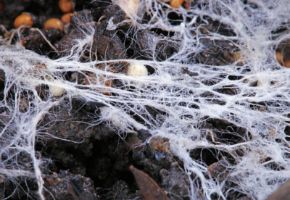
To fully understand the strategy of stinkhorns, it is necessary to start from a fundamental consideration: what we call a "fungus" is merely the temporary reproductive structure of a much larger and longer-lived organism. For most of the year, these fungi exist as mycelium, an intricate network of underground filaments that feeds on decomposing organic matter, such as dead wood, rotting leaves, and plant debris. The mycelium is the true body of the fungus, patient and invisible, waiting for optimal environmental conditions (heat, humidity, and nutrient availability) to give rise to what English speakers call the fruiting body.
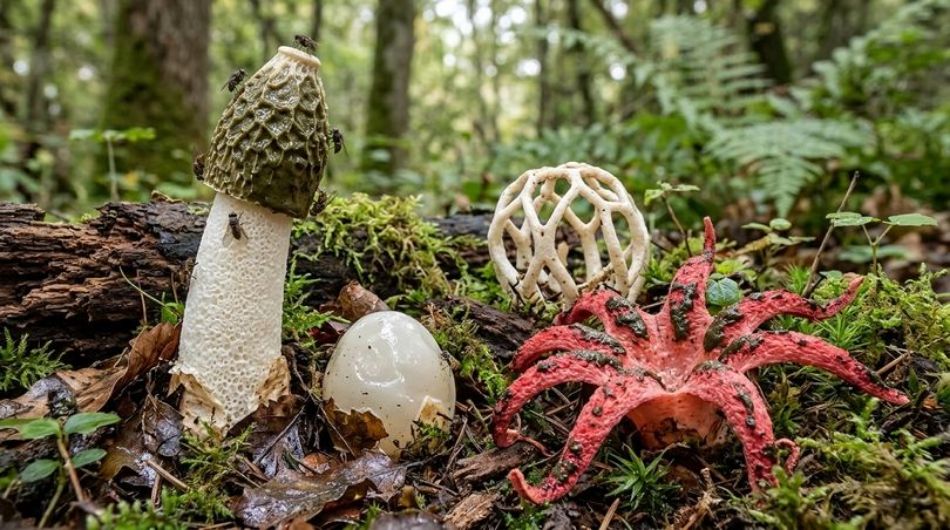
This is where the strategy of deception enters the scene. In species of the genus Phallus, such as Phallus impudicus, the fruiting body initially emerges from a whitish oval structure, sometimes called a "witch's egg," partially buried or hidden in the litter. This "egg" is a sort of protective capsule within which the mature form of the fungus is already developing. When conditions are favorable, the egg ruptures and the fungus extends upward with surprising speed: some species can grow up to six inches (about fifteen centimeters) in an hour, exerting enough force to pierce even asphalt.
This sudden, almost explosive growth is made possible by an internal hydraulic system, in which water is pumped into the fungus's cells, causing it to expand like a biological balloon. But the real wonder, and the heart of our story, lies in what happens at the top of this structure. In stinkhorn fungi, the upper part (the cap, to use an imprecise but useful term) is covered by a viscous, dense, foul-smelling substance called gleba. The gleba is not a simple coating: it is a true suspension of spores, millions and millions of tiny reproductive cells immersed in a gelatinous matrix. And it is precisely from this gleba that the nauseating odor that gives the family its name is released.
The gleba is the bait, the chemical call that convinces flies to land on the fungus, to feed on the sugary substance and, without knowing it, to load themselves with spores that they will then disperse everywhere. The entire architecture of the fungus, therefore, is functional to this purpose: the elongated shape and exposed top maximize the diffusion of the odor into the air, while the open or reticulated structure of some species, such as the lattice fungus, facilitates insect access. Nothing is left to chance in this evolutionary machine designed to deceive.
2. The chemistry of putrefaction: the volatile compounds that deceive flies
The smell of rotting meat emanating from these fungi is not the result of a single molecule, but of a complex cocktail of volatile compounds that, taken together, faithfully reproduce the olfactory profile of a decomposing corpse or animal excrement. An in-depth study conducted on Phallus impudicus revealed that the air surrounding the fungus contains as many as fifty-nine distinct volatile compounds, all contributing to that unmistakable and repugnant aroma.
Among these, the most important are sulfur compounds, such as dimethyl disulfide, which imitate the characteristic odor of putrefying animal tissues, rich in sulfur-containing amino acids such as methionine and cysteine. To these are added other molecules, such as phenol, cresol, and indole, which help evoke the smell of feces and decomposing organic matter. The presence of methanethiol and hydrogen sulfide (the classic smell of rotten eggs) has also been documented in other related species, such as Phallus impudicus observed in China, where it is called "zhū sūn" or "bamboo without a skirt". But why should a fungus evolve such sophisticated chemistry? The answer lies in the sensory biology of flies.
Necrophagous flies, such as blue bottle flies (Calliphora spp.) and green bottle flies (Lucilia spp.), are irresistibly attracted to these odors because their olfactory system is tuned to detect decomposing flesh as a source of nourishment and an oviposition site. For a fly, the smell of putrefaction means food and a safe place to lay eggs. The fungus exploits this innate programming: it emits the same chemical signal, but instead of a carcass it offers a sugary, nutrient-rich solution – the gleba – which the flies consume avidly.
The deception is all the more refined when one considers that the gleba also contains a laxative substance, which induces the flies to defecate rapidly, dispersing the spores near the fungus and thus increasing the chances of colonizing new substrates. It is a system of biological propaganda of astonishing precision, where organic chemistry becomes the language with which one species communicates with another, manipulating its behavior to its own advantage.
3. The protagonist species: from Phallus impudicus to Clathrus archeri
Although the strategy of olfactory deception is shared by several species, each has developed unique shapes and characteristics that make it recognizable and fascinating. The best-known and most-studied species is undoubtedly Phallus impudicus, whose Latin name ("shameless phallus") describes without mincing words its elongated morphology and its uninhibited display. This fungus, widespread in Europe and North America, has a white, hollow stalk supporting a conical cap covered with greenish, foul-smelling gleba. When the gleba is consumed by flies or exhausted, the cap appears yellowish-white, with a deeply reticulated surface reminiscent of a honeycomb or sponge. A close relative, Mutinus caninus, is smaller and thinner, with an appearance reminiscent of a finger or a small phallus, and it too emits an unpleasant odor to attract dipterans.
But the true visual star is Clathrus archeri, known as the "octopus fungus" or "devil's fingers." Native to Australia and Tasmania, it was accidentally introduced to Europe, North America, and Asia, probably through bales of wool or exotic plants, and today it can be encountered in Italian woods as well. At maturity, its fruiting body emerges from a whitish "egg" and opens into four to seven reddish, fleshy arms, initially united at the apex and then spread out, reminiscent of an octopus's tentacles. On the inner surface of these arms is the greenish, foul-smelling gleba, which attracts flies with the same effectiveness as Phallus.
Another noteworthy species is the lattice fungus (Ileodictyon cibarium or related species), which presents as a whitish reticulated structure, similar to a sphere or a cage, within which the gleba is exposed to the air and insects. The variety of forms is surprising, but the principle remains the same: every morphological detail is aimed at maximizing the exposure of the gleba and the diffusion of the odor, transforming the fungus into a chemical trap for flies. Knowing these species is not merely an exercise in taxonomy, but a way to recognize in the field the protagonists of this fascinating natural history and to appreciate the diversity of solutions that evolution has been able to elaborate starting from a single problem: ensuring the dispersal of spores in a competitive environment.
4. A dangerous relationship: the ecological role of flies
The relationship between stinkhorn fungi and flies is a classic example of mutualism, an ecological interaction in which both species benefit, albeit with an asymmetry of intent. From the fungus's point of view, flies are extraordinarily efficient dispersal vectors. While most fungi entrust their spores to the wind, with random and often limited dispersal, stinkhorns have "hired" specialized insects to transport their spores in a targeted way toward new substrates rich in decomposing organic matter. Flies, attracted by the odor, land on the gleba, consume it, and in doing so ingest and transport millions of spores on their legs and bodies.
When they fly away and land on another rotting trunk or a compost heap, they deposit the fungus's spores along with their excrement, and the spores thus find an ideal environment in which to germinate. From the flies' point of view, the benefit is more ambiguous: they obtain a sugary, nutritious meal, but they are deceived, because the fungus offers them neither a carcass on which to lay eggs nor true protein nourishment. However, the relationship is so ancient and consolidated that some fly species have become specialists of these fungi, so much so that their presence is often associated with that of stinkhorns. An interesting aspect is that the gleba contains laxative substances that accelerate the intestinal transit of flies, increasing the likelihood that spores are deposited near the fungus, in an area where conditions for mycelial growth are already favorable.
This level of behavioral manipulation is a striking example of how fungi, despite being relatively simple organisms from an anatomical point of view, can exert a profound influence on the behavior of much more complex animals. For cultivators and enthusiasts, understanding this dynamic is also essential for managing potential fly problems in cultivation environments: while flies are useful in nature, they can become a problem in greenhouses or at home, where they can contaminate substrates or infest crops. The lesson to be drawn is that every organism in an ecosystem is linked to others by a network of complex relationships, and that mushroom cultivation, even in a domestic environment, cannot disregard a knowledge of these dynamics.
5. Cultivating fungi: what to learn from stinkhorns for home cultivation
Although stinkhorns are not fungi commonly cultivated for food purposes (their odor makes them unsuitable for most domestic environments), studying their biology offers valuable lessons for anyone involved in mushroom cultivation, whether for passion or profession. First, their existence reminds us that fungi are extremely sensitive organisms to environmental conditions, particularly humidity, temperature, and the availability of organic substrate. The mycelium of stinkhorns develops in decomposing plant material, such as wood, leaves, and debris, and fruiting occurs only when conditions are optimal.
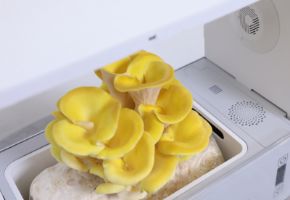
This principle applies to all fungal species: the key to success in cultivation is to replicate as faithfully as possible the natural habitat of the species one intends to cultivate. For those using a grow box like those developed by NaturNext, this means carefully monitoring temperature and humidity parameters, which are crucial for mycelial growth and for inducing fruiting.
A second lesson concerns insect management. In nature, flies are beneficial vectors for stinkhorns, but in a controlled cultivation environment they can become a problem, contaminating substrates with molds or parasites. Prevention is essential: maintaining a clean environment, using sterilized substrates, and controlling insect access are fundamental practices for those cultivating mushrooms at home or in a greenhouse.
A third aspect concerns understanding the life cycle of fungi. Many beginners focus exclusively on the visible phase (the fruiting body), neglecting that the health of the fungus depends on the health of the mycelium, which in turn depends on the quality of the substrate and environmental conditions. Stinkhorns, with their extremely rapid growth and their dependence on a rich, moist substrate, are an example of how substrate preparation and humidity management are decisive for successful cultivation. Finally, the story of stinkhorns is a warning against excessive simplification: not all fungi are the same, and strategies that work for one species may be ineffective for another.
Those approaching home cultivation would do well to start with robust and well-documented species, such as pleurotus (oyster mushrooms) or pioppini, and then explore, with caution and knowledge, more demanding species. Mushroom cultivation is an art that requires patience, observation, and respect for the rhythms of nature, and stinkhorns, with their bizarre biology, are there to remind us of this.
6. Curiosities, edibility, and safety: what every enthusiast must know
The story of stinkhorns is studded with curiosities that fascinate mycologists, researchers, and simple enthusiasts. One of the most surprising concerns edibility: despite the repugnant odor, some species of Phallus are considered edible in certain cultures, but only at the "egg" stage, before the fungus opens and develops the foul-smelling gleba. In China, Phallus impudicus is commercially cultivated and consumed as a delicacy, and the "egg" is said to have a flavor reminiscent of hazelnuts or radish. In Europe, however, collecting these fungi for food purposes is rare and discouraged, both because of the odor and because of the difficulty of safe identification.
The golden rule for any enthusiast is clear: never consume a wild mushroom without absolute certainty of its identification, and this applies even more so to species that, like stinkhorns, have an unusual appearance and can be confused with other non-edible species. Another curiosity concerns growth speed: Phallus impudicus can emerge from the ground and reach maturity in a few hours, a phenomenon that has intrigued scientists and naturalists for centuries. Its growth is so rapid that in some cases it has been possible to observe it in time-lapse, revealing a hydraulic mechanism of cellular expansion unique in the fungal kingdom.
From a safety standpoint, it is important to emphasize that stinkhorns are not considered poisonous to humans, but their odor can cause nausea and discomfort in particularly sensitive individuals, and the gleba can be irritating to the skin and mucous membranes. Moreover, the presence of flies around these fungi can represent a hygiene risk, since flies are known vectors of pathogenic microorganisms.
For those who encounter them during a walk in the woods, the advice is to observe them from a distance, without touching or smelling them directly, and to enjoy the spectacle of this extraordinary manifestation of nature. Finally, a note on geographic distribution: Clathrus archeri, native to Australia, has now naturalized in many regions of Europe, including Italy, where it has been reported in various locations. Its spread is an example of how human activities (trade, transport of goods, troop movements) can alter the distribution of fungal species, with unpredictable consequences for local ecosystems. Knowing these stories enriches our understanding of the natural world and makes us more aware and responsible observers.
7. Frequently asked questions (FAQ)
| Why do stinkhorn fungi smell of rotting meat? |
Show answerStinkhorns produce a cocktail of volatile compounds – including dimethyl disulfide, phenol, cresol, and indole – that imitate the smell of decomposing meat and feces. This chemical deception attracts flies, which are naturally attracted to these odors because they associate them with food and oviposition sites. Flies, feeding on the gleba, transport the fungus's spores to new environments. |
| Are stinkhorn fungi poisonous? |
Show answerNo, stinkhorns are not considered poisonous. However, their odor can cause nausea and the gleba can irritate the skin and mucous membranes. Some species, such as Phallus impudicus, are edible at the "egg" stage in certain cultures, but collection for food purposes is discouraged due to the difficulty of identification and the risks associated with consuming wild mushrooms. |
| Which mushroom species use this strategy? |
Show answerThe best-known species are Phallus impudicus (common stinkhorn), Mutinus caninus (dog stinkhorn), Clathrus archeri (octopus fungus or devil's fingers), and the lattice fungus (Ileodictyon spp.). All belong to the order Phallales and share the strategy of attracting flies with unpleasant odors to disperse their spores. |
| How can I recognize a stinkhorn fungus in nature? |
Show answerStinkhorns have very distinctive shapes: Phallus impudicus has a white stalk and a conical cap covered with greenish gleba; Clathrus archeri has reddish arms resembling tentacles; the lattice fungus has a whitish reticulated structure. The odor is unmistakable and is often perceived before the fungus is seen. They are found in damp woods, on rotting wood, or in soils rich in organic matter. |
8. Deception as a masterpiece of evolution
Having reached the end of this journey into the world of stinkhorns, it becomes clear how what at first glance seems merely a foul-smelling fungus is in reality one of the most refined biological machines that nature has ever designed. In a perfect balance between chemistry, anatomy, and animal behavior, species such as Phallus impudicus and Clathrus archeri have transformed an apparent handicap (the repugnant odor) into a decisive competitive advantage, succeeding where many other fungi fail: ensuring the survival of their lineage through a sensory deception as simple as it is ingenious.
Their story teaches us that in nature there are no "better" strategies in absolute terms, only solutions precisely adapted to a specific environment and interlocutor: flies, with their olfactory system programmed for decomposing flesh, have become involuntary allies of an organism that has learned to speak their chemical language. For mushroom enthusiasts, cultivators, and researchers, stinkhorns therefore represent an invitation to look beyond appearances and to cultivate a curiosity that does not stop at flavor or aesthetics, but that knows how to appreciate the ecological and biochemical complexity of every species.
Whether it is observing an octopus fungus in an autumn wood, designing a grow box for home cultivation, or simply marveling at such a sophisticated evolutionary mechanism, the lesson remains the same: nature is a book written in a language that is always worth learning to read, and fungi, with their secrets, continue to offer us some of the most fascinating and unexpected pages.
This article was developed with the support of artificial intelligence and subsequently reviewed, corrected, and validated by the technical team of NaturNext.eu, which guarantees its reliability and compliance with official sources.
The fungal kingdom is a universe in continuous evolution, with new scientific discoveries emerging every year about their extraordinary benefits for intestinal health and general well-being. From now on, when you see a mushroom, you will no longer think only of its flavor or appearance, but of all the therapeutic potential it holds within its fibers and bioactive compounds. ✉️ Stay connected - Subscribe to our newsletter to receive the latest studies on: Nature offers us extraordinary tools to take care of our health. Fungi, with their unique balance between nutrition and medicine, represent a fascinating frontier that we are only beginning to explore. Continue to follow us to discover how these extraordinary organisms can transform your approach to well-being.Continue your journey into the world of fungi