


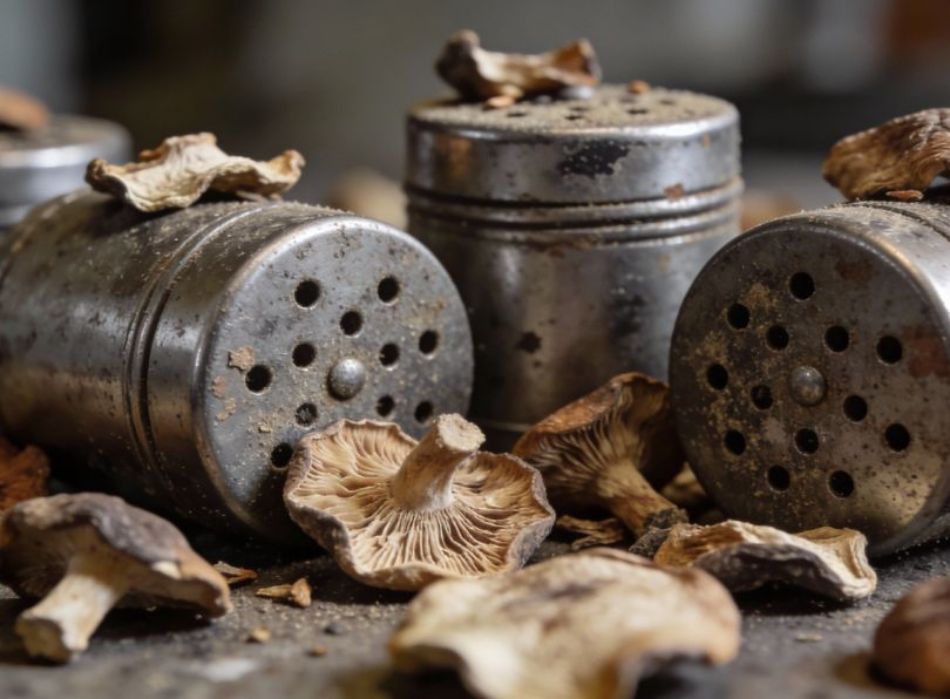
Today we want to introduce you to a useful tool for those who enjoy DIY: the grinder. In the vast and fascinating world of practical mycology—from foraging to home cultivation—there’s a crucial step that follows drying: reducing the mushroom into a more easily usable form. This is where this tool, often associated with other fields, proves extraordinarily useful for mushroom enthusiasts.
This article aims to explore in depth every aspect related to the use of grinders in processing dried mushrooms, analyzing their types, pros and cons, usage techniques, and implications for storage and consumption. Through a detailed and meticulous analysis, we’ll delve into a fundamental technical topic for anyone looking to optimize the fruits of their mycological passion.
After the thrilling phases of foraging in the woods or delicate cultivation on controlled substrates, and after the meticulous drying process that preserves mushrooms over time, both amateur mycologists and cultivators face a choice: how best to prepare their harvest for final use? While an intact, dried mushroom may be aesthetically pleasing, it poses practical limitations. Challenges include imprecise dosing, material inconsistency, and limited surface area for interaction—factors that often lead toward mechanical processing. In this context, the grinder (or mill) becomes highly relevant. This isn’t merely about “chopping up” mushrooms; it’s a deliberate technical decision that affects storage, bioavailability, and user experience. This introductory section lays the groundwork for understanding the importance of a step often overlooked in standard mycology guides. In everyday language, the term “grinder” is often associated with coffee or spices. However, in applied mycology and mushroom cultivation, the grinder takes on a specific and technical meaning. A grinder is defined as any mechanical device designed to reduce dry, solid materials into finer particles through the action of rotating blades, abrasive wheels, or pressure-based mechanisms. For dried mushrooms—which are brittle and woody yet fibrous—the grinder breaks down the hyphae and fruiting body tissues into controlled-size fragments. The core principle is impact and cutting fragmentation, transforming dehydrated fruiting bodies into either a powder or uniform small pieces. The type of grinder chosen directly determines the final particle size (granulometry), a critical parameter for subsequent uses. To fully understand the interaction between the tool and the mushroom, it’s essential to know the key parts of a grinder. The grinding chamber, typically made of metal, ceramic, or high-grade food-safe plastic, is where the transformation occurs. Inside it, blades—central to the device’s function—rotate. These blades can be made of stainless steel (often tempered to retain sharpness) or ceramic, a premium material that doesn’t oxidize or impart flavors. An airtight closure mechanism, often bayonet-style or screw-type, ensures powder doesn’t escape during operation. Higher-end grinders may also include interchangeable screens or magnetic systems that separate ultra-fine powder from coarser pieces, enabling dual collection: the top lid usually catches the finest powder, while the main chamber holds larger fragments. The market offers a range of grinders, each with distinct features, costs, and specific applications. The choice isn’t trivial and should be guided by objective criteria such as processing volume, desired granulometry, ease of cleaning, and, not least, the available budget. An occasional forager’s needs differ significantly from those of a cultivator regularly processing large quantities of dried mushrooms. This chapter provides a detailed taxonomy of the main grinder families, analyzing their strengths, weaknesses, and suitability for mycological purposes—from humble manual mills to sophisticated multi-blade electric grinders. Manual grinders represent the most basic and widespread type. They operate via the user’s physical effort, turning a crank or rotating a top section. Inside, two or more blades mounted on a central shaft crush the contents. Their main advantage lies in the user’s total process control: you can stop at any moment to check consistency, preventing over-processing and minimizing heat buildup from friction that could degrade heat-sensitive compounds. Manual grinding is silent, energy-independent, and fosters an almost artisanal connection with the material. However, it requires time and physical effort—especially with large batches or particularly tough dried mushrooms. Ideal for small batches, manual grinders suit those who value slowness and precision. For large-scale cultivators or those seeking time efficiency, electric grinders are ideal. Powered by electricity or batteries, these devices house a motor that spins blades at high speed. Crucial parameters include power (measured in watts) and rotational speed (RPM). A powerful motor (above 150W) with high RPM can powder even slightly under-dried or highly fibrous mushrooms in seconds. The clear advantage is speed and consistent processing of large quantities. The downside is reduced control over final particle size (unless equipped with a timer or variable speed) and the risk of overheating during prolonged operation. Cleaning can also be more complex, especially in non-disassemblable models. The choice of blade and chamber material isn’t merely aesthetic—it affects durability, hygiene, and final product quality. Stainless or hardened surgical-grade steel blades are extremely hard, stay sharp longer, and resist corrosion. They’re standard in most manual and electric grinders. Ceramic blades, however, offer distinct advantages for mushroom enthusiasts. First, ceramic is inert: it doesn’t react with mushroom compounds, transfer metal, or alter flavor or chemical profiles—crucial for those using mushrooms for microscopic study or preparations requiring chemical purity. Second, ceramic doesn’t oxidize, even with slightly moist mushrooms. The main drawback is fragility: a fall can shatter ceramic blades, whereas steel might only bend. Beyond the grinding mechanism, consider how powder is collected. Basic models require unscrewing and emptying. Advanced designs integrate smart collection systems. Gravity grinders (“shakers”) feature an upper chamber for mushroom pieces and a lower chamber where powder falls by gravity, separated by a screen. Simply shaking the device sifts the ground material. Other models include small removable drawers or trays as collectors. These aren’t just luxuries: they efficiently separate ultra-fine powder (which tends to become airborne and hard to handle) from coarser fragments, which can be re-ground. For mycologists needing varied granulometries—e.g., fine powder for capsules and coarser granules for tinctures—these grinders are indispensable. Timing in grinder use isn’t arbitrary. Grinding too early or too late can compromise final product quality. This chapter outlines the ideal workflow—from fresh harvest to ready-to-use powder—highlighting the critical point when the grinder should be deployed. The golden rule is simple: grinders should only be used on fully dried mushrooms. We’ll explore why this rule matters, the consequences of grinding partially moist mushrooms, and best practices for material preparation. Before approaching the grinder, mushrooms must pass the drying test. “Complete drying” means more than crispness—it requires a moisture content below 10–12%, preventing mold growth and enzymatic degradation. Under-dried mushrooms are gummy and plastic-like; they clump under grinder blades, forming hard-to-separate masses that can clog mechanisms and promote mold in the powder itself. Using an electric dehydrator with temperature control (40–50°C) is the most reliable method to ensure this result. Only then does the mushroom structure become brittle enough for clean, efficient fragmentation. A frequently overlooked but critical step is stabilization. Right after drying, mushrooms may still harbor unevenly distributed residual moisture. It’s best practice to place fully dried mushrooms in airtight glass jars for 24–48 hours. During this time, any remaining moisture equilibrates throughout the batch. If condensation appears on jar walls, mushrooms must return to the dehydrator. This simple step prevents post-grinding surprises and ensures long-term powder stability. Cultivators often ask: is it better to store whole dried mushrooms and grind as needed, or grind the entire harvest and store the powder? The answer depends on goals. Whole mushrooms better preserve volatile compounds and organoleptic qualities due to reduced oxygen exposure. The whole form offers maximum flexibility: later decisions can be made on using whole pieces, fragments, or powder. On the other hand, pre-ground powder is exceptionally convenient for daily use or standardized preparations. The downside is that powder, with its vastly increased surface area, is far more susceptible to oxidation and degradation unless stored optimally (in dark glass jars, vacuum-sealed, and frozen). For those who consume their harvest quickly, powder is convenient. For long-term archival storage, whole mushrooms are preferable. Let’s now address the core question: what concrete benefits does investing in a quality grinder—and integrating it into your workflow—offer? Advantages span from pure science to daily practice, efficiency, and safety. This chapter examines each benefit, providing a solid rationale for adopting this practice. A major challenge with whole dried mushrooms is their inherent variability. A cap and stem from the same mushroom may differ slightly in density and composition. Using a whole piece results in approximate dosing. The grinder elegantly and thoroughly solves this issue. Grinding an entire batch performs “homogenization”—deep mechanical blending. The resulting powder is homogeneous: every single gram has a statistically identical composition to any other gram from the same batch. This is essential for mycologists conducting experiments, cultivators selling mushroom-based products (where consistency is both legally and ethically required), and enthusiasts seeking controlled, repeatable experiences. Standardization is the foundation of scientific rigor and safe mushroom use. Powdering exponentially increases the material’s total exposed surface area. This physical principle has profound practical consequences. For those preparing tinctures, alcohol-based, or hydroalcoholic extracts, fine powder enables faster, more complete extraction of active compounds, as solvents penetrate particles more easily. The same applies to teas and decoctions: greater surface area enhances compound release into water. From a potential bioavailability standpoint, if mushrooms are ingested, fine powder is more easily broken down by digestive enzymes than whole fibrous pieces, possibly facilitating the absorption of certain compounds. This physical-chemical advantage translates directly into practical efficiency. Whole dried mushrooms—especially those with long stems and wide caps—are bulky, requiring large containers and significant storage space. Once powdered, the same quantity occupies a fraction of the original volume. This allows storing larger harvests in compact containers: smaller glass jars, vacuum-sealed bags, or freezer boxes. For serial producers or avid collectors, this logistical advantage is significant. Additionally, properly pressed, air-free powder is less prone to mechanical damage during storage (whole mushrooms can crumble from impact). Finally, the most immediate advantage: practicality. Mushroom powder is incredibly versatile. It can be easily measured with a teaspoon and incorporated into sauces, soups, bread or pasta doughs without visible pieces, yet still deliver full umami flavor. It can be pressed into vegetarian capsules for discreet, precise dosing. It can be uniformly blended with other powders (spices, other mushroom species) to create custom blends. This ease of use encourages more regular and creative consumption of one’s harvest, inspiring enthusiasts to experiment with new recipes and preparations that would be more laborious or less effective with whole mushrooms. No tool is without drawbacks or contexts where it’s ill-advised. A thorough discussion must address the disadvantages and potential issues of using grinders for mushrooms. Understanding these aspects enables informed decisions and strategies to mitigate problems—turning disadvantages into manageable considerations. As noted, exponentially increased surface area is a double-edged sword. While it aids extraction, it also exposes far more mushroom compounds to atmospheric oxygen, light, and humidity. Many active compounds, alkaloids, terpenes, and aromatic molecules in mushrooms are oxidation-sensitive. Poorly stored powder (in open, transparent jars at room temperature) will lose organoleptic properties—and potentially efficacy—much faster than whole mushrooms. This isn’t an insurmountable flaw but a constraint requiring meticulous storage. Risk mitigation involves using dark glass (or storing in darkness), airtight containers, preferably vacuum-sealed. For long-term archival storage, freezing vacuum-sealed powder is optimal. The grinding process itself—especially if aggressive and prolonged—can cause slight material heating due to friction. Even modest heat may promote volatilization and degradation of delicate aromatic molecules that contribute to the complex scent of dried mushrooms. Moreover, cell rupture may release enzymes that, if not fully inactivated by drying, could trigger enzymatic browning reactions, altering powder color. To best preserve organoleptic profiles, use manual or low-speed electric grinders, perform brief, intermittent grinding cycles, and let the device cool between runs. A grinder—especially models with complex mechanisms, multiple blades, and collection trays—is a difficult tool to clean thoroughly. Fine powder particles lodge in every crevice, under seals, and in gears. Using the same grinder for different mushroom species or other materials (spices, coffee) risks cross-contamination. For purist mycologists studying individual species, this is unacceptable. Cleaning requires specific tools: soft brushes, compressed air jets, and sometimes full disassembly. Non-porous materials like ceramic and food-grade stainless steel are easier to clean. Risk mitigation involves dedicating grinders to specific species or adopting rigorous post-use cleaning protocols. A quality grinder—especially advanced electric or ceramic models—represents a significant financial investment. For occasional hobbyists, it may not be justified. Additionally, optimal use requires some experience: understanding chamber loading limits (never more than 2/3 full), grinding duration, particle size adjustment, and disassembly/cleaning procedures. There’s a small learning curve. Common beginner mistakes—overfilling or over-grinding—can yield disappointing results or even damage the device. The solution is to start with small batches, experiment, and carefully read your device’s instruction manual. Beyond practical aspects, grinder use intersects with subtler issues tied to research and enthusiast-driven empirical knowledge. This chapter gathers curiosities, available research data, and advanced insights that enrich the discussion, revealing how this seemingly simple practice opens doors to broader reflections. There’s no universal powder. Ideal particle size (granulometry) varies by intended use. For encapsulation in standard gelatin or vegetarian capsules (e.g., size 00), ultra-fine, sifted powder is required to ensure dense, uniform filling and prevent clogging manual capsule fillers. For alcoholic tinctures, a medium granulometry (similar to coarse salt) is often preferred, allowing good solvent flow during percolation without forming an overly compact “mash.” In culinary applications like soups and sauces, fine powder disperses better, while slightly coarser granules offer pleasant texture when used raw. Some high-end grinders allow fineness adjustment by changing blades or grinding-wheel spacing. Knowing your end goal guides tool selection and technique. While modern grinders are industrial products, the concept of powdering dried mushrooms is ancient. In various ethnomycological traditions, mushrooms were pounded in stone or wooden mortars to create powders for rituals, medicines, or seasonings. The mortar-and-pestle action, though primitive, served the same purpose as rotary grinders: homogenization and increased surface area. Studying these ancient tools offers insights: for instance, certain mortars were made from materials believed to positively interact with mushrooms. The electric grinder is thus merely the latest evolution of a practical need humans have felt for millennia in their relationship with fungi. Scientific literature specifically comparing the stability of medicinal or edible mushrooms in powdered versus whole form remains limited. However, related research on medicinal herbs provides guidance. Studies on herbs like echinacea or turmeric clearly show that powdered forms, under identical storage conditions, degrade faster due to increased oxygen and light exposure. Yet these same studies highlight that, when stored optimally (vacuum-sealed, nitrogen-flushed, in darkness and cold), powder stability can match that of whole material. The key isn’t the form itself, but the rigor of the accompanying storage protocol. For serious mycologists, investing in quality storage (vacuum jars, airtight zipper bags, desiccant packs) is as important as investing in a quality grinder. The topic of grinders fits into a broader context of knowledge about mushroom cultivation, drying, and storage. It emerges as a highly valuable practice for anyone approaching mycology with seriousness, precision, and pragmatism. It’s not a mere accessory but a tool enabling homogenization, standardization, efficiency, and versatility. Grinder selection should be carefully considered based on specific needs—volume, desired granulometry, and budget. The tangible benefits—precise dosing, ease of use, and optimized preparations—must be balanced with conscious management of oxidation risks and a commitment to proper final-product storage. Integrating this step into your workflow elevates your mycological practice from amateur to professional and mindful, fully honoring the precious product of your labor or natural exploration. This article was developed with the support of artificial intelligence and subsequently reviewed, corrected, and validated by the NaturNext.eu technical team, which guarantees its reliability and compliance with official sources. The fungal kingdom is a universe of constant evolution, with new scientific discoveries emerging each year about their extraordinary benefits for gut health and overall well-being. From now on, when you see a mushroom, you’ll no longer think only of its taste or appearance—but of the full therapeutic potential held within its fibers and bioactive compounds. ✉️ Stay Connected – Subscribe to our newsletter to receive the latest research on: Nature offers extraordinary tools for caring for our health. Mushrooms, with their unique balance of nutrition and medicine, represent a fascinating frontier we are only beginning to explore. Keep following us to discover how these remarkable organisms can transform your approach to wellness. Grinder: introduction to post-harvest processing
What is a grinder? Definition and operating principle in a mycological context
Anatomy of a mushroom grinder: essential product-contact components
Complete overview of grinder types available to mycologists and cultivators
Manual grinders: tradition, control, and simplicity
Electric grinders: power, speed, and uniformity for large volumes
Ceramic vs. steel grinders
Gravity grinders vs. grinders with collection trays: powder collection systems compared
The ideal moment: when to use a grinder in post-cultivation and post-harvest processing
Complete drying: the essential prerequisite for effective grinding
From Dehydrator to Jar: The Stabilization Period Before Grinding
Grind before or after storage? Pros and cons of both strategies
Why use a grinder? Multiple benefits for mycologists and cultivators
Homogeneity and standardization: the key to precise, repeatable dosing
Increased surface area: implications for extractions, preparations, and bioavailability
Efficient storage and space savings: the mycologist’s logistics
Convenience and versatility in culinary and non-culinary preparations
Disadvantages and challenges: when a grinder isn’t the best choice
Risk of oxidation and accelerated degradation: the critical role of storage
Loss of volatile compounds and organoleptic alterations
Cleaning challenges and cross-contamination risk
Initial investment and learning curve
Grinder: technical insights and curiosities
Optimal granulometry for different uses: a practical guide
The grinder in the history of mycology and ethnomycology
Research on compound stability in powder vs. whole form: what does science say?
Grinder: an essential tool and step for the professional cultivator
Continue your journey into the world of mushrooms