



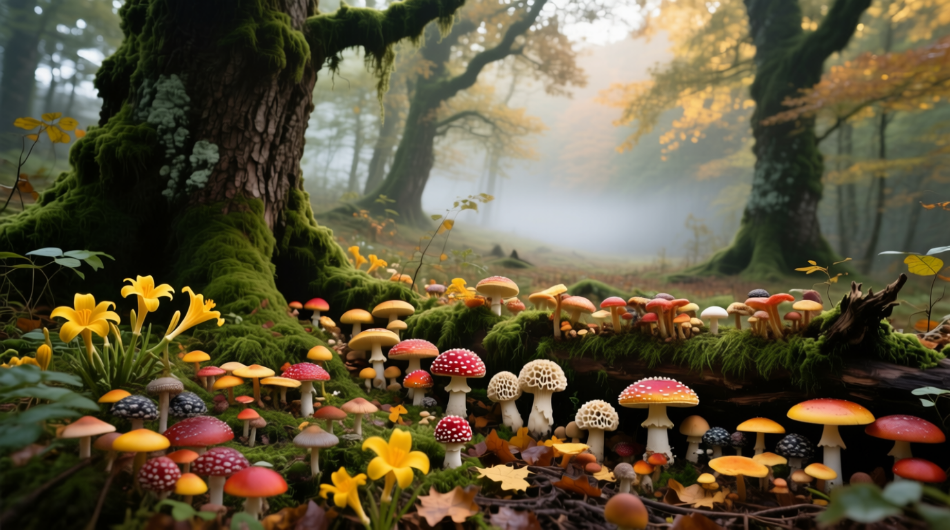
Italy, with its extraordinary variety of forest ecosystems, represents one of the richest and most interesting mycological basins in Europe. The search for fungal richness is not just a passion for thousands of foragers, but a true ecological study that allows us to understand the health of our woods. This article aims to dissect, in an extremely detailed and technical manner, the concept of richness in Italian mycological forests, providing a mental and scientific map of the most productive mushroom habitats Italy.
We will analyze the biogeographic, climatic, and pedological factors that make certain woods with more mushrooms true sanctuaries of biodiversity, supporting every statement with data, tables, and specific studies. An indispensable guide for the mycologist, the mushroom cultivator, and the simple enthusiast who wants to deepen their knowledge of the fungi kingdom in our country.
Before delving into the geography of mushrooms, it is essential to define what is meant by richness in mycology. This term does not simply refer to the abundance of fruiting bodies in an area, but to a more complex and articulated concept that includes specific biodiversity, fungal biomass, and fruiting frequency. In this chapter, we will explore the scientific parameters used to quantify this richness and why it is such a precious ecological indicator for assessing the health status of a forest ecosystem. Specific richness is the number of mushroom species present in a given habitat. In Italy, it is estimated that there are over 15,000 macromycete species, but only a fraction of these are regularly fruiting and visible. The most diversified mushroom habitats Italy can host, in a few hundred hectares, several hundred different species. Mycological biodiversity is not uniform and depends on a complex interaction of factors. One wood might be very rich in porcini (Boletus edulis and the edulis group) but poor in other species, while another might have an incredible variety of milk caps, russulas, and amanitas, albeit with less abundance of the most sought-after species. The true richness lies precisely in this diversity, which guarantees stability to the ecosystem and continuous scientific interest. In addition to species count, richness is measured by quantifying the fungal biomass produced per hectare per year. Studies conducted in high-trunk mycological forests have recorded productions ranging from 50 to over 500 kg of epigeous mushrooms per hectare annually. Fruiting frequency is equally important: some woods with more mushrooms are able to produce multiple times during the year, unlike others that have a very narrow main season. The following table, based on average data collected from university studies, illustrates these differences in three macro-areas. The distribution of mushrooms is not random. The richness of a wood is the direct result of very specific environmental conditions. In this chapter, we will analyze in detail the three ecological pillars that govern the productivity of our woods with more mushrooms: soil characteristics, microclimate, and symbiotic relationships with plants. Understanding these mechanisms is the first step to successfully identifying the most promising mushroom habitats Italy. Soil is much more than just a support for trees; it is a living and dynamic ecosystem. Its chemical-physical composition is decisive for fungal richness. Well-aerated soils, with good drainage but capable of retaining a certain degree of moisture, are generally the best. pH is a crucial factor: most symbiotic (mycorrhizal) fungi prefer sub-acid to neutral soils (pH 5.5 - 7.0). Woods with more mushrooms of porcini, for example, are often associated with siliceous soils or those derived from volcanic rocks, rich in minerals like potassium. Conversely, excessively calcareous soils can limit the growth of some prized species. The presence of a thick, well-structured layer of humus, derived from the slow decomposition of litter, provides not only nutrients but also an ideal microhabitat for the mycelium. Climate plays an even more evident role than soil in determining seasonal richness. Rain is the trigger that initiates fruiting, but a downpour is not enough. A good mushroom season requires constant and well-distributed rainfall, followed by periods of high atmospheric humidity and mild temperatures. Temperature variations between day and night are often a positive factor, as they favor condensation and keep the substrate moist. This is why north-facing wooded slopes, which enjoy less direct sunlight and therefore less evaporation, are often among the most productive mushroom habitats Italy. Mycological forests at high altitudes, for example, fruit mainly after the snow melts, when the soil is saturated with water and temperatures begin to rise. The heart of richness in temperate forests is mycorrhizal symbiosis. Over 80% of forest plants establish mutual exchange relationships with soil fungi. The fungus, with its network of hyphae, extends the root absorption capacity of the plant hundreds of times, providing water and minerals. In return, the host plant gives the fungus sugars and other organic compounds produced through photosynthesis. This alliance is so efficient that forests with a high rate of arboreal biodiversity tend to have a correspondingly high fungal richness. The map of mushroom habitats Italy therefore closely follows the map of plant associations. Beech forests, chestnut groves, oak woods, and spruce forests are the emblematic environments of this productive collaboration. We now arrive at the heart of the article: the detailed map of the richest mushroom habitats Italy. We will traverse the boot from north to south, including the islands, analyzing for each macro-area the most productive forest formations, the emblematic species, and the best periods for harvesting. This richness is not uniform, but follows precise biogeographic logics that we will try to illustrate in maximum detail. The Italian Alps, from Piedmont to Friuli-Venezia Giulia, host some of the most famous and productive mycological forests in Europe. Here, richness is linked above all to conifers (spruce, silver fir, larch) and beech. Mature fir forests, with soils rich in humus and a cool, humid microclimate, are paradise for the penny bun (Boletus edulis), the bronze bolete (Boletus aereus), the pine bolete (Boletus pinophilus), and the chanterelle (Cantharellus cibarius). Beech forests, especially those at medium mountain altitudes, are equally generous, offering besides porcini a myriad of other species like russulas and the parasol mushroom (Macrolepiota procera). The following table summarizes the main associations. Moving south, the Apennines offer a diversified mycological panorama. Richness here is often associated with mixed oak woods and, above all, chestnut groves. The sweet chestnut (Castanea sativa) is an extraordinarily generous tree for symbiotic fungi. The woods with more mushrooms of the Tuscan-Emilian Apennines, Marche, and Umbria are often abandoned or centuries-old fruit chestnut groves, where it is possible to find porcini in abundance, but also the excellent Caesar's mushroom (Amanita caesarea) and numerous species of black trumpet (Craterellus cornucopioides). Turkey oak forests, with their deep soil, are another hotspot, especially for the summer bolete (Boletus aestivalis). Often underestimated, the mycological richness of the Mediterranean is instead peculiar and of great interest. The mushroom habitats Italy of the south and the islands are dominated by holm oak forests, forests of stone pine and Aleppo pine, and high maquis. The season here is shifted towards late autumn and winter, awaiting the first significant rains. Coastal pine forests are the realm of the saffron milk cap (Lactarius deliciosus), while in holm oak forests it is possible to find thermophilic species like the bronze bolete (Boletus aereus), which finds its optimal habitat here, and various species of chanterelles. The cork oak forests of Sardinia and Sicily are unique ecosystems, whose fungal richness is still largely to be studied and cataloged. For a specific database on the Mediterranean mycoflora, the Acta Fungorum project represents an online resource of the highest quality. In this chapter, we enter the heart of scientific research, presenting aggregated data, statistics, and results of long-term studies that quantify the richness of Italian mycological forests. With numbers in hand, it will be possible to get a concrete idea of the productive potential of our woods and the ongoing trends, also in relation to climate change. A study coordinated by several Italian universities attempted to estimate the annual production of spontaneous epigeous mushrooms at a regional level. The data, although they should be taken as indicative due to interannual variability, paint a fascinating picture. The Alpine biogeographic region confirms itself as the most productive in terms of overall biomass, followed by the Apennine region. The Mediterranean region, although with lower absolute numbers, boasts a production very concentrated in specific ecosystems, such as chestnut groves and coastal pine forests. It is important to note that biomass does not always coincide with specific richness: one wood can produce many kg of a few commercial species, while another can produce less biomass but with a much wider diversity of species. The most recent research is beginning to highlight the consequences of climate change on the richness of our woods. The increase in average temperatures, the reduction in summer precipitation, and the increase in the frequency of extreme weather events (like cloudbursts) are altering fruiting cycles. In some areas, an anticipation of the autumn season is observed, in others a general reduction in the biomass produced, especially for species more sensitive to drought like porcini. Conversely, more thermophilic or drought-resistant species might expand their range. Monitoring these changes is crucial not only for foragers but for the sustainable management of our mycological forests. The richness of Italian mycological forests is an invaluable heritage, the result of millennia of evolution and intricate ecological relationships. Woods with more mushrooms are not just a natural pantry, but living laboratories of biodiversity and indicators of planetary health. Knowing, respecting, and preserving these mushroom habitats Italy is a duty for all enthusiasts. Responsible harvesting, respect for local regulations, and the promotion of a mycological culture based on science and sustainability are the only ways to ensure that this extraordinary richness continues to fruit for future generations. This article was produced with the support of artificial intelligence; it has therefore been verified, corrected, and validated by the NaturNext.eu technical team, ensuring its reliability and compliance with official sources. The kingdom of fungi is a universe in continuous evolution, with new scientific discoveries emerging every year about their extraordinary benefits for gut health and overall well-being. From now on, when you see a mushroom, you will no longer think only of its taste or appearance, but of all the therapeutic potential it holds in its fibers and its bioactive compounds. ✉️ Stay Connected - Subscribe to our newsletter to receive the latest studies on: Nature offers us extraordinary tools to take care of our health. Mushrooms, with their unique balance between nutrition and medicine, represent a fascinating frontier that we are only beginning to explore. Continue to follow us to discover how these extraordinary organisms can transform your approach to well-being.Fungal richness: what it is and how it's measured
Definition of specific richness and mycological biodiversity
Measurement parameters: biomass and fruiting frequency
Geographic area Average annual biomass (kg/hectare) Average number of species recorded Main fruiting seasons Central-Eastern Alps (beech and fir forests) 150 - 400 180 - 250 Late spring, summer, early autumn Tuscan-Emilian Apennines (oak-chestnut woods) 100 - 300 150 - 220 Autumn Mediterranean forests (holm oak and pine forests) 50 - 150 80 - 150 Autumn-Winter (following rains) The factors determining richness: soil, climate, and symbiosis
The soil: a world to discover under our feet
Climate and microclimate: the importance of rain, temperature, and humidity
Mycorrhizal symbiosis: the secret relationship that fuels richness
The map of richness: a journey through italian mycological regions
The Alpine arc: the kingdom of Porcini and Chanterelles
Forest type Dominant tree species Emblematic fungal species Peak period Subalpine Spruce Forest Norway Spruce (Picea abies) Boletus edulis, Lactarius deliciosus, Cantharellus cibarius August - October Mountain Beech Forest Beech (Fagus sylvatica) Boletus edulis, Amanita caesarea, Russula cyanoxantha September - November Larch-Swiss Pine Forest Larch (Larix decidua) and Swiss Pine (Pinus cembra) Suillus grevillei, Lactarius deliciosus July - September The northern and central Apennines: the middle earth of mycology
The south and the islands: the hidden richness of the Mediterranean
Data, statistics, and research on Italian fungal production
Biomass estimates by biogeographic region
The impact of climate change on fungal richness
Forest richness: preserving it for the future
Continue your journey into the world of mushrooms