


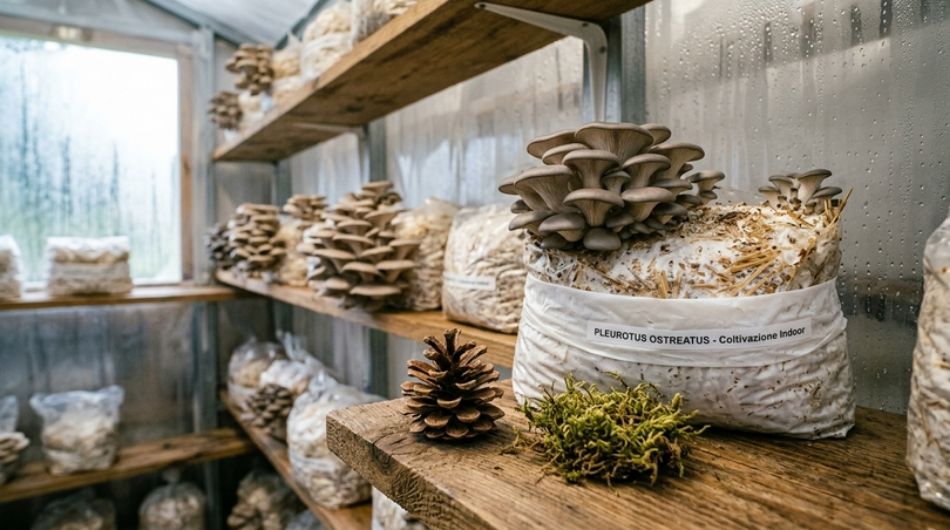
There is a moment, in the life of anyone who cultivates mushrooms, when suspicion becomes certainty: the hygrometer is lying. The display says 92% relative humidity, the substrate is visibly dry, primordia abort one after another, and the caps crack like earth in a drought. Or the opposite happens: the instrument reads 78%, but water is dripping down the walls of the box and the mycelium is drowning in a bacterial film. It is not a faulty instrument. It is hysteresis: the phenomenon whereby a physical system responds not only to how much a quantity is worth, but also to where it comes from, that is, to the history it went through to get there.
Hysteresis is probably the most underestimated concept in all of applied mycology. It is studied with great rigor in electrical engineering, where the magnetic cycle of iron is exam material; it is measured in metrology, where hysteresis error is a mandatory item in the calibration certificate; it is discussed in economics, respiratory physiology, and materials science. But when it comes to mushrooms, hysteresis disappears from the manuals, replaced by formulas like "maintain 90% humidity". That number, alone, means almost nothing, because the substrate, the air, the fruiting body, and the sensor measuring them are all hysteretic systems: each with its own memory, its own delay, its own loop.
This guide is born from a practical conviction: understanding hysteresis is worth more than a three-hundred-euro hygrometer. A cultivator who has internalized the hysteretic behavior of their substrate reads humidity with a kitchen scale, with a sheet of paper, with the appearance of condensation on the lid, with the shape of a Pleurotus cap. A cultivator who blindly relies on a cheap sensor, on the other hand, chases a number that has a hysteresis error of 5-8% and a time constant of several minutes: they are driving while looking into a foggy mirror.
In the following sections, we will tackle hysteresis from every useful angle: the etymology and meaning of the word, the hysteretic cycle in its various forms (magnetic, thermal, elastic, electronic, hygroscopic), the physics of capillary condensation that generates the loop in porous materials, the measurement error of transducers, thermostat and humidistat hysteresis, comparators with hysteresis and the Schmitt trigger, down to species-specific operational protocols. Every theoretical concept will be immediately translated into a concrete action that you can take tonight on your grow box or on your incubated substrate block.
The path is designed for four types of readers who often coexist in the same person: the enthusiast who wants to understand why their mushrooms grow crooked, the cultivator who must stabilize yields and cycles, the researcher who seeks the correct formalism behind sorption isotherms, and the hobbyist who wants excellent results while spending little. To all four, hysteresis offers the same thing: a mental model that transforms uncertainty into prediction.
In this article...
1. Hysteresis: meaning, etymology, and why it concerns every mushroom you cultivate
Before applying hysteresis to mushroom cultivation, we must fix the concept with precision, because it is one of those words that are used often and rarely defined. The confusion arises from the fact that hysteresis is not a property of a specific material, but a class of behaviors that manifests in physical, biological, and economic systems that are profoundly different from one another. The common denominator is always the same: the response depends on the path, not just the destination.
Hysteresis etymology: the Greek word that describes delay
The etymology of hysteresis is rooted in the ancient Greek ὑστέρησις (hystéresis), from ὑστερεῖν, "to be late", "to come after", "to fall short". The same root generates "posterior" and the late Latin derived from it. The term was introduced into modern scientific language by the Scottish physicist James Alfred Ewing in the 1880s, while studying the magnetism of iron: he needed a word to describe the fact that magnetization lagged behind the applied field. From there, the word migrated everywhere.
Linguistically, it is worth clarifying a few curiosities. Hysteresis is a feminine noun and invariable in the plural in Italian ("le isteresi"); the accent falls on the second "e", pronounced isterèsi, not istèresi. In English, hysteresis is hysteresis, in French hystérésis, in Spanish histéresis, in German Hysterese. A perfect synonym for hysteresis does not exist in Italian: the most used approximations are "delay", "system memory", "response inertia", "path dependence". However, none of these convey the idea of the hysteresis loop, that is, the closed curve that the system draws when the stimulus increases and then decreases. Note well: hysteresis has nothing to do with hysteria, which derives from hystera, "uterus". This is a frequent folk etymology and must be discarded.
What is meant by hysteresis: the operational definition
Here is the definition we will use throughout the article. Hysteresis occurs when, for the same value of the input quantity, the output quantity assumes different values depending on whether the input is increasing or decreasing. Translated to the field: for the same relative humidity of the air, the water content of your substrate will be different if you are wetting it or drying it. Not "a little different": in certain lignocellulosic materials, the difference exceeds 30% in equilibrium moisture.
The phenomenon of hysteresis requires three ingredients, always the same, and recognizing them helps predict where hysteresis will hide in your setup:
- A multiplicity of stable states: the system can rest in multiple different configurations under the same external conditions: magnetic domains oriented in different ways, pores filled or empty, turgid or plasmolyzed cells.
- An energy barrier between these states: to move from one state to another requires a "snap" that costs energy: energy that is dissipated, not returned. It is this dissipation that gives the area of the cycle its physical meaning.
- A slow dynamic relative to observation: if the system re-equilibrated instantaneously, we would see no delay. Temporal hysteresis is what makes the phenomenon visible.
When you find all three ingredients in a box (and you always do), you can be certain that hysteresis is governing your microclimate much more than the number on the display is.
How hysteresis works: the cycle, the area, the memory
Representing hysteresis means drawing a graph with the input on the horizontal axis and the output on the vertical axis. A system without memory produces a line: each input corresponds to a single output. A hysteretic system produces two branches, one forward and one return, which together enclose an area. That area is not a graphical artifact: it represents the energy dissipated by hysteresis in each complete cycle, energy that becomes heat in iron and work of reorganization of the porous matrix in the substrate.
Important practical consequences follow from this. A narrow hysteresis cycle means little dissipation, clean response, little memory: the system "forgets" its history quickly. A wide hysteresis cycle means strong dissipation and a lot of memory: the system retains the imprint of what happened to it for a long time. In mushroom substrate, a wide hysteresis cycle is enemy number one, because it means that a single episode of dehydration will leave a water scar that no amount of misting will be able to erase.
2. The faces of hysteresis: magnetic, electrical, thermal, mechanical
To truly understand the hygroscopic hysteresis of mushrooms, it is worth taking a reconnaissance tour among its more studied sisters. This is not an academic exercise: the mathematical models of magnetic hysteresis and elastic hysteresis are the same ones that describe the behavior of water in the pores of a sawdust block. Anyone who has studied electrical engineering already possesses, without knowing it, the tools to govern a grow box.
Magnetic hysteresis and the magnetic hysteresis loop
The magnetic hysteresis loop is the archetype of all known hysteretic cycles. Take a ferromagnetic material (iron, nickel, cobalt, ferrites) and apply an increasing magnetic field. The magnetization follows the initial magnetization curve, which describes how the Weiss domains (microscopic regions already magnetized but randomly oriented) progressively align with the external field. The magnetization curve of a magnetic substance rises steeply, then bends, and finally flattens: this is saturation, the point at which all domains are aligned and there is nothing left to orient.
This is where the actual phenomenon begins. If we now reduce the field to zero, the magnetization does not return to zero: a residual value remains, called residual magnetization or remanence. To zero it out, an inverse field equal to the coercive field must be applied. Continuing to invert and restore the field yields the closed curve we call the hysteresis loop. What does the hysteresis loop allow us to represent? Everything needed to characterize a magnetic material: saturation, remanence, coercivity, and, above all, losses.
Hysteresis losses are due to the internal friction that magnetic domains encounter in reorienting with each field inversion. Each cycle dissipates an energy proportional to the area enclosed by the hysteresis loop; multiplied by the frequency, it gives a power lost as heat. To these are added eddy current losses, due instead to induced currents circulating in the conductive mass of the core when the flux varies: these are combated by laminating the core into insulated sheets. The sum of the two items, normalized, is the loss figure of a magnetic material, expressed in watts per kilogram at a given induction and frequency.
What is the use of having a narrow hysteresis loop? To drastically reduce losses. "Soft" materials (silicon-iron, permalloy, ferrites) have narrow loops and low coercivity: perfect for transformers and motors, where the field reverses fifty times a second. "Hard" materials have very wide loops: terrible for transformers, ideal for permanent magnets and magnetic recording, where memory is the desired function. This distinction between "narrow loop = efficiency" and "wide loop = memory" will return when we talk about substrates.
Electronic hysteresis: comparators with hysteresis and the Schmitt trigger
What is electronic hysteresis? It is hysteresis introduced deliberately into a circuit to stabilize its behavior. The classic case is the comparator with hysteresis, also known as the Schmitt trigger. A comparator without feedback compares a signal to a fixed threshold: if the signal is noisy and oscillates around the threshold, the output switches dozens of times per second. By adding positive feedback, we obtain a comparator with hysteresis featuring two distinct thresholds: one high to switch upward and one low to switch back. Between the two is a dead band where the output does not change, and the noise stops causing damage.
There are inverting and non-inverting versions; in the non-inverting variant, positive feedback is applied to the non-inverting input, and the thresholds are calculated with a simple resistive divider. In both cases, the advantage of the comparator with hysteresis is the same: noise immunity and clean switching. This is exactly the problem you will have with your humidifier if you control it with a hard threshold: it will turn on and off continuously, wearing out the pump and producing a pulsed microclimate that mushrooms despise.
Thermal hysteresis and thermostat hysteresis
What is thermostat hysteresis? It is the difference (also called thermal differential) between the turn-on temperature and the turn-off temperature. A thermostat with a hysteresis of 0.5 °C set to 20 °C will turn on at 19.75 °C and turn off at 20.25 °C. What is the purpose of the thermal differential? To prevent so-called "short cycling", that is, the continuous turning on and off that destroys compressors, heat pumps, and heating elements.
This parameter is adjustable on almost all modern programmable thermostats, from built-in models to WiFi thermostats, and can be implemented in a few lines of code with an Arduino or ESP32. The logic is universal: narrow hysteresis = more constant temperature but more cycles; wide hysteresis = fewer cycles but greater oscillation. For a radiant floor heating system, which is highly inertial, wide bands are used; for a 60-liter box, where thermal mass is minimal, narrow bands are needed but paired with minimal restart delays. We will return to these numbers in chapter 7 with an operational table.
Mechanical and elastic hysteresis: the energy that does not come back
What is the elastic hysteresis cycle? When you deform a real material and then release it, the unloading curve does not retrace the loading curve. The area between the two is dissipated energy: it becomes heat. This is why a tire heats up while rolling (rubber hysteresis, the origin of rolling resistance), why a real spring dampens oscillations, and why anti-vibration elastomers work. Viscoelastic hysteresis is the principle of hysteresis damping in shock absorbers and seismic isolation devices, where wide and stable cycles are an advantage because they dissipate the energy of an earthquake.
This form of dissipation has a direct counterpart in the fungal world: the cell wall of the mycelium and the substrate matrix are viscoelastic materials. A block that has contracted upon drying does not regain its exact original volume upon rehydration; the collapse of the pores is partially irreversible, and mechanical memory adds to water memory. Anyone who has seen a sawdust block detach from the bag and never re-adhere has observed mechanical and elastic dissipation firsthand.
Biological, pulmonary, and ecological hysteresis
Biological hysteresis is documented everywhere in living organisms. Pulmonary hysteresis is the most famous example: the pressure-volume curve of the lung during inspiration is different from that during expiration, and the difference depends largely on alveolar surfactant, which reduces surface tension in an area-dependent manner. Surfactant and hysteresis are so closely linked that measuring this loop is a clinical indicator.
Ecological hysteresis is perhaps the most relevant for nature lovers: a degraded ecosystem does not restore itself simply by removing the pressure that degraded it. A drained peat bog, compacted soil, or a forest with an interrupted mycorrhizal network follows a completely different return path than the outbound one. This is environmental hysteresis, and it is the reason why prevention is infinitely more valuable than restoration.
Comparative table: types of hysteresis and their lesson for the cultivator
Table 1 - The ten faces of hysteresis compared
| Type of hysteresis | Input | Output | Physical origin | Lesson for cultivation |
|---|---|---|---|---|
| Magnetic hysteresis | Magnetic field H | Induction B | Reorientation of Weiss domains | Narrow loop = efficiency; wide loop = unwanted memory |
| Electrical / ferroelectric hysteresis | Electric field | Polarization | Blocked permanent dipoles | Every memory costs energy |
| Electronic hysteresis (comparator) | Input voltage | Logic state | Positive feedback | Two thresholds eliminate noise: use it in the humidistat |
| Thermal hysteresis | Temperature | ON/OFF state | Set differential | Protects the actuator, oscillates the climate |
| Mechanical and elastic hysteresis | Stress | Deformation | Internal friction, viscoelasticity | The collapsed substrate does not return to how it was |
| Hygroscopic / capillary hysteresis | Relative humidity | Water content | Capillary condensation, contact angle | This is the heart of cultivation: chap. 3 |
| Adsorption hysteresis | Relative pressure | Amount adsorbed | Pore geometry (IUPAC loop) | Tells you what type of porosity you have |
| Biological / pulmonary hysteresis | Pressure | Volume | Surfactant, surface tension | Living tissues also have memory |
| Ecological hysteresis | Environmental pressure | Ecosystem state | Alternative stable states | Prevention costs less than restoration |
| Hysteresis in transducers | Measured quantity | Reading | Relaxation of the sensitive polymer | Your hygrometer is wrong in a predictable way |
Read all together, this table says one thing only: hysteresis is not a defect to be eliminated, it is a parameter to be designed. In transformers it is fought, in magnets it is sought, in comparators it is introduced on purpose, in substrates it is prevented. Anyone who cultivates mushrooms must learn to do all four things, and to know when.
3. Hygroscopic hysteresis: the heart of the relationship between mushrooms and humidity
We arrive at the point. If there is one form of hysteresis that every cultivator should know by heart, it is hygroscopic hysteresis, also called sorption or capillary hysteresis. It governs wood, straw, sawdust, coco coir, vermiculite, cardboard, mycelium, and the fruiting body itself. It is the reason why "90% humidity" can mean two radically different conditions depending on how you got there.
Adsorption and desorption isotherms: the hysteresis loop
Place a substrate sample in a controlled relative humidity chamber and wait for equilibrium. Measure the water content. Repeat at increasing humidities: you obtain the adsorption isotherm. Then retrace the path backward, from high to low humidity: you obtain the desorption isotherm. The two curves do not coincide. The desorption curve always lies above the adsorption curve: at the same relative humidity, a material that is drying retains more water than one that is being moistened. The space between the two curves is the loop, and in adsorption isotherms, this is the rule, not the exception.
The operational consequences are immediate and often counterintuitive. Imagine two identical sawdust-based substrate blocks, both exposed to air at 85% relative humidity. The first comes from a humid incubation and is drying out; the second was left to dry for three days and is now rehydrating. The first may contain 58% water, the second 44%. Same air, same number on the hygrometer, completely different biological conditions: the first fruits, the second does not. Those who measure only the air will never see this difference.
Capillary condensation and hysteresis: the Kelvin equation explained simply
Why does capillary hysteresis exist? The most solid explanation involves capillary condensation. In a narrow pore, water vapor condenses at a relative humidity below 100%, because the concave meniscus that forms lowers the vapor tension at equilibrium. The relationship between pore radius and condensation humidity is described by the Kelvin equation: the narrower the pore, the lower the humidity at which it fills with water.
The key point is geometry: real pores are not smooth cylinders, they are cavities connected by constrictions. During filling (adsorption), water enters when the humidity reaches the value corresponding to the radius of the cavity; during emptying (desorption), water exits only when the humidity drops to the value corresponding to the radius of the constriction, which is smaller. This effect, called the "ink-bottle" effect, mechanically generates the loop. To this is added the contact angle hysteresis: the dynamic contact angle in advance is greater than in recession, meaning wetting costs more than drying. This is also pure hysteresis.
There is then a third contribution, typical of biological materials: the swelling of the matrix. Cellulose fibers and chitinous walls swell by absorbing water and contract by releasing it, but with slow viscoelastic dynamics. This is a mechanical effect superimposed on the hygroscopic one, and it is the reason why wood hysteresis is still the subject of research after a century of studies.
IUPAC loops: what the shape of the loop tells us
The IUPAC classification recognizes different types of loops in isotherms, and each tells a different story about the material's porosity. This is not a laboratory detail: the shape of the loop determines how difficult it will be to rehydrate your substrate.
Table 2 - IUPAC classification of sorption loops
| Loop type | Pore geometry | Hysteresis width | Typical materials | Behavior in the box |
|---|---|---|---|---|
| H1 | Uniform, well-connected cylindrical pores | Narrow and steep | Expanded vermiculite, perlite | Rehydrates easily, little memory |
| H2 | Complex networks with constrictions (ink-bottle) | Wide and asymmetric | Sawdust, hardwood, compost | Slow and incomplete rehydration |
| H3 | Plate-like aggregates, slit-shaped pores | Does not close at low humidity | Compressed straw, stratified fibers | Absorbs on the surface, not in depth |
| H4 | Micropores plus narrow mesopores | Narrow but long | Vegetable charcoal, biochar | Retains a lot, releases little |
The most common substrate in cultivation, hardwood sawdust supplemented with bran, belongs to the H2 family: the worst possible from the point of view of hysteresis. This is why a block left to dry for two days too long becomes almost impossible to recover, while a coco coir and vermiculite substrate, closer to H1, is much more forgiving. Those who purchase professionally formulated substrates benefit from blends in which the ratio of components has been calibrated also in function of this hysteretic behavior.
Real numbers: hygroscopic hysteresis in the materials you actually use
Let's move from curves to numbers. The following table reports equilibrium moisture content (EMC) values as a percentage of dry weight, measured in adsorption and desorption at the same relative humidity. The difference between the two columns is the hysteresis width. The values are typical orders of magnitude from literature on lignocellulosic materials science, useful as a practical reference.
Table 3 - Equilibrium moisture content in adsorption and desorption
| Material | Test RH | EMC in adsorption | EMC in desorption | Hysteresis width | Hysteresis ratio |
|---|---|---|---|---|---|
| Beech wood | 85% | ~17% | ~21% | ~4 points | High |
| Oak sawdust + bran | 85% | ~19% | ~24% | ~5 points | Very high |
| Chopped wheat straw | 85% | ~15% | ~19% | ~4 points | High |
| Coco coir fiber | 85% | ~14% | ~16% | ~2 points | Moderate |
| Vermiculite | 85% | ~5% | ~6% | ~1 point | Low |
| Fresh fruiting body (Pleurotus) | 85% | ~28% | ~38% | ~10 points | Extreme |
| Dried mushroom (Shiitake) | 65% | ~9% | ~13% | ~4 points | High |
Look at the last row of the fresh section. The fruiting body has the most marked hysteresis of the entire system. A cap that has dehydrated, even slightly, does not regain its original turgidity when humidity rises: the hyphae have collapsed, the walls have stiffened, the hysteretic cycle has closed on a lower branch. This explains the phenomenon that torments beginner cultivators: a single night with the humidifier off produces cracked caps that never heal, no matter how much you mist in the following days. It is not the mushroom's bad will: it is hysteresis, and it cannot be negotiated retroactively.
Hysteresis and water activity (aw): the biological threshold
The relative humidity of the air in equilibrium with a material, divided by one hundred, is called water activity (aw). It is the parameter that determines whether a microorganism can grow. And here hysteresis has a surprising effect: at the same water content, a substrate in desorption has a slightly lower water activity than the same substrate in adsorption. The difference seems minimal, but it often falls right on the edge of critical thresholds.
| Organism | Minimum aw for growth | Corresponding RH | Effect of hysteresis |
|---|---|---|---|
| Bacteria (Pseudomonas, Bacillus) | 0.95 - 0.97 | 95 - 97% | An adsorption branch favors bacterial contamination |
| Pleurotus mycelium | 0.93 - 0.95 | 93 - 95% | Narrow band: hysteresis can exclude you from the useful window |
| Trichoderma | 0.90 - 0.92 | 90 - 92% | Tolerates the dry branch better: competitive advantage |
| Xerophilic molds (Aspergillus) | 0.75 - 0.80 | 75 - 80% | Colonize surfaces that the mushroom has already abandoned |
| No microbial growth | < 0.60 | < 60% | Dry storage zone |
This table explains a fact that many cultivators observe without knowing how to interpret it: Trichoderma almost always wins after an episode of dehydration. Not because it is absolutely more aggressive, but because the substrate's hysteresis leaves it in a water activity zone still favorable to it, while the cultivated mushroom's mycelium is already below the threshold. Preventing substrate hysteresis is, literally, a contamination control strategy.
4. The substrate is a memory: hysteresis in the fruiting block
If the previous chapter was physics, this one is engineering. Here we see how hysteresis behaves in a real block, with its geometry, its mycelium, and its history. The thesis is simple and has profound implications: the substrate is not a water tank, it is a recorder of water events. Every cycle of drying and rehydration leaves a permanent trace, and the traces add up.
Why a dry block does not truly rehydrate
The experience is universal: a block that has lost 20% of its weight is immersed in water for twelve hours, regains almost all the lost weight, and then produces nothing, or produces a meager and deformed flush. The explanation lies in three hysteretic phenomena acting together.
First: the water distribution has changed: the weight has returned, but the water has settled in the macropores and cracks created by contraction, not in the microporosity of the cell wall where the mycelium can draw it from. The adsorption branch fills large pores before small ones, exactly the opposite of what is needed.
Second: the matrix has undergone permanent deformation: the contraction has collapsed pores that do not reopen, has detached the block from the bag creating preferential channels, and has stiffened the lignin. The elastic cycle of the material has closed on a new and worse configuration.
Third: the mycelium itself has memory: dehydrated hyphae undergo plasmolysis; some die, others enter a state of quiescence from which they emerge slowly. This is biological hysteresis: the mycelium's response to rising humidity is not the inverse of its response to falling humidity. The mycelium remembers drought much longer than it remembers abundance.
Weight as a free hygrometer: the fundamental method
And here we are at the practical heart of the article, the method that replaces the expensive hygrometer. It is disarmingly simple and more precise than any sensor under a hundred euros, because it completely bypasses the problem of instrumental hysteresis: instead of measuring the air, it measures directly what matters, namely the water in the substrate.
- Weigh the block at the end of incubation, when it is fully colonized and before opening it. Mark the value on the bag with a marker. This is your reference weight, let's call it P0.
- Weigh it every day at the same time, with a kitchen scale with 1 g resolution. Record it on a sheet of paper or in an app.
- Calculate the percentage loss: (P0 − Current P) / P0 × 100.
- Interpret according to the table below, which is calibrated to the hysteretic behavior of lignocellulosic substrates.
Table 4 - Gravimetric reading: from weight to real water status
| Weight loss relative to P0 | Real water status | Position on the hysteresis cycle | Action |
|---|---|---|---|
| 0 - 3% | Optimal | High branch, no accumulated hysteresis | None, maintain |
| 3 - 7% | Physiological during flush | Descent along the desorption branch | Slightly increase ambient humidity |
| 7 - 12% | Initial water stress | Entering the hysteretic zone | Mist the walls, reduce ventilation |
| 12 - 20% | Severe stress | Wide loop, partial recovery | Brief immersion (2-4 h) after the flush |
| 20 - 30% | Structural damage | Low branch, permanent memory | Long immersion, expect reduced yield |
| > 30% | Compromised block | Irreversible hysteresis | Recycle as soil amendment or mulch |
This table is worth more than a high-end hygrometer, because it tells you not only where you are, but on which branch of the hysteresis cycle you are. A block at 10% loss on the way down and one at 10% on the way up require opposite interventions: the first must be stopped, the second must be assisted with patience. Only the time series of weights tells you which of the two cases you are in.
Hysteresis and biological yield: how much it costs you in grams
The yield loss due to water hysteresis is not theoretical. Biological efficiency (BE), that is, the ratio between fresh mushrooms harvested and initial dry substrate, degrades in a typically non-linear way as accumulated hysteretic stress increases. Here is an indicative model, useful for estimating the economic impact of approximate management.
| Water hysteresis management | BE first flush | BE second flush | BE third flush | Total BE | Loss vs optimal |
|---|---|---|---|---|---|
| Optimal (loss < 5% per cycle) | 55-70% | 25-35% | 10-18% | 90-120% | — |
| Good (5-10%) | 50-62% | 20-28% | 7-12% | 77-100% | −15% |
| Average (10-15%) | 42-55% | 12-20% | 3-7% | 57-80% | −35% |
| Poor (15-25%) | 30-45% | 5-12% | 0-3% | 35-58% | −55% |
| Absent (> 25%) | 15-30% | 0-5% | 0% | 15-35% | −75% |
The most instructive data is not the first row, but the column of subsequent flushes. Hysteresis punishes not so much the first harvest as the ones after: water memory accumulates and, by the third flush, a mistreated block has simply ceased to be a vital environment. Those who cultivate for personal consumption lose satisfaction, those who cultivate to sell lose two-thirds of their margin, because the cost of the substrate and labor has already been incurred.
5. Reading humidity without expensive hygrometers: the observed hysteresis method
This is the operational chapter that gives the article its title. The underlying idea is to flip the problem: instead of buying an increasingly precise instrument to measure a quantity (relative air humidity) that is only a proxy for what we really care about, we use the system itself as a measuring instrument. The mushrooms, the substrate, the condensation, and even a simple sheet of paper are natural sensors that, if you know how to read them, tell you more than a display. They are also hysteretic systems, but with a decisive advantage: their behavior is the same one you want to control, so it does not introduce an additional error.
Condensation: your zero-cost hygrometer
Condensation on the walls of the box is the most informative and most ignored phenomenon. It forms when the surface is colder than the dew point of the internal air, and its morphology is a direct reading of the balance between humidity and temperature. Here is how to decode it.
| Appearance of condensation | Estimated RH | Hysteretic interpretation | Correction |
|---|---|---|---|
| Walls perfectly dry and clear | < 70% | System stalled on the desorption branch | Mist abundantly, reduce FAE |
| Barely perceptible veil, evaporates in minutes | 75-82% | Low zone of the loop | Increase evaporating surface |
| Uniform and persistent veil, dense micro-droplets | 85-93% | Ideal equilibrium, minimal hysteresis | None: this is the target |
| Large drops starting to run | 95-99% | Saturation, risk of hysteretic stall | Increase FAE, raise temperature by 1 °C |
| Continuous runoff, puddles on the bottom | 100% + active condensation | System outside the useful cycle | Ventilate, dry, check thermal gradients |
A detail that makes a difference: look at the condensation after opening and closing the box. The speed with which the veil reforms is a direct measure of the system's capacity to climb the adsorption branch. If it takes more than ten minutes to return to how it was, your substrate is no longer releasing water: you are on the dry branch of hysteresis and you are about to have problems, even if the sensor still says 90%.
Biological signals: the mushroom as a humidity transducer
The fruiting body is a highly sophisticated and free measuring instrument, which integrates environmental conditions over time. Its morphology is a pen recorder of the hysteresis it has passed through. Reading it requires practice, but the correlations are robust and apply to most cultivated species.
Table 5 - Diagnostic by biological signals
| Observed symptom | Hysteretic cause | Real RH at the time of damage | Intervention |
|---|---|---|---|
| Scaly cracked caps (cracking) | Cuticle dehydrated more rapidly than internal growth | < 75% with high FAE | Reduce air exchange, mist the environment not the mushroom |
| Primordia yellowing and aborting | Abrupt descent along the desorption branch | Drop > 15 points in a few hours | Stabilize, do not chase: avoid overcorrections |
| Long, thin stems, tiny caps | High CO2 with sufficient humidity | 90-95% but no FAE | Increase air exchange, increase light |
| Cottony aerial mycelium that does not form primordia | Hysteresis stuck on the wet branch, no shock | > 97% constant | Introduce a controlled excursion of RH and temperature |
| Amber drops on the mycelium (guttation) | Excess metabolic water unable to evaporate | > 98% with stagnant air | Increase air movement, never dry abruptly |
| Block detaching from the bag | Contraction from mechanical hysteresis | Weight loss > 12% | Rehydrate and seal preferential channels |
| Viscous film and acrid odor | Free water on the surface, aw > 0.97 | 100% with active condensation | Dry the surface, increase FAE |
| Small but healthy mushrooms, early flush | Insufficient water reserve but vital mycelium | Substrate on the low branch | Immersion between flushes, not during |
The golden rule in reading biological signals is this: the symptoms you see today tell the story of yesterday's hysteresis. The cracking of a Pleurotus cap forms in the six to twelve hours prior; the abortion of a primordium reflects a shock that occurred one or two days earlier. Those who correct on sight, reacting to the symptom with an aggressive intervention, superimpose a second shock on the first and amplify the excursion instead of closing it. The right correction is almost always gentler and longer than instinct suggests.
The saturated salt test: precision calibration for two euros
If you really want to use a sensor, at least calibrate it. The saturated salt solution method is the reference standard used even in metrological laboratories, and it allows you to quantify the hysteresis error of your instrument. You need an airtight container, some salt, and patience.
| Salt | Equilibrium RH at 25 °C | Use in calibration | Stabilization time |
|---|---|---|---|
| Lithium chloride (LiCl) | ~11.3% | Low point, verification of practical zero | 12-24 h |
| Magnesium chloride (MgCl2) | ~32.8% | Alternative low point, safer | 8-16 h |
| Potassium carbonate (K2CO3) | ~43.2% | Intermediate point | 8-16 h |
| Sodium chloride (NaCl, table salt) | ~75.3% | Standard high point, economical | 6-12 h |
| Potassium chloride (KCl) | ~84.3% | Close to the operational range of mushrooms | 8-16 h |
| Potassium sulfate (K2SO4) | ~97.3% | Verification in the saturation zone | 12-24 h |
The trick to measuring the hysteresis of your hygrometer is to calibrate it twice, in two opposite directions. First bring it to 75.3% starting from a dry environment (adsorption branch), note the reading; then bring it to 97.3%, wait for stabilization, and finally bring it back to 75.3% (desorption branch) and note it again. The difference between the two readings is exactly the hysteresis error of your instrument. On cheap sensors, it is normal to find 4-8 percentage points; on quality industrial sensors, it drops below 1.5 points. Knowing this number allows you to mentally correct every future reading, and it is the reason why a well-characterized cheap hygrometer is more useful than an expensive one that has never been verified.
The artisan psychrometer and the paper method
Two low-cost techniques complete the picture, both chosen because they have negligible hysteresis, unlike polymer sensors.
The psychrometer measures two temperatures: that of the air (dry bulb) and that of a bulb wrapped in a wet, ventilated gauze (wet bulb). The difference between the two, called psychrometric depression, depends uniquely on relative humidity. The method is based on a direct thermodynamic principle, not on a material that absorbs water, therefore it does not suffer from hygroscopic hysteresis or drift. All you need are two digital thermometers for a few euros, some gauze, and a small fan. At typical fruiting humidities, a depression of 0.5 °C corresponds to about 95% RH, 1 °C to about 90%, 2 °C to about 80%, 3 °C to about 72%.
| Psychrometric depression (at 20-22 °C) | Approximate RH | Judgment for fruiting |
|---|---|---|
| 0.0 - 0.3 °C | 97 - 100% | Too humid, risk of bacteria and hysteretic stall |
| 0.4 - 0.8 °C | 93 - 96% | Ideal for primordia and demanding species |
| 0.9 - 1.5 °C | 87 - 92% | Ideal for fruiting body development |
| 1.6 - 2.5 °C | 78 - 86% | Lower limit, cracking probable |
| > 2.5 °C | < 78% | Zone of permanent hysteretic damage |
The paper method is even simpler and is surprisingly reliable for relative monitoring. Hang a strip of absorbent paper of known weight in the box, weigh it at the start of the cycle with a precision scale, and reweigh it every day. Paper is a hysteretic material too, but its loop is narrow and repeatable: the weight variations of the strip faithfully follow the variations in air humidity and give you an early warning without electronics, without batteries, and without drift. It is the classic "hair hygrometer" reduced to its essence.
6. Hysteresis error: why your cheap hygrometer is deceiving you
We arrive at the question that gives the article its subtitle. Why do hygrometers cost from three to three hundred euros, and why do the cheap ones get it wrong? The answer lies almost entirely in a parameter that no packaging declares: the hysteresis error of the transducer. Understanding it means understanding whether you really need to spend more, or if you just need to spend better.
What is hysteresis error and how it is measured
What is hysteresis in a transducer? It is the maximum difference between the readings provided by the instrument for the same measured quantity, when that quantity is reached via increasing versus decreasing values. It is expressed as a percentage of full scale or in points of the measured quantity. The associated uncertainty is one of the mandatory components of the uncertainty budget in metrology, along with linearity, repeatability, and drift.
The measurement protocol is standardized and is the same one we described in a home form in the previous chapter: the entire measuring range is traversed upward, recording readings at fixed points, full scale is reached, stabilization is awaited, and the range is traversed downward, recording at the same stations. The maximum discrepancy between the pair of readings at the same point is the instrument's hysteresis. If the specification declares "hysteresis ±1% FS", on a 0-100% hygrometer it means one percentage point: acceptable. If it is not declared, it is because it is bad.
Hysteresis in humidity sensors: why the polymer remembers
Cheap humidity sensors are almost all polymer film capacitive sensors. A thin layer of hygroscopic polymer absorbs water vapor, changing its dielectric constant and thus the capacitance of the capacitor. Elegant, cheap, miniaturizable. But that polymer is a porous material, and like all porous materials, it has its own adsorption loop, identical in physics to that of the substrate: capillary condensation, contact angle hysteresis, matrix swelling.
The result is that the sensor, after prolonged exposure to a saturated environment, continues to read values higher than reality even when the air has dried, and it takes hours or days for the polymer to release the trapped water. This is the effect operators call "saturation drift" or "wet-up hysteresis", and it is precisely the regime in which a mushroom box operates: very high humidity, frequent condensation, rapid excursions. Your cultivation environment is the worst possible case for a cheap capacitive sensor.
Table 6 - Hysteresis error by sensor technology
| Sensor technology | Typical hysteresis error | Response time | Annual drift | Indicative cost | Suitability in box |
|---|---|---|---|---|---|
| Cheap resistive (nursery hygrometers) | 6 - 12 points | 1 - 5 min | 3 - 8 points | 3 - 10 € | Indicative only |
| Basic capacitive (DHT11) | 5 - 10 points | 6 - 30 s | 2 - 5 points | 2 - 5 € | Poor above 90% |
| Mid-range capacitive (DHT22/AM2302) | 2 - 4 points | 2 - 10 s | 1 - 3 points | 5 - 12 € | Acceptable if calibrated |
| Advanced digital capacitive (SHT3x/BME280) | 1 - 2 points | < 8 s | < 1 point | 10 - 30 € | Good, with protective filter |
| Industrial capacitive with heater | < 1 point | < 15 s | < 0.5 points | 80 - 400 € | Excellent |
| Wet-bulb psychrometer | Negligible | 1 - 3 min | None (it is thermometry) | 10 - 25 € | Excellent, requires maintenance |
| Chilled mirror dew point | Negligible | 10 - 60 s | None | > 1500 € | Laboratory reference |
| Scale + substrate (gravimetric method) | Not applicable | Integrated over time | None | 10 - 20 € | Absolutely the most reliable |
Look at the last row and compare it to the second to last. A fifteen-euro kitchen scale provides, for the purpose you care about, more reliable information than a fifteen-hundred-euro instrument, simply because it measures the right variable instead of a surrogate. This is the central thesis of the article, and the table demonstrates it numerically.
Temporal hysteresis, drift, and the maintenance no one does
Hysteresis error is not static: it worsens with use. Three mechanisms aggravate it over time, and all three can be countered with basic maintenance.
- Contamination of the sensitive film: spores, dust, misting residues, and hardness salts from tap water deposit on the polymer and alter its porosity, widening the loop. Remedy: use demineralized water for misting, protect the sensor with a porous PTFE cap, never point the mister directly at the instrument.
- Prolonged saturation: a sensor left for weeks above 95% develops a progressive offset because water stably condenses in the micropores. Remedy: the "conditioning cycle", that is, periodically exposing the sensor to dry air for a few hours, or using models equipped with an integrated micro-heater that performs the procedure automatically.
- Polymer aging: hydrolysis and cross-linking irreversibly modify the material. Remedy: none, except replacement. A cheap capacitive sensor in a box has a realistic useful life of twelve to eighteen months, not years. Keeping it longer means making decisions based on false data.
There is also a component of hysteresis that is not a defect but a feature: the delay due to the protective filter. Every serious sensor is enclosed in a membrane that slows exchange with the air. The declared response time is typically the time to reach 63% of the variation. This means that a sensor with an 8-second response takes about 25-30 seconds to correctly read a humidity step: during a box opening, the reading you see is always lagging behind reality, and this is hysteresis too.
7. Control hysteresis: thermostat, humidistat, and comparators
So far we have talked about hysteresis as a phenomenon to be endured and compensated for. In this chapter we change perspective: hysteresis becomes a design tool. Every on-off regulation system, from a boiler thermostat to a box humidistat, needs hysteresis to function. Choosing the right value is the competence that separates a stable setup from one that oscillates endlessly.
Why on-off control requires hysteresis
Imagine a humidifier controlled by a hard threshold at 90%: it turns on below 90, turns off above 90. The sensor has a noise of ±0.5 points, so the reading oscillates between 89.6 and 90.4 even at perfectly constant humidity. Result: the humidifier switches dozens of times per minute. The piezoelectric transducer wears out, the relay burns out, the fog arrives in irregular packets, and the microclimate becomes unstable.
The solution is the hysteresis regulator, also called on-off control with hysteresis or two-position regulator: two thresholds are defined, one for turning on (for example 88%) and one for turning off (for example 93%). Between the two, the actuator maintains its current state. This is exactly the principle of the comparator we talked about in chapter 2, applied to an actuator rather than a logic output. The band between the two thresholds is the hysteresis band, and its width determines everything: switching frequency, stability, wear, consumption.
How to choose the hysteresis value: the practical rule
There is an ineliminable compromise. Narrow hysteresis: more constant controlled quantity, but frequent cycles, high wear, sensitivity to noise, risk of chasing measurement error instead of reality. Wide hysteresis: few cycles, long-lasting actuators, noise immunity, but oscillation of the controlled quantity that may exit the optimal biological window. The practical rule is: the hysteresis band must be at least three times the sensor noise and at least twice the instrument's hysteresis error, and at the same time it must not exceed the amplitude of oscillation that the organism can tolerate without damage.
From this double constraint arises an important observation: a sensor with a large hysteresis error forces you to use a wide hysteresis band, and therefore to tolerate greater oscillations. Buying a better sensor is not about "knowing better": it is about being able to tighten the control hysteresis without the system going crazy. This is where the expense makes sense, and only here.
Table 7 - Recommended hysteresis values by phase
| Phase / System | RH Setpoint | Recommended RH hysteresis | Temp Setpoint | Thermal hysteresis | Notes |
|---|---|---|---|---|---|
| Incubation (closed bag) | Not controlled | - | 22-26 °C | 1.0-1.5 °C | High thermal mass, wide hysteresis acceptable |
| Primordia induction (Pleurotus) | 93-97% | 3-4 points | 15-18 °C | 0.5-0.8 °C | Desired thermal shock: narrow hysteresis on T |
| Fruiting body development | 85-92% | 4-6 points | 18-22 °C | 0.8-1.2 °C | Useful oscillation to prevent stagnation |
| Pre-harvest (last 24 h) | 80-85% | 5-7 points | 18-22 °C | 1.0-1.5 °C | Slight drying improves shelf life |
| Casing layer (Agaricus) | 90-95% | 2-3 points | 16-18 °C | 0.5 °C | Thin layer: narrow hysteresis indispensable |
| Post-harvest drying | < 40% | 8-10 points | 40-50 °C | 2.0 °C | Slow ramp, avoid case-hardening |
| Small box (< 60 L) | As per phase | +1-2 points | As per phase | +0.3 °C | Little inertia: widen to reduce cycles |
| Large box (> 500 L) | As per phase | −1-2 points | As per phase | −0.3 °C | High inertia: hysteresis can be tightened |
Hysteresis with Arduino and ESP32: the logic in ten lines
Anyone who knows how to upload a sketch can implement a hysteresis regulator. The logical structure is universal and applies identically to a programmable hysteresis thermostat or a humidistat:
Read the sensor. If the state is OFF and the value has dropped below the low threshold, turn ON. If the state is ON and the value has exceeded the high threshold, turn OFF. In all other cases, do nothing.
Three precautions turn this draft into reliable control.
- First, minimum state time: require that the actuator remains on or off for at least N seconds, regardless of the thresholds. This is temporal hysteresis added to amplitude hysteresis, and it protects against transients.
- Second, signal filtering: a moving average over 5-10 readings reduces noise and allows tightening the hysteresis band.
- Third, compensation for sensor hysteresis: if you have characterized your instrument with the saturated salt method, apply a different correction depending on whether the reading is rising or falling.
This is exactly what professional instruments do, and in software it costs nothing.
Hysteresis and actuators: what changes between mister, humidifier, and fan
Not all actuators react the same way to the hysteresis band, because each has its own dynamics and inertia. Applying the same hysteresis to different devices is a common and costly mistake.
| Actuator | Inertia | Recommended hysteresis | Minimum ON time | Risk if hysteresis is too narrow |
|---|---|---|---|---|
| Ultrasonic mister | Very low | 3-5 points | 20-30 s | Piezo wear, large drops on substrate |
| Evaporative humidifier | Medium | 4-6 points | 2-3 min | Continuous fan, power consumption |
| Hot steam humidifier | High (thermal) | 5-8 points | 5 min | Thermal and hygroscopic overshoot |
| FAE fan (extraction) | Low | Based on CO2 or timer | 30-60 s | Pulsed drying, cracking |
| Resistance heater | Medium | 0.5-1.0 °C | 2 min | Frequent cycles, stratification |
| Peltier cell / cooling | High | 1.0-1.5 °C | 5 min | Uncontrolled condensation on the cold side |
| Heat pump | Very high | 1.5-2.0 °C | 8-10 min | Permanent damage to the compressor |
Note the case of the heat pump, where hysteresis is not a comfort parameter but hardware protection: a compressor restarted too soon after shutdown works against residual pressure and damages itself. The same logic applies, on a smaller scale, to the piezoelectric element of your twenty-euro mister.
The hidden advantage: when hysteresis is therapeutic
There is a point that is rarely stated and deserves a dedicated paragraph: a certain amount of oscillation is good for mushrooms. A perfectly constant environment at 95% humidity, without any excursion, produces cottony aerial mycelium, surface stagnation, and no primordia induction. The oscillation generated by a well-dimensioned hysteresis band reproduces in miniature the natural day-night rhythm that in nature dictates fruiting.
This turns the common way of thinking on its head: the goal is not to zero out control hysteresis, but to dimension it as a rhythm. An oscillation of 4-6 humidity points with a period of 15-40 minutes is a useful biological signal; an oscillation of 20 points with a period of 6 hours is a shock. The difference is not in the principle, it is in the amplitude and frequency - exactly as in the magnetic hysteresis cycle, where what matters is not the existence of the cycle but its area.
8. Thermal hysteresis, VPD, and the air the mushroom breathes
We have talked a lot about relative humidity, but we must now admit the limit of that parameter. Relative humidity alone does not tell the mushroom how much water it is losing. The parameter that tells it is the Vapor Pressure Deficit, and its relationship with thermal hysteresis is the piece that completes the picture.
Why relative humidity is deceptive: VPD
Evaporation from a wet surface (the cuticle of a cap, the surface of the substrate) depends on the difference between the saturated vapor pressure at the surface temperature and the actual vapor pressure of the air. This difference is the VPD (Vapor Pressure Deficit). Since saturated vapor pressure grows exponentially with temperature, the same 90% relative humidity produces almost double the evaporation at 26 °C compared to 16 °C.
| Temperature | RH 85% | RH 90% | RH 95% | Judgment at RH 90% |
|---|---|---|---|---|
| 14 °C | 0.24 kPa | 0.16 kPa | 0.08 kPa | Very gentle, ideal for primordia |
| 18 °C | 0.31 kPa | 0.21 kPa | 0.10 kPa | Optimal for growth |
| 22 °C | 0.40 kPa | 0.26 kPa | 0.13 kPa | Good, watch for cracking |
| 26 °C | 0.50 kPa | 0.34 kPa | 0.17 kPa | Aggressive, high risk of water hysteresis |
| 30 °C | 0.64 kPa | 0.42 kPa | 0.21 kPa | Unsustainable without saturation |
The practical reading is clear: if your box is warm, 90% is not enough. Those who cultivate in summer without cooling and are surprised by cracking are observing the interaction between the environment's thermal hysteresis and VPD. The correction is not to mist more — which would mean chasing the symptom and widening the hysteresis loop — but to lower the temperature or accept a higher humidity setpoint.
Enclosure thermal hysteresis and stratification
Air temperature is not uniform and, above all, the walls have a different temperature than the air. This difference generates an enclosure thermal hysteresis: when the heating turns on, the air heats up in minutes while the walls take hours; when it turns off, the walls return heat, keeping the air warm longer than expected. It is the same phenomenon that makes too narrow a hysteresis useless in a radiant floor heating system.
In a box, the effect has a precise and annoying consequence: the cold walls are the surface where the air reaches the dew point. If the walls are more than 1-2 °C colder than the air, all the humidity you introduce ends up condensing there instead of remaining available for the mushroom. You have a humidifier working at full power, a hygrometer reading low values, and liters of water on the bottom. The problem is not the humidifier: it is the thermal gradient. Insulating the walls or heating them slightly solves more than any increase in misting power.
FAE, CO2, and the hysteretic triangle
Fresh Air Exchange (FAE) is necessary to clear the CO2 produced by fungal metabolism, but every volume of outside air that enters is drier than the air that leaves. There is therefore a structural antagonism between CO2 control and humidity control, and this antagonism is mediated by substrate hysteresis.
Here is the triangle: you increase FAE to reduce CO2, humidity drops, the substrate yields water by descending the desorption branch, loses weight, and when you bring the humidity back to the previous value, the substrate does not recover the lost water because it ascends on a different branch. Every aggressive FAE cycle costs the substrate water in a partially irreversible way. A block can survive many cycles, but the memory accumulates.
The elegant solution is not to reduce FAE, which is necessary, but to pre-humidify the incoming air and distribute the exchange into many short events rather than a few long ones. Ten thirty-second ventilations produce the same gas exchange as one five-minute ventilation, but with a much smaller instantaneous hygroscopic excursion, and therefore with much tighter hysteresis cycles on the substrate. Frequency is free, amplitude is paid for. This is the most important principle of the entire chapter.
9. Hysteresis species by species: operational protocols
Each species has its own tolerance to water hysteresis, determined by cuticle structure, flesh density, growth speed, and original ecology. Species that naturally grow on exposed wood tolerate wide hysteresis cycles; those that grow in litter or soil do not tolerate them at all. Knowing this hierarchy allows you to choose the right species for the environment you can realistically offer.
Pleurotus ostreatus and Pleurotus pulmonarius: the tolerant ones
Pleurotus are the most forgiving of hysteresis, which is why they are recommended to beginners. Rapid growth (from primordium to harvest in four to six days) means the mushroom passes through few water excursions before being harvested, and therefore accumulates little water memory. The thin cuticle is however vulnerable: cap cracking is the quintessential early warning sign and appears before any other symptom.
The protocol for Pleurotus is essential: humidity 85-92% during development with a hysteresis band of 4-6 points, temperature 18-22 °C with a differential of 1 °C, frequent and short FAE, misting the walls and never the fruiting bodies. Weekly weight control is more important than any hourly hygrometer reading. A pre-inoculated Pleurotus pulmonarius substrate arrives with a calibrated water content: your task is simply not to let it lose it.
Lentinula edodes (Shiitake): hysteresis as a tool
Shiitake reverses the perspective and is the most fascinating case in the entire article, because here hysteresis is deliberately used as a trigger for fruiting. The classic protocol involves a fully colonized and "browned" block (with the characteristic brown superficial pellicle) that is immersed in cold water for 12-24 hours. This water and thermal shock, which is a forced jump from one branch of the cycle to another, induces massive primordia formation.
Between flushes, the block must rest and partially dry out, a controlled hysteretic excursion that recharges the system. Management consists of cyclically and deliberately traversing the hysteresis loop: immersion (forced adsorption branch), fruiting, dry rest (desorption branch), new immersion. Those who keep Shiitake constantly humid get nothing, because without excursion there is no signal. Weight remains the guiding parameter: re-immerse when the block has lost about 10-15% compared to the previous post-immersion weight.
Hericium erinaceus: the delicate one
Hericium is the exact opposite of Pleurotus. The spines are very thin, have an enormous surface-to-volume ratio, and no protective cuticle. An excursion of ten humidity points for an hour produces irreversible yellowing of the tips: pure biological hysteresis, because once yellowed, they do not turn white again even if ideal conditions are restored.
It requires humidity of 90-95% with a hysteresis band of only 2-3 points, stable temperature between 18 and 21 °C, and gentle, constant air movement. It is the species that fully justifies the investment in a control system with a low-hysteresis sensor, because here the biological window is narrower than the measurement error of a cheap sensor. A closed and well-regulated environment like a Grow Box with integrated parameter control solves the problem at the root, because it reduces the volume to be controlled and therefore the amplitude of the excursions.
Ganoderma lucidum (Reishi): the slow one with long memory
Reishi grows for weeks, not days. This means that it accumulates hysteresis throughout the cycle: every excursion adds to the previous ones and is written into the morphology of the carpophore. The classic "antlers" instead of the fan-shaped cap are the signature of high CO2, the irregular concentric bands on the cap are the signature of hygroscopic oscillations.
Curiously, Reishi is the species in which hysteresis becomes visible to the naked eye like a chart recorder: by reading the growth rings of the cap, one can reconstruct the climatic history of the previous weeks, exactly as one reads the rings of a tree trunk. For the cultivator, this is precious feedback, even if it arrives late. Humidity 90-95% with a band of 3-4 points, temperature 24-28 °C, CO2 managed with precision depending on the desired morphology.
Agaricus bisporus and the casing layer: hysteresis in a two-centimeter layer
The button mushroom introduces an extra variable: the casing layer, typically peat and calcium carbonate, which has its own hygroscopic hysteresis independent of that of the underlying compost. The layer is thin, has a large exposed surface, and dries quickly: its hysteresis cycle is rapid but narrow, while that of the compost is slow and wide. Managing two coupled hysteretic systems with different time constants is the true craft of the professional mushroom grower.
The operational rule has been known for decades: water the casing little and often, never a lot and rarely. Many small events keep the casing on the high branch without ever allowing water to percolate into the compost; one large event saturates the casing, percolates, and creates an anoxic zone in the compost that favors bacteria. Once again: frequency is free, amplitude is paid for.
Comparative table: tolerance to hysteresis by species
Table 8 - Tolerance to hysteresis species by species
| Species | Optimal RH | Tolerated hysteresis band | Temperature | Cycle duration | Overall tolerance | Early symptom |
|---|---|---|---|---|---|---|
| Pleurotus ostreatus | 85-92% | 5-7 points | 15-22 °C | 5-7 days | High | Cap cracking |
| Pleurotus pulmonarius | 85-92% | 5-8 points | 20-28 °C | 4-6 days | Very high | Curling margins |
| Pleurotus eryngii | 88-93% | 3-5 points | 15-20 °C | 8-12 days | Medium | Rough stem |
| Lentinula edodes | 80-90% | 8-12 points (desired) | 16-22 °C | 7-12 days | High with programmed cycles | Cap that does not open |
| Hericium erinaceus | 90-95% | 2-3 points | 18-21 °C | 7-10 days | Very low | Yellowed spines |
| Ganoderma lucidum | 90-95% | 3-4 points | 24-28 °C | 30-60 days | Low (accumulation) | Irregular bands |
| Agaricus bisporus | 88-93% | 2-4 points | 16-18 °C | 18-25 days | Low | Casing detaching |
| Flammulina velutipes | 85-90% | 4-6 points | 10-15 °C | 14-21 days | Medium | Uneven stems |
| Grifola frondosa | 90-95% | 2-4 points | 16-20 °C | 14-21 days | Low | Dry fringes |
A strategic tip that is worth the entire table: choose the species based on the hysteresis your environment can guarantee, not based on the one you would like to cultivate. An apartment heated in winter, without active control, offers excursions of 10-15 points per day: this is Pleurotus territory, not Hericium. Those who want to move to delicate species must first reduce the amplitude of the hysteresis cycle of their environment, and only then change the mycelium.
10. Hysteresis and light: the role of LED bars in the box
Light seems extraneous to the discussion on hysteresis, and yet it enters through two different doors, both practical. It is worth dedicating a chapter to them because a lighting error can vanquish perfect hygrometric control.
The thermal load of light generates thermal hysteresis
Every light source introduces heat into the box. An inefficient lamp creates a thermal gradient between the illuminated zone and the rest of the volume, and that gradient becomes a thermal delay: the warm zone evaporates more, the underlying substrate descends the desorption branch, and within the same box, two microclimates with different hysteresis cycles are created. This is the most frequent cause of uneven fruiting in home boxes illuminated with generic sources.
Modern low-consumption LEDs, mounted at an adequate distance and powered at low voltage, drastically reduce this effect. The growing LED bars for indoor cultivation available in the NaturNext catalog, with 48 V drivers and programmable irradiation management, are designed to deliver the useful spectrum with a contained and distributed thermal contribution: fewer hot spots mean fewer gradients, and fewer gradients mean tighter hysteresis cycles.
Photoperiod, UV, and vitamin D: a desirable biological hysteresis
The second door is biological. Light is an induction signal for most cultivated species: it is not needed for photosynthesis, which does not exist in fungi, but to orient growth and trigger fruiting. The response to light is itself hysteretic: a certain dose is required to trigger the transition, and once triggered, it does not reverse by removing the light. It is a snap system, with two stable states and a threshold: the exact definition of biological hysteresis.
In the case of UV radiation, the phenomenon is even clearer: exposure converts the ergosterol present in the fruiting body into vitamin D2, and the conversion is irreversible. Once formed, the vitamin D remains in the mushroom even in the dark. A system that programs UV irradiation at the right hours exploits this irreversibility to its advantage, transforming what in other contexts would be a loss due to hysteresis into a measurable nutritional gain.
11. Data, market, and numbers: how much it costs to ignore hysteresis
We close the technical part with an economic evaluation, because hysteresis has a cost that can be quantified. The values that follow are estimates and orders of magnitude derived by crossing known agronomic parameters with current market prices; they serve as a reasoning model rather than absolute data, and must be adapted to your own context.
The direct cost of water loss
| Production scale | Annual substrate | Yield with optimal management | Yield with hysteresis neglected | Difference in kg | Lost value (at €10/kg) |
|---|---|---|---|---|---|
| Hobbyist (1 block/month) | ~36 kg | ~32 kg mushrooms | ~15 kg mushrooms | 17 kg | ~170 € |
| Advanced enthusiast | ~150 kg | ~135 kg | ~65 kg | 70 kg | ~700 € |
| Micro-production | ~1,200 kg | ~1,080 kg | ~520 kg | 560 kg | ~5,600 € |
| Small farm | ~12,000 kg | ~10,800 kg | ~5,200 kg | 5,600 kg | ~56,000 € |
The message is brutal in its simplicity: even for a hobbyist, the value lost in a year due to approximate hysteresis management comfortably exceeds the cost of a decent hygrometer, a scale, and a serious humidifier. For those who produce, the ratio becomes two orders of magnitude greater.
Cost of control versus cost of hysteresis
| Equipment level | Investment | Residual hysteresis error | Typical RH excursion | Estimated yield loss |
|---|---|---|---|---|
| No instrument, by eye | 0 € | Unquantifiable | 20-35 points | 50-70% |
| Kitchen scale + observation | 15-25 € | Bypassed (gravimetric) | 10-18 points | 15-25% |
| Untuned cheap hygrometer | 10 € | 6-12 points | 15-25 points | 30-45% |
| Cheap hygrometer tuned with salt | 12 € | 2-4 points (compensated) | 8-14 points | 10-20% |
| Digital sensor + humidistat | 60-120 € | 1-2 points | 4-7 points | 5-10% |
| Integrated grow box | 130-350 € | < 1.5 points | 3-5 points | 2-6% |
| Professional chamber | > 2,000 € | < 1 point | 2-3 points | < 3% |
Look at the second row and compare it to the third. A fifteen-euro kitchen scale beats an untuned ten-euro hygrometer, and the next row shows that tuning that hygrometer with two euros of salt brings it almost to the level of a system ten times more expensive. This is the heart of the message: it is not the expense that solves hysteresis, it is the understanding. The big qualitative leap occurs between "no method" and "any method applied with consistency"; everything else is marginal optimization.
The market context: why the topic is emerging now
Domestic and micro-farm mushroom cultivation has seen marked growth in recent years, driven by three converging factors: interest in functional mushrooms and their role in well-being, the search for short and sustainable food supply chains, and the lowering of the technological barrier thanks to ready-to-use substrates and integrated systems. The global cultivated mushroom market is estimated in the tens of billions of euros with mid-to-high single-digit compound annual growth rates, and the domestic segment is growing faster than the average.
This growth brings with it a new problem: a generation of cultivators arriving at mycology without agronomic training, who buy a kit, follow the instructions to the letter, and collide with the variability of reality. Hysteresis is the first wall they encounter, and almost no one explains it to them. It is no coincidence that assistance requests to kit manufacturers largely concern humidity problems: aborted primordia, cracked caps, absent second flushes. These are all symptoms of a single misunderstood phenomenon.
12. The 14 most common hysteresis errors (operational checklist)
This section is designed to be printed and hung next to the box. It collects the errors that, in practical experience, generate the majority of failures attributable to hysteresis. Each of them has one thing in common: it stems from treating humidity as an instantaneous number instead of a history.
- Trusting an uncalibrated hygrometer: two euros of salt and a day of patience eliminate 70% of the uncertainty. Not doing so means making decisions based on an invented number.
- Misting directly onto the mushrooms: free water on the carpophore favors bacteriosis and spotting. Mist the walls and the volume, never the mushroom.
- Correcting with large, rare interventions: this amplifies the hysteresis loop. Ten small corrections are better than one large one.
- Ignoring the weight of the block: it is the only data that measures the variable that truly matters. Weighing every day costs thirty seconds.
- Using the same hysteresis band for all phases: primordia and development have different needs; casing and compost have different time constants.
- Setting hysteresis too narrow on inertial actuators: this destroys pumps, piezos, and compressors without improving the climate.
- Confusing relative humidity and VPD: 90% at 26 °C dries almost twice as much as 90% at 16 °C.
- Leaving cold walls in a warm box: all the water condenses there and the mushroom stays dry.
- Doing long, rare FAE: a long event costs the substrate water in a partially irreversible way.
- Aiming for perfectly constant humidity: stagnation produces aerial mycelium and blocks induction: a rhythm is needed, not a flat line.
- Rehydrating a block during a flush: immersion should be done between flushes, never with primordia in progress.
- Placing the sensor near the mister: it reads the fog, not the environment, and permanently saturates, widening its own hysteresis.
- Attributing symptoms to current conditions: what you see today is the hysteresis of one or two days ago; correcting the present based on a past symptom is overcorrection.
- Changing species instead of the environment: if excursions are wide, no prized mycelium will tolerate them: first reduce the amplitude of the cycle, then increase the difficulty.
13. The minimum NaturNext kit to tame hysteresis
Let's translate all this into a reasoned shopping list. The order matters: each item makes sense only if the previous ones are already in place, and spending on the latter before resolving the former is the most effective way to throw money away.
Level 1 - Start with a substrate that does not betray
The first antidote to hysteresis is not an instrument: it is a well-formulated substrate. A substrate with the right proportion between narrow-hysteresis-cycle components and nutrients tolerates excursions much better, and above all arrives in your hands with a correct water content, without you having to guess it. The range of NaturNext substrates includes both standard formulations to inoculate and already incubated blocks ready for fruiting: the second option eliminates in one stroke the two phases in which hysteresis does the most damage, namely hydration and colonization.
Level 2 - A vital mycelium reacts better to shocks
A vigorous mycelium recovers from water excursions much faster than a weak or old one: its biological hysteresis is less marked. It is therefore worth starting from fresh, certified genetic material, whether it is mycelium on solid support or liquid cultures, which have the advantage of faster colonization and therefore a shorter window of vulnerability.
Level 3 - The environment: reducing volume to tighten hysteresis
Here lies the technical leap. A small, well-insulated volume oscillates less than a large, dissipative one, given the same control power. A Grow Box Basic integrates environmental parameter control in a compact volume, which is exactly the right strategy: instead of fighting hysteresis with more power, it is reduced at the source by acting on the geometry of the system. The entire Grow Box range is born from this logic.
Level 4 - Light and accessories
Only after stabilizing substrate, mycelium, and volume does it make sense to optimize light and automation. The growing LED bars with programmable UV add photoperiod control and vitamin D enrichment without introducing significant thermal gradients, the accessories section gathers power supplies and complements. For those starting from scratch, the basic cultivation guide in PDF covers the entire path from mycelium to harvest step by step, and the NaturNext blog regularly delves into mycological and environmental topics.
Level 5 - The three items you do not buy on a mushroom website
For completeness, here is what is missing: a 1 g kitchen scale (ten to twenty euros, the single purchase with the best return on the entire list), an airtight jar and a bag of table salt for calibration, and a notebook. Yes, a notebook: hysteresis is a memory phenomenon and only a time series tells you which branch of the cycle you are on. An isolated datum contains no information about hysteresis, a series does. This is the reason why the cultivator who takes notes almost always beats the one who just buys.
14. FAQ: all questions about hysteresis, in a single answer
We have collected here the most frequently asked questions about hysteresis, both in its general sense and in its mycological application. Click on each to open the answer.
What is meant by hysteresis?It is the property whereby the response of a system depends not only on the current value of the stimulus, but also on the previous history. For the same input, the output is different depending on whether the input is increasing or decreasing. This is the definition that applies to magnetic, thermal, elastic, hygroscopic, and biological hysteresis. |
How does hysteresis work?It works through three elements: multiple possible stable states under the same external conditions, an energy barrier between these states, and a slow re-equilibration dynamic. The transition from one state to another requires energy that is dissipated and not returned: this is why the hysteresis cycle encloses an area, which represents precisely the lost energy. |
What does hysteresis mean?Hysteresis is the English term for hysteresis (same spelling), derived from the Greek ὑστέρησις, "delay", "coming after". It was introduced into the scientific vocabulary by the physicist James Alfred Ewing in the 19th century while studying the magnetism of iron. In French it is hystérésis, in Spanish histéresis, in German Hysterese. |
What is hysteresis error?It is the maximum difference between two readings provided by an instrument for the same value of the measured quantity, when that value is reached once on the way up and once on the way down. It is expressed as a percentage of full scale. In cheap hygrometers, it is typically 5-10 points of relative humidity, in industrial instruments less than one point. |
What is hysteresis in a transducer?It is the systematic discrepancy between the upward cycle and the downward cycle due to the fact that the sensitive element (a polymer film, a membrane, an elastic element) does not re-equilibrate instantaneously or symmetrically. Hysteresis uncertainty is a mandatory item in the metrological budget of every transducer. |
What is hysteresis used for?It depends on the context. In control systems, it is used to avoid continuous switching due to noise and to protect actuators. In permanent magnets and memories, it is used to retain information. In anti-vibration and seismic devices, it is used to dissipate energy. In mushrooms, it does not "serve" a purpose: it must be known and managed, because it determines how much water is actually available. |
What is the use of having a narrow hysteresis cycle?To reduce the energy dissipated in each cycle and to obtain a more faithful and predictable response. In magnetic cores, a narrow cycle means low hysteresis losses and therefore greater efficiency; in a substrate, it means that after a water excursion, the material returns close to its starting conditions, meaning it retains little memory of the damage. |
What is the magnetic hysteresis cycle used for?It is used to completely characterize a ferromagnetic material: from the cycle, one reads saturation induction, residual magnetization, coercive field, and, from the enclosed area, hysteresis losses. It is the tool with which the right material is chosen for transformers, motors, permanent magnets, and recording media. |
What are hysteresis losses due to?To the internal friction that magnetic domains encounter in reorienting with each inversion of the applied field. The energy spent to overcome this resistance turns into heat and is proportional to the area of the hysteresis cycle multiplied by the frequency. |
What are eddy current losses due to?To induced currents circulating in the conductive mass of a magnetic core when the flux varies over time. This is a phenomenon distinct from hysteresis losses and is reduced by laminating the core into thin, insulated sheets. The sum of the two items constitutes the material's loss figure. |
What are ferromagnetic materials?They are materials (iron, nickel, cobalt, and many alloys) in which electron spins spontaneously align in regions called Weiss domains, producing intense magnetization even with weak applied fields. These are precisely the materials that exhibit a pronounced magnetic hysteresis cycle. |
What is meant by magnetization curve?It is the curve that describes how magnetic induction varies as the applied field increases in an initially demagnetized material. It rises steeply, then bends, and finally flattens, reaching saturation. It is the forward branch from which, by inverting the field, the complete hysteresis cycle is constructed. |
What is electronic hysteresis?It is hysteresis deliberately introduced into a circuit via positive feedback, typically in a comparator. It generates two distinct thresholds instead of one, creating a dead band that makes the output immune to noise. The circuit that implements this is called a comparator with hysteresis or Schmitt trigger, and inverting and non-inverting versions exist. |
What is thermostat hysteresis?It is the difference between the temperature at which the system turns on and the temperature at which it turns off, also called the thermal differential. A thermostat set to 20 °C with a hysteresis of 0.5 °C will turn on at 19.75 °C and turn off at 20.25 °C. It serves to avoid continuous turning on and off. |
What is the thermal differential used for?To protect the actuator from "short cycling", that is, from very brief cycles that wear out compressors, pumps, and heating elements, and to stabilize operation in the presence of measurement noise. A differential that is too narrow increases wear, one that is too wide causes the ambient temperature to oscillate too much. |
What is thermal hysteresis?It is the delay with which a thermal system responds to a temperature variation, due to the heat capacity of the masses involved. In a box, it manifests as a difference between the air temperature and the wall temperature, and it is the main cause of condensation in unwanted spots. |
What is the elastic hysteresis cycle?It is the closed curve obtained by loading and then unloading a real material: the unloading phase does not retrace the loading phase. The enclosed area is energy dissipated as heat. This is the principle of hysteresis damping in shock absorbers, anti-vibration elastomers, and seismic isolation devices. |
What is pulmonary hysteresis?It is the difference between the pressure-volume curve of the lung during inspiration and that during expiration. It depends largely on alveolar surfactant, which modulates surface tension as a function of area. It is a classic example of biological hysteresis with clinical relevance. |
What is hygroscopic hysteresis?It is the difference between the adsorption isotherm and the desorption isotherm of a porous material: at the same relative humidity of the air, the material retains more water if it is drying than if it is being moistened. This is the form that directly governs mushroom cultivation. |
Why does hysteresis make my hygrometer unreliable?Because the polymer film that constitutes the sensitive element is itself a porous material subject to adsorption hysteresis. After prolonged exposure to a saturated environment, it continues to read values higher than reality for hours. In a box, where humidity is constantly above 90%, the sensor operates in the worst possible condition. |
How do I calibrate a hygrometer without laboratory instruments?With the saturated salt solution method. In an airtight container, wet table salt generates an equilibrium of about 75.3% relative humidity at 25 °C; magnesium chloride about 32.8%. By doing the test twice, once coming from dry and once from humid, the hysteresis error of the instrument is also measured. |
Can I really cultivate mushrooms without a hygrometer?Yes, and often better. The gravimetric method (weighing the block every day with a kitchen scale and monitoring the percentage loss) measures the water in the substrate directly instead of a surrogate, and does not suffer from any hysteresis error. It should be integrated with reading condensation and the morphological signals of the mushroom. |
Why does a dry block not recover even if I rehydrate it?For three overlapping hysteretic reasons: water re-enters the macropores instead of the microporosity useful to the mycelium; the matrix has undergone a partially irreversible mechanical contraction; the dehydrated mycelium slowly emerges from quiescence and some hyphae have died. The weight may return, the functionality does not. |
How much weight loss can I tolerate on a block?Up to 3% the situation is optimal, between 3 and 7% it is physiological during a flush, between 7 and 12% water stress begins, beyond 20% the damage becomes structural and the yield of subsequent flushes plummets. Above 30%, the block is generally to be recycled as a soil amendment. |
What hysteresis value should I set on the humidistat?As a general rule, at least three times the sensor noise and at least twice its hysteresis error, remaining within the oscillation tolerated by the species. In practice, 4-6 points for developing Pleurotus, 2-3 points for Hericium, 3-4 points in the primordia induction phase. |
Is it true that perfectly constant humidity is harmful?Yes. A motionless environment above 95% produces cottony aerial mycelium, surface stagnation, and failed primordia induction. A moderate oscillation, of 4-6 points with a period of tens of minutes, reproduces the natural rhythm and is a useful biological signal. What must be avoided is not the oscillation, but its excessive amplitude. |
Why do caps crack even with high humidity?Almost always due to a VPD that is too high: at high temperatures, the same relative humidity value produces much greater evaporation. 90% at 26 °C dries almost twice as much as 90% at 16 °C. The correct correction is to lower the temperature or raise the setpoint, not to increase direct misting. |
Is one long FAE better than many short ones?Many short ones, without a doubt. For the same gas exchange, many short events produce much smaller instantaneous hygroscopic excursions and therefore tighter hysteresis cycles on the substrate. Frequency costs nothing, amplitude is paid for in irreversibly lost water. |
Does hysteresis explain why Shiitake must be immersed in water?Exactly. Immersion is a forced jump from one branch of the hysteresis cycle to another, and this water and thermal shock is precisely the signal that triggers massive fruiting. Between flushes, the block must then partially dry out: without excursion, there is no induction. |
What is ecological hysteresis and why does it concern mushrooms?It is the phenomenon whereby a degraded ecosystem does not restore itself simply by removing the pressure that degraded it, but follows a different and slower return path. It concerns mushrooms closely because mycorrhizal networks, once interrupted, take a very long time to reconstitute: prevention costs incomparably less than restoration. |
How is hysteresis pronounced and what gender is it?In Italian, it is pronounced isterèsi, with the accent on the second "e". It is a feminine noun and invariable in the plural: one says "un'isteresi", "le isteresi". It has no etymological relationship with the word hysteria, which derives from a different Greek root. |
Hysteresis is the true unit of measurement for the cultivator
If we were to condense eight thousand words into one sentence, it would be this: humidity is not a number, it is a trajectory. The display reading 90% does not tell you if you are going up or down, it does not tell you where you came from, it does not tell you how much water is actually available for the mycelium. All this information is contained in the hysteresis of the system, and hysteresis is read with a scale, with an eye on the condensation, with the observation of the shape of a cap, and with a notebook on which a time series is recorded.
This does not mean that instruments are useless. It means that an instrument serves to tighten the control hysteresis band, not to replace the understanding of the phenomenon. A cheap hygrometer calibrated with two euros of salt, in the hands of someone who knows what they are looking at, is worth more than an industrial sensor in the hands of someone chasing a number. The difference between the two cultivators is not in the budget: it is in the mental model.
The kingdom of fungi rewards those who think in terms of process rather than state, of path rather than point, of memory rather than instant. This is exactly the way of thinking that hysteresis imposes, and it is the reason why this concept, born to describe magnetized iron, reveals itself today as the most useful conceptual tool that a practical mycologist can bring into the box.
This article was developed with the support of artificial intelligence and subsequently reviewed, corrected, and validated by the technical team of NaturNext.eu, which guarantees its reliability and conformity with official sources.
The kingdom of fungi is a universe in continuous evolution, with new scientific discoveries emerging every year about their extraordinary benefits for gut health and general well-being. From today on, when you see a mushroom, you will no longer think only of its flavor or appearance, but of all the therapeutic potential it holds within its fibers and bioactive compounds. ✉️ Stay connected - Subscribe to our newsletter to receive the latest studies on: Nature offers us extraordinary tools to take care of our health. Mushrooms, with their unique balance between nutrition and medicine, represent a fascinating frontier that we are only just beginning to explore. Continue to follow us to discover how these extraordinary organisms can transform your approach to well-being.Continue your journey in the world of mushrooms