



Today we want to introduce you to a mushroom that requires close attention: Hypholoma fasciculare, commonly known as the Sulphur Tuft. We will explore its taxonomy, morphology, habitat, toxicity, and the subtle differences that separate it from highly sought-after edible species, such as true Honey Fungi (Armillaria mellea) and Poplar Mushrooms (Cyclocybe aegerita). The goal is to provide critical tools for certain and safe identification, answering the most common questions: "Is Armillaria edible?", "How do you recognize the false Honey Fungus?", "Are Poplar mushrooms poisonous?". Through comparative tables, microscopic data, and a discursive yet rigorous language, we will dissect every single paragraph, making this content an essential reference for anyone wishing to deepen their knowledge of Hypholoma fasciculare.
Hypholoma fasciculare: general description and classification
Before delving into morphological details, it is essential to place Hypholoma fasciculare in its taxonomic and general context. This mushroom, first described by the mycologist Elias Magnus Fries in 1821, belongs to a genus that includes several species, many of which are wood-dwelling. Its geographical distribution is cosmopolitan, making it one of the most studied and feared mushrooms due to its toxicity.
Taxonomic classification of Hypholoma fasciculare
Correct systematic placement is the first step in understanding the relationships and characteristics of the mushroom. Here is the taxonomy:
- Domain: Eukaryota
- Kingdom: Fungi
- Division: Basidiomycota
- Class: Agaricomycetes
- Order: Agaricales
- Family: Strophariaceae
- Genus: Hypholoma
- Species: Hypholoma fasciculare (Huds.) P. Kumm. 1871
The genus name derives from the Greek "hyphos" (tissue) and "loma" (fringe), referring to the partial veil that leaves remnants on the cap margin. The specific epithet "fasciculare" refers to its growth in dense clusters (fascicles), a characteristic it shares with many Armillaria species. This similarity is precisely the origin of numerous identification errors. According to a 2019 study published in the "Journal of Fungal Biology", the species is phylogenetically distant from Armillaria, but evolutionary convergence in similar habitats has led to the development of analogous forms.
Visual appearance and dimensions of the Sulphur Tuft mushroom
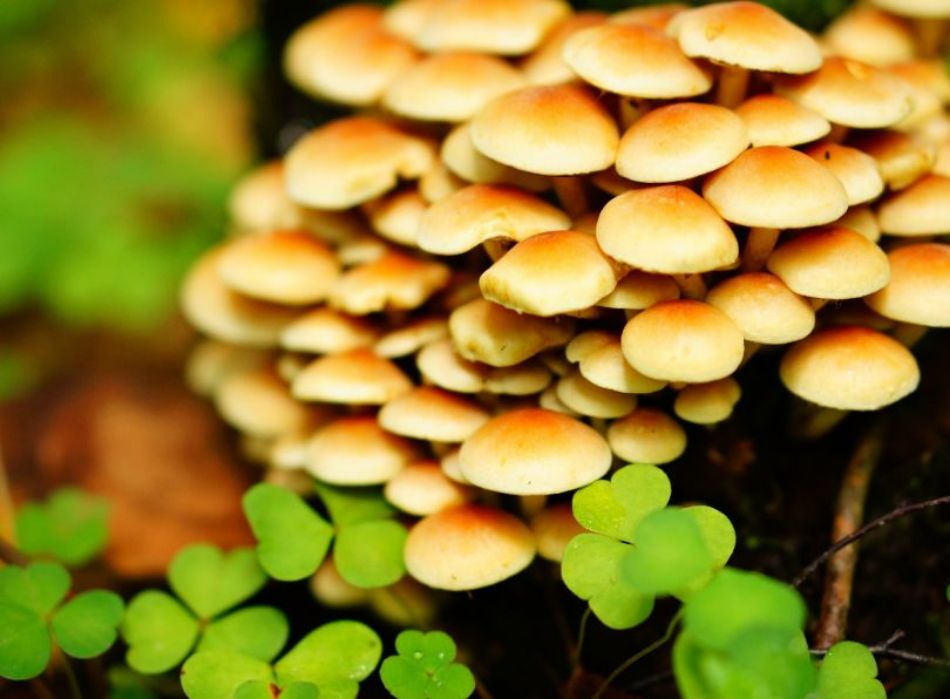
Hypholoma fasciculare presents with a cap varying from 2 to 7 cm in diameter, initially convex and then plano-convex, often with a small obtuse umbo. The cuticle is smooth, dry, with a characteristic sulphur-yellow color, more intense at the center and paler at the margin. The gills, crowded and adnate, are initially sulphur-yellow and become greenish as the spores mature, eventually turning olivaceous-blackish. The stem, slender (3-10 cm x 4-8 mm), is cylindrical, often curved, pale yellow in color, with a noticeable annular zone (remnant of the veil) that soon disappears. The flesh is yellowish, tough, with a strong odor and decidedly bitter taste. The spore print is dark brown-purple. These chromatic characteristics, particularly the sulphur-yellow color of the gills, are an important first warning sign.
Geographical distribution and habitat
The distribution of Hypholoma fasciculare is extremely wide: it is found in Europe, Asia, North America, North Africa, and Australia. In Italy, it is very common from lowlands to mountains, in all types of woodland. It prefers stumps, logs, and decaying branches of broadleaf trees (beech, oak, chestnut) but also conifers (fir, pine). It is a saprophytic wood-dwelling fungus, responsible for the degradation of cellulose and lignin, playing a crucial ecological role in the carbon cycle. It grows from spring to late autumn, often persisting until the first frosts. Over 70% of findings occur on dead beech wood, followed by oak and chestnut.
Morphological characteristics of Hypholoma fasciculare
For amateur mycologists, thoroughly understanding morphology is the only path to safe foraging. Every detail, from the cuticle to the spore print, contributes to an unmistakable portrait of this toxic mushroom. Let us examine the individual parts in detail.
The cap
The cap of Hypholoma fasciculare is initially hemispherical, then convex, and finally flattened, sometimes with a slightly revolute margin. The cuticle is dry, smooth, with a more or less intense sulphur-yellow color, often with a darker center (yellow-orange or reddish-brown). When moist, it may become slightly viscous but is not hygrophanous. The surface is covered with tiny innate fibrils. The diameter, as mentioned, ranges between 2 and 7 cm. The yellow coloration is due to the presence of specific pigments such as fasciculine, a molecule with antibacterial properties, but also toxic to humans. The cap margin is often adorned with remnants of the partial veil (cortina), which disappear rapidly.
The gills
The gills are crowded, narrow, adnate (broadly attached to the stem) and sometimes slightly decurrent with a small tooth. Their color is perhaps the most distinctive characteristic: they are a beautiful sulphur-yellow in young specimens, then turning olive-green and finally brown-black as the spores mature. This chromatic transition is a fundamental clue. At maturity, the bicolored appearance (yellow at the edge and dark in the center) is typical. Observing the gills of an adult specimen allows for the immediate exclusion of many edible species.
The stem and veil remnants
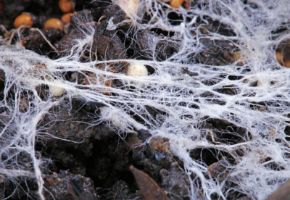
The stem is cylindrical, often flexuous, with a fibrous and tough consistency. The color is pale yellow, tending toward rust at the base, and it is equipped with a membranous ring, but very ephemeral: often in adult specimens only a trace or a barely perceptible annular zone remains. The surface of the stem is fibrillose, and the base may present intertwined hyphae forming a small rhizomorph, but not comparable to the blackish, robust ones of Armillaria mellea. Length varies from 3 to 10 cm, thickness from 4 to 8 mm.
The flesh
The flesh is yellowish, fibrous, and tough, especially in the stem. The odor is faint, fungoid, but in some texts it is described as slightly unpleasant or earthy. The most important organoleptic characteristic is the strongly bitter taste. This is a very useful field test: taste a tiny fragment of the cap and spit it out immediately. The intense bitterness is an unmistakable warning sign for Hypholoma fasciculare. This test should only be performed by experts and never if the presence of deadly species is suspected. Table 1 summarizes the morphological data compared with the main look-alikes.
Microscopic analysis and chemical reactions
Microscopic analysis shows that the spores of Hypholoma fasciculare are ellipsoidal, smooth, with a visible germ pore, and measure 6-8 x 3.5-5 µm. The spore print is brown-purple, and cheilocystidia are present, often encrusted. A useful macrochemical reaction is the use of KOH (potassium hydroxide) on the cuticle, which produces a greenish or black coloration, a distinctive test compared to some similar species.
Habitat and distribution
Understanding the habitat is half of identification: Hypholoma fasciculare is a ubiquitous fungus, but with precise ecological preferences. Its presence is an indicator of wood decay and of a forest ecosystem in evolution.
Growth zones and plant associations
The Sulphur Tuft grows almost exclusively on dead wood: stumps, fallen logs, buried branches. It is a saprophytic fungus, although some studies hypothesize weak parasitism on stressed trees. It is found on both broadleaf trees and conifers, with a slight preference for beech wood. It is less frequent on chestnut or oak wood. The plant associations are therefore those typical of mixed woodland: beech forests, oak woods, chestnut groves, pine and fir forests. It does not form mycorrhizal associations with living plants, and its abundant presence on a stump is often accompanied by that of other decomposers such as Trametes versicolor or Schizophyllum commune.
Seasonal and altitudinal distribution
Fruiting begins in spring (April-May) and continues uninterrupted until late autumn (November). In mild winters, it can be found even in December; it is cold-resistant and appears after rains. From an altitudinal perspective, it is common from lowlands up to the upper limit of arboreal vegetation (approximately 1500-1800 meters). Statistical data collected in Trentino show that the highest density of findings occurs between 600 and 1200 meters, corresponding to beech forests. A recent citizen science study published on Naturalist has confirmed this distribution, with thousands of reports throughout the Alpine and Apennine ranges.
Toxicity and health risks: why is Hypholoma fasciculare dangerous?
To the question "are wood-dwelling mushrooms poisonous?" it is not possible to give a generic answer; some mushrooms are, others are not. In the case of Hypholoma fasciculare, the answer is a clear yes: it is not a deadly mushroom, but it is toxic and causes serious gastroenteric syndromes. It is important to know that no culinary preparation can make it safe due to the presence of certain toxins.
Toxins and mechanism of action
The active toxic principle has not yet been identified with 100% certainty, but it is believed that the syndrome is caused by a mix of molecules. Historically, "fasciculol" was mentioned, but modern research points to steroids and sesquiterpene lactones. These substances act as irritants to the gastroenteric mucosa, provoking an acute inflammatory response. Unlike other syndromes (such as phalloid syndrome), there is no primary hepatic or renal damage, but dehydration and electrolyte imbalance caused by vomiting and diarrhea can be very dangerous, especially for children, the elderly, or debilitated individuals. A 2021 toxicological study isolated fasciculins A and B, demonstrating their cytotoxic effect on intestinal cell lines in vitro.
Poisoning symptoms
The symptoms of Sulphur Tuft poisoning fall within the short-incubation gastroenteric syndrome: they generally appear from 30 minutes to 3 hours after consumption and include:
- violent nausea and profuse vomiting;
- cramp-like abdominal pain;
- watery diarrhea, sometimes with mucus;
- headache and cold sweating;
- prostration and, in severe cases, hypotension.
Recovery occurs spontaneously after 24-48 hours, but it is essential to seek medical care to rehydrate the patient and prevent complications. According to data from the Milan Poison Control Center, Hypholoma fasciculare is among the top five causes of mushroom poisoning in Italy, often due to confusion with Armillaria mellea or with the Poplar Mushroom (one more reason to choose cultivated mushrooms!).
Specific risks for inexperienced foragers
The greatest risk is precisely confusion: the false Honey Fungus, as it is often called, grows in the same environments and with the same clustered habit. Those seeking the prized Honey Fungi (Armillaria mellea) or Poplar Mushrooms (Cyclocybe aegerita) can easily make a mistake. Table 2 shows the fundamental differences. It is essential never to rely solely on outward appearance and always to proceed with a cross-check of all characteristics, including odor and, for experts, the bitter taste.
Table 1: comparison between Hypholoma fasciculare, Armillaria mellea, and Cyclocybe aegerita
| Characteristic | Hypholoma fasciculare (Sulphur Tuft - toxic) | Armillaria mellea (Honey Fungus - edible after cooking) | Cyclocybe aegerita (Poplar Mushroom - edible) |
|---|---|---|---|
| Gill color | Sulphur-yellow → olive-green → brown-black | Whitish → cream → rust-stained | White → cream-ochre |
| Cap color | Sulphur-yellow with darker center | Honey, brown, ochre, with dark scales | Dark brown, lighter at the margin |
| Ring | Ephemeral, often absent | Membranous, persistent, white-yellowish | Membranous, persistent, white |
| Odor/taste | Strongly bitter taste | Fungoid odor, sweetish taste | Farinaceous odor, pleasant taste |
| Rhizomorphs (at base) | Absent or poorly developed, yellowish | Present, blackish, shoelace-shaped | Absent |
| Consistency | Tough, fibrous, bitter | Tough but not bitter | Tender, fleshy |
Uses and gastronomic considerations
Given the toxicity of the Sulphur Tuft mushroom, we can now state that to the question "how to prepare Hypholoma fasciculare?" there is only one answer: you do not prepare it. There is no culinary tradition that envisages its use, except in some Eastern cultures for ethnobotanical studies (non-food). Its bitter taste and toxicity make it absolutely unsuitable for human consumption. Some texts report that prolonged cooking eliminates the bitterness and toxicity, but this is dangerous and unverified information. Heat-stable toxins are not destroyed by normal cooking temperatures. Therefore, consumption of Hypholoma fasciculare should be considered dangerous and discouraged; no recipe can make it safe. Its only gastronomic utility is, paradoxically, as a "indicator mushroom": its abundant presence in a woodland indicates that true Honey Fungi might also grow in that area, but one must know how to distinguish them.
Identification methods
This section is the heart of the article for anyone wishing to learn to navigate the world of wood-dwelling mushrooms. We will try to help you understand how to recognize false Honey Fungi, how to distinguish the true "famigliola" (clustered fungi), and know which poisonous mushrooms resemble Poplar Mushrooms.
How to recognize the false Honey fungus (Hypholoma fasciculare) from the true Honey Fungus (Armillaria mellea)
How to recognize edible Honey Fungi? The answer lies in meticulous observation: true Honey Fungi (Armillaria mellea and related species) have caps with honey colors, brown-ochre, and are covered with dense, dark scales. The gills are whitish, then cream, and never turn green. The most reliable characteristic is the presence of black, robust rhizomorphs, similar to shoelaces, at the base of the cluster and in the decaying wood, whereas the false Honey Fungus lacks them. Tasting (and spitting out) a small piece of gill from the false Honey Fungus reveals an unmistakable bitterness, absent in the true Honey Fungus. The odor is also different: that of Armillaria is pleasant and fungoid, while that of the Sulphur Tuft is more earthy. If you were wondering whether Armillaria is edible, we can affirm that it is, but only after prolonged cooking that eliminates its heat-labile toxicity; indeed, Armillaria, if consumed raw, is toxic.
How to recognize poisonous poplar mushroom look-alikes?
Poplar Mushrooms (Cyclocybe aegerita) are among the most appreciated fungi and also among the most imitated. To the question "what are the poisonous mushrooms similar to Poplar Mushrooms?" Hypholoma fasciculare provides a partial answer: the Sulphur Tuft indeed grows on decaying wood, not necessarily poplar, while the Poplar Mushroom grows on living or dead poplar and willow, but in sunnier positions. Poplar Mushrooms have a robust, persistent membranous ring, a smooth cap that becomes viscous when moist, dark brown color, and white gills. The Sulphur Tuft has yellow gills, not white. Another look-alike that may cause concern is Agrocybe cylindracea (Poplar Mushroom), but it is edible and is more easily confused with Galerina marginata, which is deadly, but which has brown-rust spores and grows on conifers. In any case, analysis of the gills and spore print is very important. If you are now wondering whether Poplar Mushrooms are poisonous, well, if correctly identified, true Poplar Mushrooms are excellent edibles.
How to recognize the true "famigliola" (Armillaria mellea) and the false "Famigliola" (Hypholoma fasciculare)
In Italian, "famigliola" often refers to Armillaria mellea, due to its clustered growth. So what is the false "famigliola"? It is a deceptive cluster of Hypholoma fasciculare. The differences have already been listed, but we add that the "true famigliola" has a well-developed ring and often presents a bulb at the base of the stem. So how do you recognize the famigliola? By observing the dark scales on the cap, which are absent in the Sulphur Tuft (the cap is smooth). Table 2 below summarizes the key differences for quick visual recognition.
Table 2: quick distinctive characters between Hypholoma fasciculare and Armillaria mellea
| Character | Hypholoma fasciculare (false Honey Fungus) | Armillaria mellea (Honey Fungus) |
|---|---|---|
| Young gill color | Bright sulphur-yellow | Dirty white |
| Adult gill color | Olive-green/blackish | Cream with rust spots |
| Cap surface | Smooth, yellow | Dark scales on ochre/honey background |
| Rhizomorphs | Absent | Present, black, filamentous |
| Taste | Very bitter | Sweet |
Honey fungi: how many types exist?
How many types of Honey Fungi exist? This is a complex question. The term "Chiodino" (Honey Fungus) is a common name that refers to several species of the genus Armillaria, but also to other genera. The main Italian armillarias are: Armillaria mellea (true Honey Fungus), Armillaria gallica, Armillaria ostoyae (darker and more scaly), Armillaria cepistipes. All are edible after cooking. But there are also false Honey Fungi: besides Hypholoma fasciculare, we recall Hypholoma capnoides (which grows on conifers and is not toxic, but is not edible due to poor quality and slightly bitter taste) and the very dangerous Galerina marginata, which is deadly. Therefore, the Honey Fungus family is vast and includes both edible and deadly toxic species, and confusion is frequent. An excellent guide to navigate this is the one from Monzatoday.
Microscopic and chemical identification
Scientific research for making the distinction instead requires certain methods: microscopic analysis of spores is the most important. The spores of Hypholoma fasciculare, as mentioned, have typical dimensions and shape. A quick field test is that with potash (KOH) on the cuticle: in the Sulphur Tuft it darkens. Another test is with Melzer's reagent, but it requires a microscope. Differentiation from Hypholoma capnoides, which grows on conifers and has grayish gills, is based precisely on gill color and habitat: Capnoides on conifers, Fasciculare ubiquitous. These methods are fundamental for those who need to certify the species or for those who wish to study pharmacological properties. Currently, no beneficial properties have been clinically proven in humans; indeed, the toxins exclude any do-it-yourself therapeutic use.
Conservation
Hypholoma fasciculare represents a fascinating study model: its role in decomposition and the production of secondary metabolites are subjects of research. Also, the conservation of the mushroom (as dried specimens for herbaria) follows specific protocols.
Ecological role: an essential decomposer
Hypholoma fasciculare is one of the main actors in the mineralization process of woody organic matter: together with other fungi, it helps transform dead wood into humus, returning nutrients to the soil. Its ability to degrade lignin is remarkable. A forest without these decomposers would be overwhelmed by branches and logs. Furthermore, its intertwined hyphae stabilize the soil and retain moisture. It is a fundamental cog in the forest machine. Research conducted by the Institute for Sustainable Plant Protection of the CNR has highlighted how the biodiversity of wood-dwelling fungi is an indicator of ecosystem health.
Methods for conserving the mushroom for Herbarium purposes
To conserve Hypholoma fasciculare for study purposes, drying is performed: specimens should be cleaned of soil and debris, then placed in dryers with warm air flow (not exceeding 45°C) to preserve DNA and morphological characteristics. Once dry, they should be stored in paper bags or airtight containers with silica gel, in the dark and protected from insects. For DNA analysis, a small portion of tissue is preserved in absolute alcohol or in special buffers. Mycological herbaria (such as that of the AMB) are precious archives of biodiversity. For the simple enthusiast, a specimen can be kept in a glass jar with a lid, but it will soon lose its original colors; for this reason, photographic documentation is always recommended.
Scientific research and potential applications
Current research on Hypholoma fasciculare focuses on two fronts: ecology and the chemistry of natural substances. On one hand, its interaction with other microorganisms in the soil is studied, and on the other, its toxins (fasciculins) are subjects of study for potential antitumor or antibacterial activities. Some preliminary in vitro studies have shown a certain selective cytotoxic activity, but we are far from any therapeutic application. At present, there are no supplements or naturopathic remedies based on Sulphur Tuft, and we strongly discourage any experimentation. Safety is not guaranteed and the toxins are dangerous. For scientific approfondimenti, one can consult the database PubMed for studies on Hypholoma fasciculare.
In summary...
Briefly, we summarize all the questions we have tried to answer.
- Is Armillaria edible? Yes, Armillaria mellea is edible, but only after prolonged cooking that destroys the heat-labile hemolysins. Raw, it is toxic.
- What is Hypholoma fasciculare? It is the scientific name of the Sulphur Tuft mushroom, a toxic wood-dwelling fungus, with a characteristic sulphur-yellow color and bitter taste.
- How do you recognize a Honey Fungus? / how to recognize edible Honey Fungi? It is recognized by its honey-colored cap with dark scales, white-cream gills, a ring, and black rhizomorphs at the base. The edible ones belong to the genus Armillaria.
- How to recognize the false Honey Fungus? / how to recognize false Honey Fungi? The false Honey Fungus (Hypholoma fasciculare) is recognized by its sulphur-yellow gills, smooth yellow cap, absence of black rhizomorphs, and very bitter taste.
- How to recognize the true "famigliola"? / how do you recognize the famigliola? The true "famigliola" (Armillaria mellea) has a scaly cap and black rhizomorphs; the false "famigliola" (Hypholoma) is smooth and yellow.
- How to recognize Poplar Mushrooms? Poplar Mushrooms (Cyclocybe aegerita) have a dark brown, smooth cap, white gills, and a robust ring. They grow on poplars and willows.
- What does a Honey Fungus look like? It is a slender mushroom, with a 4-10 cm cap, honey-colored, covered with dark scales. It grows in clusters on wood.
- How do you recognize Armillaria mellea? As already mentioned: honey color, dark scales, black rhizomorphs, and a ring.
- Are wood-dwelling mushrooms poisonous? Not all. Many wood-dwellers such as Poplar Mushrooms, Honey Fungi (after cooking), and oyster mushrooms are edible. Others, like Hypholoma fasciculare and Galerina marginata, are toxic or deadly.
- Are Honey Fungi poisonous? True Honey Fungi (Armillaria) are toxic if raw, not if cooked. False Honey Fungi (Hypholoma) are toxic even when cooked.
- Is the false Honey Fungus poisonous? Yes, Hypholoma fasciculare is toxic and causes gastroenteric syndrome.
- What is an edible mushroom similar to the Honey Fungus? Besides true Honey Fungi, Hypholoma capnoides (grows on conifers, gray gills) is harmless but inedible due to poor quality.
- What is a poisonous mushroom similar to the Honey Fungus? Hypholoma fasciculare and the deadly Galerina marginata, which however has brown spores, not purple.
- When are Honey Fungi collected? In autumn, from September to November, but also in spring in some regions.
Hypholoma fasciculare: if you know it, you don't cook it
Hypholoma fasciculare, the Sulphur Tuft mushroom, is an omnipresent inhabitant of our woodlands, a master of mimicry and a stern warning to hasty foragers. Its chromatic beauty hides a toxicity that, although not deadly, can ruin a day of hiking and put health at risk.
We have seen how correct identification is based on a set of characteristics: the sulphur color of the gills, the unmistakable bitterness, the absence of black rhizomorphs. We have also answered all crucial questions regarding comparison with Honey Fungi and Poplar Mushrooms, providing the tools for safe foraging. Once again, we remind you that in case of doubt, do not collect, do not consume, and always rely on an expert or a mycological inspection service.
Nature offers wonderful gifts, but demands respect and knowledge.
This article was developed with the support of artificial intelligence and subsequently reviewed, corrected, and validated by the NaturNext.eu technical team, which guarantees its reliability and compliance with official sources. The kingdom of fungi is a universe in constant evolution, with new scientific discoveries emerging every year regarding their extraordinary benefits for gut health and general well-being. From today onward, when you see a mushroom, you will no longer think only of its flavor or appearance, but of all the therapeutic potential it holds within its fibers and bioactive compounds. ✉️ Stay connected - Subscribe to our newsletter to receive the latest studies on: Nature offers us extraordinary tools to take care of our health. Mushrooms, with their unique balance between nutrition and medicine, represent a fascinating frontier that we are only beginning to explore. Continue to follow us to discover how these extraordinary organisms can transform your approach to well-being.Continue Your Journey into the World of Mushrooms