


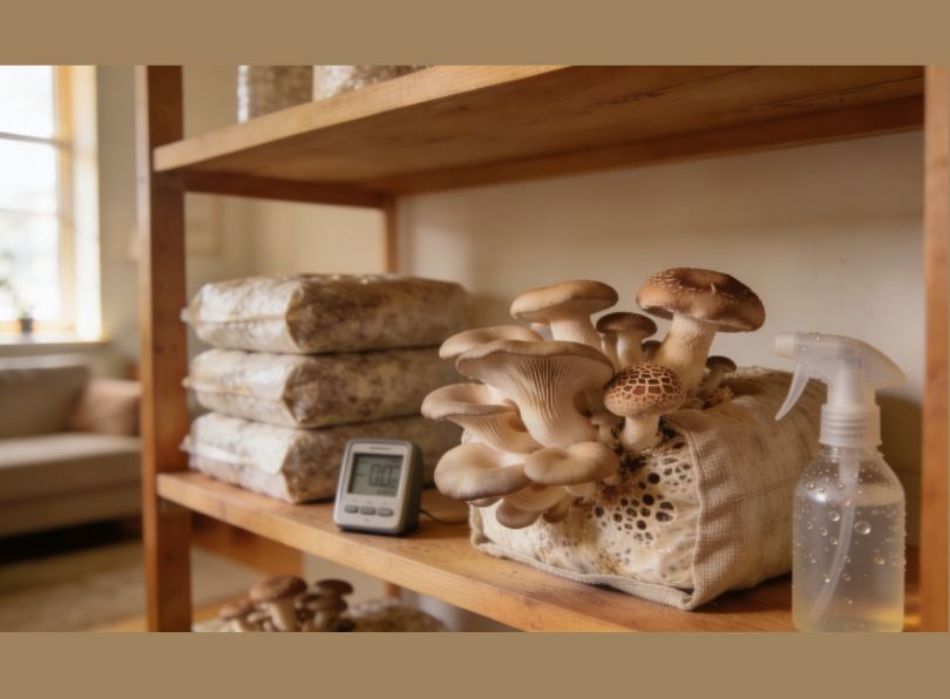
Growing mushrooms in an apartment is not just a dream for amateur mycologists: it is an increasingly widespread, sustainable, and potentially profitable reality. In just 20 square meters, with the right techniques and equipment, you can transform a corner of your home into a real productive mushroom farm, capable of generating continuous harvests of shiitake, pleurotus, cardoncelli, and other prized species.
This article is designed for mushroom enthusiasts, hobbyist growers, researchers, chefs, startups, and agricultural entrepreneurs. You will learn everything, from substrate selection to LED automation, from inoculation to harvesting, to economic aspects and advanced technological solutions like those offered by NatureNext.eu and partners Ledpoint and Skydance. Get ready to discover how to grow mushrooms at home with professional efficiency.
🍄 In this article...
Introduction to urban mycoculture
The growing attention toward food self-production, zero-kilometer consumption, and the circular economy has led thousands of people to ask: "how can I grow mushrooms in an apartment?". The answer is simpler than you might think, provided you understand the fundamental principles of fungal biology. Growing mushrooms in the city does not require a vegetable garden or a yard; just a well-managed room, shelving, and the willingness to learn.
Mushrooms are heterotrophic organisms that feed on decomposed organic matter: this is why they do not need direct sunlight, but specific light stimuli for fruiting. In this comprehensive guide, suitable for hobbyists and professionals alike, you will discover every detail to obtain abundant harvests in just 20 sqm. In Italy, the market for fresh cultivated mushrooms is growing by 12% annually, and demand for home mushroom cultivation is expanding rapidly.
What types of mushrooms can be cultivated? Recommended species
Which mushrooms are best to grow at home? The species most suitable for apartment mushroom cultivation are those with rapid growth and low requirements. Here is a ranking based on ease of cultivation and commercial value:
| Species | Fruiting time | Profitability (€/kg) | Difficulty |
|---|---|---|---|
| Pleurotus ostreatus (Oyster mushroom) | 14-21 days | 12-18 € | ⚫ Low |
| Shiitake (Lentinula edodes) | 6-10 weeks | 25-40 € | ⚫⚫ Medium |
| Cardoncello (Pleurotus eryngii) | 20-30 days | 20-30 € | ⚫ Medium |
| Champignon (Agaricus bisporus) | 3-4 weeks | 8-12 € | ⚫⚫ Medium-high (specific substrate) |
| Nameko (Pholiota nameko) | 4-6 weeks | 35-50 € | ⚫⚫⚫ High (for experts) |
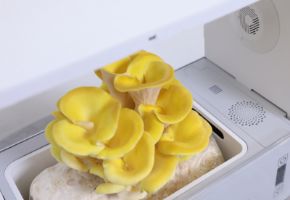
To get started, Pleurotus is the best choice: it grows on straw, coffee grounds, or cardboard, and tolerates small variations in humidity. Also, growing cardoncelli mushrooms at home is very rewarding for chefs and restaurateurs.
Growing mushrooms in pots is possible with ready-made kits, but for semi-professional production in 20 sqm, it is better to use substrate bags or bales. Remember: growing mushrooms in a garage or basement is equally valid, provided you control the parameters.
Substrate and preparation: the foundation for healthy mushrooms
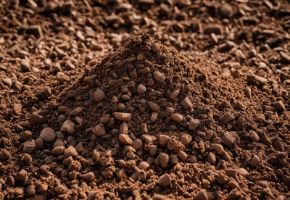
The substrate is the "soil" for mushrooms. For apartment mushroom cultivation, lignocellulosic materials are used: chopped straw, sawdust, bran, sterilized coffee grounds. How to prepare mushroom substrate? It must be pasteurized or sterilized to eliminate molds and bacteria. Here is a basic recipe for 10 kg of substrate for pleurotus: 70% wheat straw (cut 3-5 cm), 20% hardwood sawdust, 10% wheat bran, hydrated to 65-70%. Mushroom substrate preparation involves soaking (24h), then heating to 80-85°C for 2 hours.
To grow mushrooms from waste, use fresh coffee grounds (maximum 24h old) sterilized in the microwave. Many hobbyists produce mushroom bales in 5-10 kg polypropylene bags. On NatureNext you can find ready-made substrates and high-quality selected mycelium, ideal for those who want to avoid initial mistakes.
Mycelium inoculation: how seeding is done
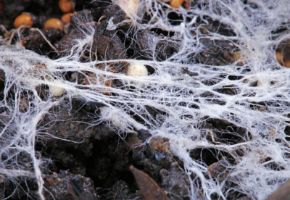
How is mushroom seeding done? After cooling the substrate (below 28°C), mix it with granular or grain mycelium (2-5% of the weight). Mushroom inoculation should take place in a clean environment, preferably with gloves and a mask. Close the bags with a filter for gas exchange. How to properly inoculate mushrooms? Distribute the mycelium in layers, seal, and incubate at 22-26°C in the dark for 10-18 days until complete colonization (compact white). During this period, the mycelium does not need light; in fact, light should be avoided.
A recurring question: How to start a profitable mushroom farm? Professional inoculation uses laminar flow hoods, but in a small environment, a makeshift exhaust hood is sufficient. For hundreds of bags, you can find semi-professional equipment on NatureNext.
Optimal environmental conditions: humidity, temperature, and ventilation
To grow mushrooms at home, it is crucial to replicate the microclimate of the forest floor: relative humidity >85% (ideal 90-95%), temperature varying by species (for pleurotus 16-20°C during fruiting, for shiitake 12-18°C). Mushroom cultivation ventilation should ensure air exchange 4-6 times per hour to avoid CO₂ buildup, which deforms fruiting bodies.
In 20 sqm, you can use an ultrasonic humidifier with a hygrostat and a small timer-controlled fan. Light is an often underestimated factor: many species require a 12/12 photoperiod with mushroom light in the blue spectrum (460-470 nm) to trigger pinhead formation. This is why we will integrate the perfect Ledpoint system.
Intelligent lighting system
Indoor mushroom cultivation in a 20 sqm apartment requires precise light control. Although mushrooms do not photosynthesize, blue light is crucial for fruiting. Using integrated solutions from Ledpoint and Skydance, you can set up a professional, low-consumption system.
Ledpoint sources with optimal spectrum: the strip growing B52-30RB-2048O2 combines warm white, red, and blue; mycological tests show that blue frequency stimulates primordia by 40% more. Humidity resistance thanks to Parylene IP65 or silicone IP67 coating (L52 series). For installations in mushroom cultivation in basements or under shelves, these LEDs are ideal.
Skydance automation: using controllers V1-L(WT) or the WT5 series with the Tuya Smart app, you can program light-dark cycles and adjust intensity (0-100% dimming). Mushrooms respond better to soft, adjustable light without thermal stress.
LightingLine profiles: to optimize vertical space, the slim profiles PR-SL08-03 (8mm) or waterproof PR-RE07-03 ensure heat dissipation and long life. Finally, Mean Well XLG IP67 drivers for humidity-proof, flicker-free power supply. In short, transform your apartment into a technological mushroom farm with products available on NatureNext.
Care and maintenance: irrigation and daily monitoring
How to maintain ideal conditions? Irrigate with fine misting 2-3 times a day, avoiding waterlogging. Check for the appearance of green molds (Trichoderma). For mushroom humidity control, use a digital hygrometer. Mushroom cultivation also requires periodic inspection: if the bag turns yellow, reduce humidity; if the mycelium does not fruit, increase light or thermal shock (day/night difference). Maintain absolute cleanliness.
Harvesting and post-harvest: timing and storage
When to harvest mushrooms? As soon as the cap begins to expand, before the gills turn dark. For pleurotus, harvest entire clusters. Use a sharp knife, rotating gently.
Mushroom storage: in the refrigerator in paper bags for max 5-7 days, or dried or preserved in oil.
A substrate bale produces 2-4 harvest waves every 15-20 days, for a total yield of 1.5-2.5 kg per 5 kg bag.
Common problems and solutions in home cultivation
What are the main mistakes to avoid?
Excessive humidity → bacterial rot; poor aeration → mushrooms with long stems and small caps;
substrate too dry → no fruiting.
Mushroom diseases: green mold (Trichoderma) is prevented with accurate sterilization. In case of contamination, eliminate infected bags.
Regarding growing porcini mushrooms at home: unfortunately, porcini (Boletus edulis) are mycorrhizal symbionts and are NOT cultivable in an apartment (except with symbiotic plants and specific soils, but this is an extremely complex procedure). So avoid false promises; it is better to focus on saprophytic species.
Economic aspects: cost and profitability of mushroom cultivation
How much does it cost to start a mushroom farm in 20 sqm? Start-up costs: shelving (€150), humidifier+hygrostat (€120), extractor (€80), LEDs (about €200 for 10m of strip), Skydance controller (€50). Substrate and mycelium for 20 bales: €250. Total ~€850-1000.
With a cyclic production of 40 kg/month sold at €15/kg (average price for fresh), revenue is €600/month. Payback in just a few months.
Mushroom cultivation is profitable, especially if you sell to chefs, farmers' markets, or through local platforms. On NatureNext, you can purchase starter kits and substrates.
Resources and useful tools: kits, equipment, and manuals
For beginners, there are ready-made mushroom cultivation kits: NatureNext offers a small pre-colonized bag with instructions. To automate optimally, use Skydance timers and wireless sensors.
Frequently asked questions about growing mushrooms in an apartment
We answer the most common searches from hobbyists, farmers, and startups.
How to grow mushrooms at home without expensive equipment? You can start with a pre-inoculated kit from NatureNext, placing it in a perforated plastic bag, misting twice a day, away from drafts. Ambient indirect light is sufficient for initial trials, but for stable production we recommend blue LEDs. |
Which mushrooms are easiest to grow for beginners? Pleurotus ostreatus (oyster mushroom) and P. citrinopileatus. They grow rapidly on straw or coffee grounds, tolerate environmental variations, and produce in 2-3 weeks. |
Is blue LED light really necessary for mushrooms? Why? Yes, many species require blue light (465-470nm) to trigger primordia formation and obtain healthy, pigmented caps. Ledpoint provides specific strips with excellent performance. |
How much space is needed to grow mushrooms for family self-consumption? Even 2-3 sqm (one shelf) can produce 5-10 kg per month. In 20 sqm, you can start a micro-enterprise. |
How much does it cost to grow champignon mushrooms in a basement? Costs for specific composted substrate (about €2/kg) plus mycelium. For 50 kg of substrate, invest ~€130, yielding 30-40 kg of champignons. |
How to make a DIY mushroom farm with recycled materials? Use old shelves, cover with transparent plastic sheets, insert an ultrasonic humidifier and an IP65 LED strip. The key is hygiene. |
Does mushroom cultivation bring real profits? Market data According to 2024 surveys, the net margin on specialty mushrooms (shiitake, cardoncelli) is 45-60%. A small setup in 20 sqm can generate €7000-12000/year. |
This article was developed with the support of artificial intelligence and subsequently reviewed, corrected, and validated by the NaturNext.eu technical team, which guarantees its reliability and compliance with official sources.
The kingdom of fungi is a universe in constant evolution, with new scientific discoveries emerging every year about their extraordinary benefits for gut health and overall wellbeing. From now on, when you see a mushroom, you will no longer think only of its flavor or appearance, but of all the therapeutic potential it holds within its fibers and bioactive compounds. ✉️ Stay connected - Subscribe to our newsletter to receive the latest studies on: Nature offers us extraordinary tools to take care of our health. Mushrooms, with their unique balance between nutrition and medicine, represent a fascinating frontier that we are only beginning to explore. Keep following us to discover how these extraordinary organisms can transform your approach to wellbeing.Continue your journey into the world of mushrooms