


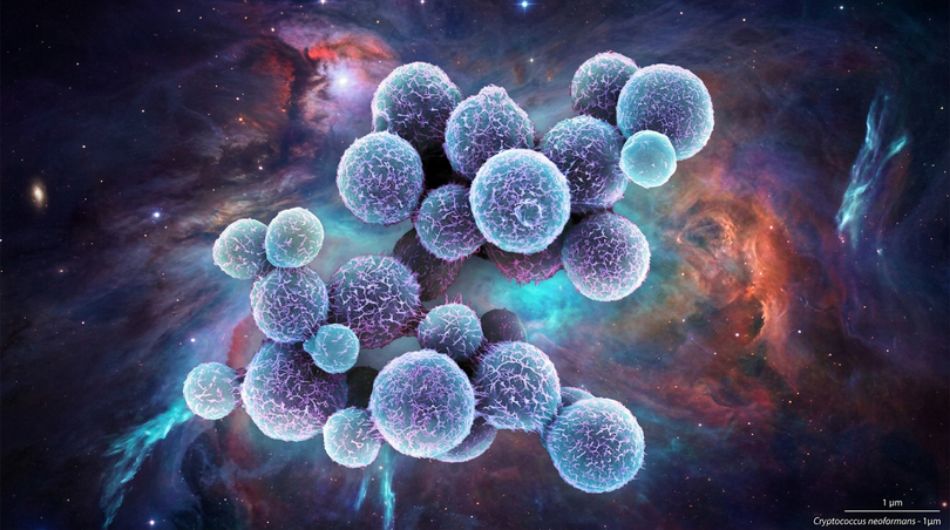
When we think of deep space, we imagine a sterile environment lethal to any form of life. Yet, there are extremophile organisms that challenge this conception, and among them stands out Cryptococcus neoformans, an encapsulated yeast primarily known as an opportunistic human pathogen. In recent years, experiments on the International Space Station (ISS) have revealed this fungus's almost legendary ability to withstand conditions that would annihilate most living beings: cosmic radiation, microgravity, extreme temperature fluctuations, and high vacuum.
This article explores in detail the molecular mechanisms behind this resistance, astrobiological implications, and terrestrial applications. We will discover how Cryptococcus neoformans has become a model for studying survival in space, and how research conducted in orbit is opening new frontiers in fungal biology. Furthermore, we will see how NatureNxt.eu offers tools and products for those who wish to approach mushroom cultivation, even in controlled conditions.
In this article...
1. Cryptococcus neoformans: a cosmic survivor
Cryptococcus neoformans is a basidiomycete yeast, widely distributed in the environment, particularly associated with bird droppings and trees. Its peculiarity lies in the polysaccharide capsule that protects it from osmotic stress and phagocytosis. But it is its extraordinary resilience to radiation that makes it an ideal candidate for space studies. The ability to withstand doses of X-rays and UV lethal to other microorganisms has intrigued the scientific community, leading to numerous experiments in orbit.
Studies have shown that Cryptococcus neoformans activates a complex network of responses to DNA damage, involving repair enzymes and antioxidant systems such as glutathione. These mechanisms, although present in many organisms, are particularly effective in this fungus, making it a model for understanding the limits of life.
Cryptococcus neoformans can survive ionizing radiation doses up to 25,000 Gray (Gy), while a human can withstand about 5-10 Gy.
2. Cosmic radiation and defense mechanisms
Space is permeated by galactic and solar radiation, composed of protons, alpha particles, and heavy ions. Cryptococcus neoformans has developed multifactorial defense strategies. In addition to DNA repair systems (such as homologous recombination and base excision repair), it produces melanin pigments that act as a shield against free radicals. Melanin, in particular, is known to absorb radiation and dissipate energy as heat, protecting cellular structures.
Furthermore, the fungus is able to modulate gene expression in response to oxidative stress, upregulating enzymes such as superoxide dismutase and catalase. This phenotypic plasticity is fundamental for adapting to the hostile environment of space. Recent studies have also highlighted the role of trehalose, a protective sugar, which stabilizes membranes and proteins during dehydration and radiation exposure.
The role of the polysaccharide capsule
The capsule of Cryptococcus neoformans is not only a virulence factor but also a protective element. Experiments have shown that encapsulated strains survive better to radiation than non-encapsulated ones, suggesting a physical and chemical barrier effect. The capsule could act as a "filter" for free radicals generated by radiation, reducing cellular damage.
3. Experiments on the ISS: data and discoveries
The International Space Station has hosted several experiments on Cryptococcus neoformans, including the "Fungus in space" project (2018-2020) and subsequent studies. Samples were exposed to open space for varying periods, from days to months, and then returned to Earth for genetic and phenotypic analysis. The results confirmed significant survival, with post-exposure growth rates similar to terrestrial controls.
| Parameter | Result | Notes |
|---|---|---|
| Exposure (months) | 6 | High vacuum + radiation |
| Survival (%) | ~78% | On encapsulated strains |
| Mutations found | Low (1-2 per genome) | Efficient repair |
| Metabolic activity | Reduced but vital | Recovery in 48h |
A surprising finding was the increase in melanin production in strains exposed to space, indicating active adaptation. Additionally, some genes involved in DNA repair were found to be overexpressed, confirming the fungus's targeted response. These experiments have paved the way for new research on radioprotection for astronauts and for biotechnological applications.
4. Cryptococcus and astrobiology: implications
Astrobiology studies the origin, evolution, and distribution of life in the universe. The resistance of Cryptococcus neoformans to space conditions makes it a model organism for the panspermia theory, namely the possibility that life can travel between planets. If a fungus can survive in open space, it is theoretically possible that resistant microorganisms could be transported by meteorites or space debris.
Moreover, the ability of Cryptococcus neoformans to grow in environments with scarce water and nutrients recalls the conditions of Mars or Europa (Jupiter's moon). Space studies on this fungus therefore provide valuable clues on where and how to search for traces of extraterrestrial life. Researchers are also studying the possibility of using these fungi for bioremediation in extreme environments, a topic that connects to practical applications on Earth.
5. Microgravity and fungal adaptation
Microgravity alters numerous cellular processes, including nutrient transport, cell polarity, and biofilm formation. Cryptococcus neoformans under microgravity conditions has shown altered three-dimensional growth, with larger cell aggregates and a different capsule architecture. These changes could influence virulence and stress resistance.
Transcriptomic analysis revealed that genes involved in lipid metabolism and cell wall are differentially expressed in microgravity. This suggests that the fungus perceives the absence of gravity as a stress signal and activates compensatory responses. Understanding these mechanisms is also fundamental for assessing health risks for astronauts, since Cryptococcus neoformans is an opportunistic pathogen that could cause infections in immunocompromised individuals.
6. Fungi in space: future perspectives
Space fungi, with Cryptococcus neoformans leading the way, are becoming protagonists of aerospace research. Fungi in space are no longer just a science fiction idea: NASA and the ESA have planned missions dedicated to cultivating fungi for food production, building materials, and even medicines in orbit. The resistance of Cryptococcus neoformans makes it a candidate for creating space "bio-factories".
Furthermore, the study of space fungi helps develop regenerative life support systems, in which fungi decompose organic waste and produce oxygen. Research on Cryptococcus neoformans and other extremophile fungi provides the basis for designing closed ecosystems capable of supporting long-duration missions. The dream of colonizing other planets also passes through the understanding of these extraordinary organisms.
7. Connections with terrestrial cultivation
For enthusiasts and mushroom growers, discoveries about Cryptococcus neoformans offer valuable insights for improving cultivation techniques. Understanding stress response mechanisms can help develop strains more resistant to adverse conditions, such as temperature variations or contamination. Additionally, the use of substrates enriched with melanin or precursors could increase the yield and quality of edible mushrooms.
NaturNext.eu offers a wide range of products for mushroom cultivation, including cultivation kits and accessories for environmental control. Our mission is to support both beginners and experts in their cultivation journey, providing high-quality materials and updated information. For instance, our substrates are formulated to maximize yield and minimize contamination risks, much like the controlled environments in which space fungi are studied.
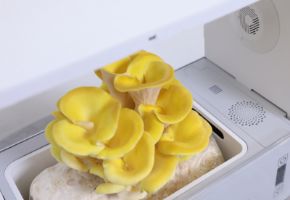
Additionally, our selection includes cultivation kits designed for those who want to start easily, and accessories such as LED lighting systems, fundamental for recreating optimal conditions for fungal growth. Inspired by research on space fungi, NatureNext promotes a scientific and conscious approach to mycology.
The importance of environmental control
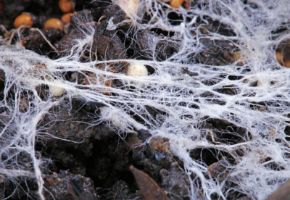
Just as every parameter is monitored on the ISS to ensure the survival of experiments, even in home cultivation, controlling temperature, humidity, and light is crucial. Products from NaturNext.eu are designed to help growers achieve professional results, with selected and tested materials. For example, our substrates enriched with mycelium guarantee a rapid and vigorous start, reducing growth times.
8. Frequently Asked Questions (FAQ)
Yes, it is an opportunistic pathogen that can cause serious infections (cryptococcosis) in immunocompromised individuals. However, space studies focus on attenuated strains or controlled conditions, and resistance mechanisms are studied to better understand basic biology.
In addition to Cryptococcus neoformans, Aspergillus niger, Penicillium spp., and Saccharomyces cerevisiae have been studied. All have shown different responses to space stress, but Cryptococcus neoformans stands out for its exceptional resistance to radiation.
The easiest way is to use the cultivation kits from NatureNext.eu. They come complete with substrate, mycelium, and instructions. For advanced results, you can explore our professional substrates and accessories for climate control.
The term "space fungi" refers to fungal species that have been exposed to space conditions (microgravity, radiation) or that are potentially usable in space missions. Cryptococcus neoformans is one of the most studied examples due to its resilience.
Studies on fungi in space have multiple objectives: understanding the limits of life, developing bioremediation technologies, producing medicines and food in orbit, and protecting astronaut health from potential fungal infections.
9. Resources and further reading
For those who wish to delve deeper, NaturNext.eu provides a blog section with updates and guides for enthusiasts and growers. Additionally, the Italian mycologist community is very active on forums and social networks, where experiences and advice can be exchanged.
Research on Cryptococcus neoformans continues to hold surprises, and we at NaturNext follow these developments with interest to translate them into increasingly cutting-edge products and services. Mycology is an expanding field, combining passion, science, and innovation.
The future of fungi between Earth and space
Cryptococcus neoformans teaches us that life is more resilient than we imagine. Its ability to survive in space is not just a scientific curiosity, but a window into potential biotechnological and astrobiological applications. For growers and hobbyists, it represents an example of how nature faces extreme challenges, offering insights to improve their own techniques.
We invite all visitors to explore the world of fungi with the awareness and wonder they deserve. NaturNext.eu stands by those who wish to embark on this fascinating journey, offering quality products and reliable information. The kingdom of fungi is a universe to discover, both on Earth and beyond.
This article was developed with the support of artificial intelligence and subsequently reviewed, corrected, and validated by the NaturNext.eu technical team, which guarantees its reliability and compliance with official sources.
The kingdom of fungi is a universe in continuous evolution, with new scientific discoveries emerging every year on their extraordinary benefits for gut health and general well-being. From now on, when you see a mushroom, you will no longer think only of its taste or appearance, but of all the therapeutic potential it holds in its fibers and bioactive compounds. ✉️ Stay connected - Subscribe to our newsletter to receive the latest studies on: Nature offers us extraordinary tools to take care of our health. Fungi, with their unique balance between nutrition and medicine, represent a fascinating frontier that we are only beginning to explore. Continue to follow us to discover how these extraordinary organisms can transform your approach to well-being.Continue your journey in the world of fungi